Hysterectomy: reasons, surgical approaches, recovery and risks
In brief
A hysterectomy is the surgical removal of the womb (uterus). It is offered for benign conditions (fibroids, adenomyosis, bleeding that does not respond to treatment, prolapse) when other treatments have not worked, for some cancers, and exceptionally as an emergency after childbirth. For benign conditions, the vaginal and laparoscopic (keyhole) approaches are recommended; the ovaries are kept whenever possible before the menopause, in which case a hysterectomy alone does not bring on the menopause.
What is a hysterectomy?
A hysterectomy removes the womb. After the operation, periods stop for good and pregnancy is no longer possible. However, if the ovaries are kept, they continue to work until natural menopause: a hysterectomy alone does not cause menopause.
For benign conditions, it is usually offered after medical treatments and more conservative procedures have failed or been declined. The decision is made with you, after information about the alternatives, benefits and risks. Other operations are described on our Gynaecological surgery page.
Why would I need a hysterectomy?
The main reasons are:
- Uterine fibroids causing very heavy periods, pain or pressure on nearby organs, when a myomectomy or other treatments are not suitable.
- Adenomyosis, with heavy, painful periods that do not respond to treatment.
- Abnormal uterine bleeding that persists despite medical treatment and hysteroscopic procedures (see heavy periods).
- Some cases of endometriosis, in selected situations, often combined with removal of the lesions.
- Pelvic organ prolapse, in some cases: a hysterectomy is not automatic.
- Precancerous changes and cancers of the endometrium, cervix, ovary or fallopian tubes, following specific protocols (see womb (endometrial) cancer).
- Severe bleeding after childbirth, as a last resort, when other measures have not worked.
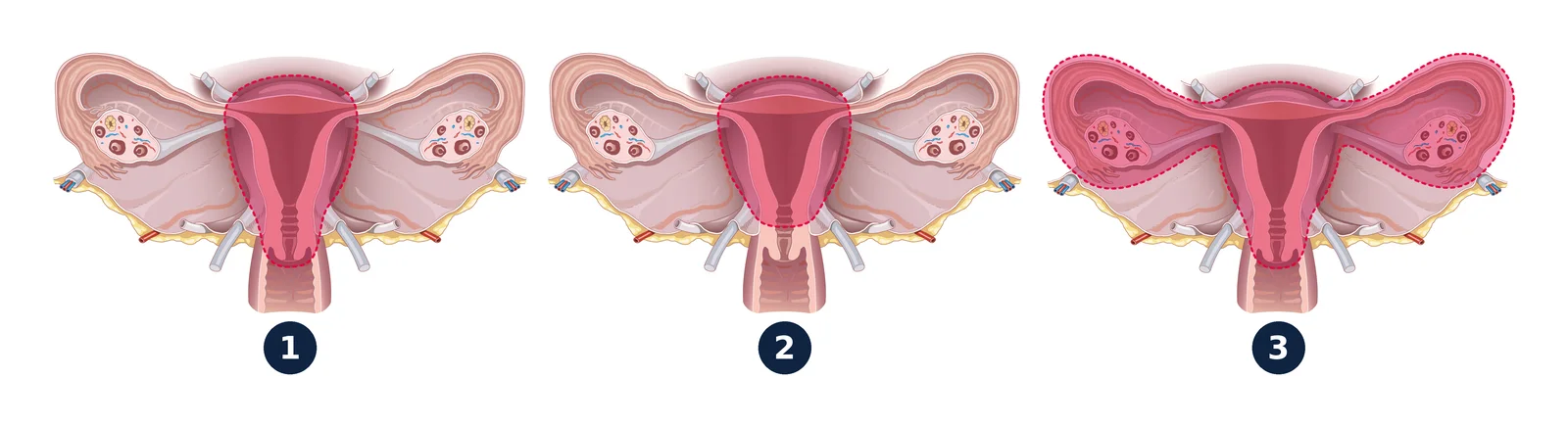
What are the different types of hysterectomy?
| Type | What is removed | When it is used |
|---|---|---|
| Total hysterectomy | Womb and cervix | Recommended technique for benign conditions |
| Subtotal hysterectomy | Body of the womb, cervix left in place | Specific situations; no longer recommended routinely |
| With salpingectomy | Womb and fallopian tubes | Discussed at your consultation when the ovaries are kept |
| With salpingo-oophorectomy | Womb, tubes and one or both ovaries | Ovarian disease, genetic risk, after the menopause depending on the case |
| Radical hysterectomy | Womb, cervix, upper vagina and surrounding tissue | Some cancers |
The 2021 French guidelines of the French College of Gynaecologists and Obstetricians (CNGOF) advise removing the cervix during a hysterectomy for a benign condition: keeping it carries a small risk of cervical cancer and of further operations for bleeding, with no proven benefit for sex life, continence or prolapse. Its 2015 guidelines also advise keeping the ovaries in women who have not reached the menopause, when there is no ovarian disease and no personal or family history of breast or ovarian cancer.
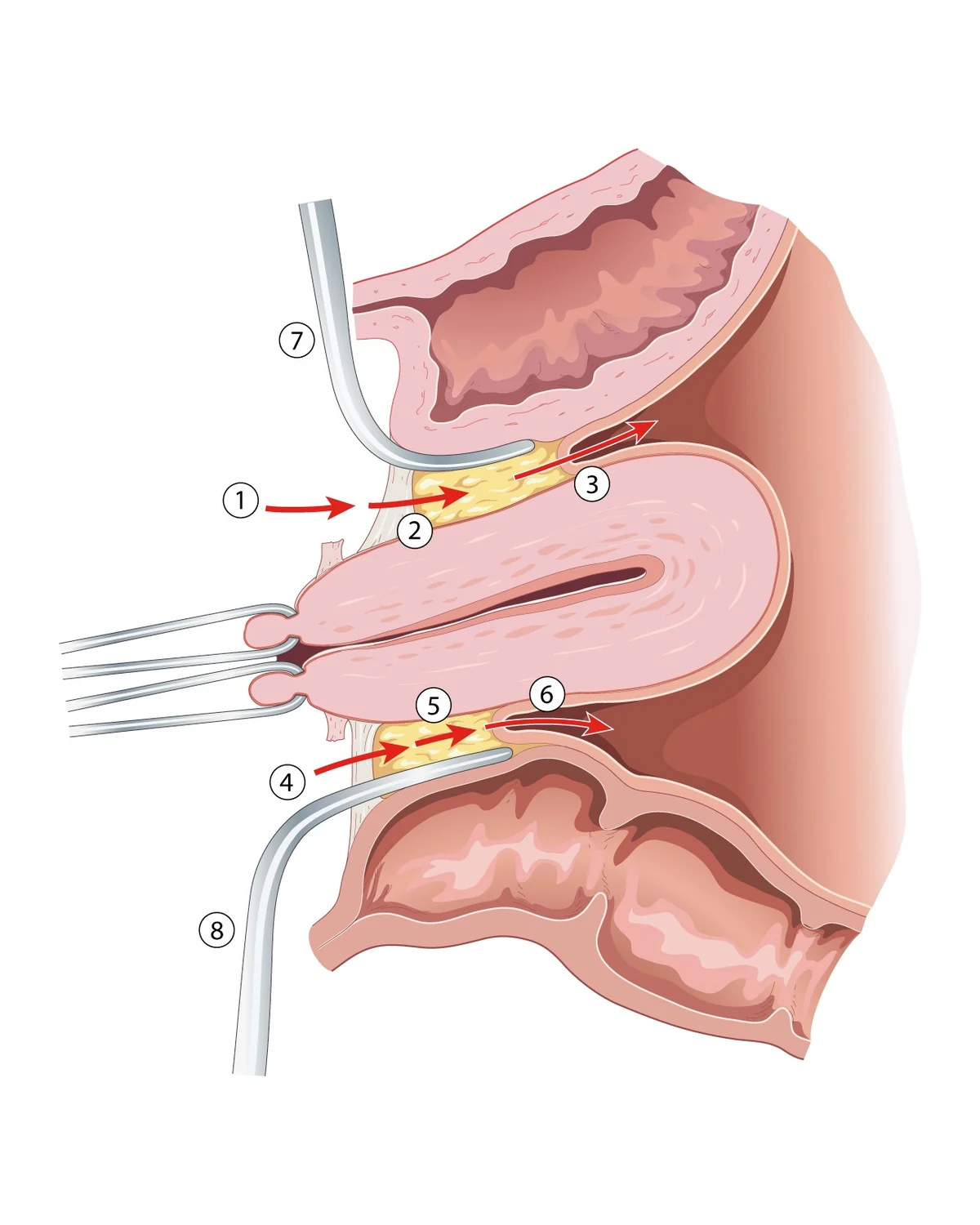
Vaginal, laparoscopic or abdominal hysterectomy: which approach?
| Approach | How it works | Key points |
|---|---|---|
| Vaginal | The womb is removed through the vagina, with no cut on the abdomen | Recommended for benign conditions; possible even without a previous vaginal birth or after a caesarean |
| Laparoscopy | Small incisions and a camera; the womb is usually removed through the vagina | Recommended for benign conditions; allows the pelvis to be explored and the ovaries or endometriosis to be treated |
| Laparotomy (open surgery) | An incision in the abdomen | Very large womb, extensive adhesions, some cancers, emergencies |
For benign conditions, the CNGOF recommends the vaginal or laparoscopic route, including for a large womb or excess weight; the choice between the two depends on anatomy, the surgeon's experience and the context. According to the 2023 Cochrane review, women return to normal activities faster after a vaginal or laparoscopic hysterectomy than after open surgery; laparoscopy, however, is associated with more urinary tract injuries than open surgery, although these remain rare. Anaesthesia is general or, for the vaginal route, sometimes regional, and is discussed at the pre-operative anaesthetic consultation.
How do I prepare for a hysterectomy?
- Surgical consultation: explanation of the technique, alternatives and risks; you are given an information leaflet and asked for your consent.
- Anaesthetic consultation, which is mandatory in France, a few days or weeks before.
- Tests: blood tests, ultrasound, up-to-date smear test, sometimes an MRI or an endometrial biopsy.
- Stopping smoking is advised, to reduce wound-healing and breathing complications.
- Medication: tell the team about anticoagulants, antiplatelet drugs and hormonal treatments; adjustments may be needed.
- Preparation: vaginal disinfection and preventive antibiotics are given in the operating theatre. Laxative enemas are not recommended.
What is recovery like after a hysterectomy?
Timeframes vary with the surgical approach and your situation; the figures below are a rough guide and are tailored at your consultation:
- Hospital stay: generally 2 to 4 days for the vaginal or laparoscopic approach; 3 to 6 days for the abdominal approach.
- Time off work: generally about 1 month for the vaginal or laparoscopic approach, 4 to 8 weeks after a laparotomy, longer for physical work.
- Sport and heavy lifting: generally after about 6 weeks for the vaginal or laparoscopic approach, and 6 to 12 weeks after a laparotomy. When you can drive again is set at your consultation.
- Resuming sex: once the top of the vagina has healed (generally 4 to 8 weeks).
- Follow-up appointment: generally 4 to 6 weeks after the operation (sooner if needed).
Light bleeding or brownish discharge for a few weeks is common, as the top of the vagina heals. Tiredness can last several weeks. Compression stockings and sometimes anticoagulant injections are prescribed to prevent blood clots; getting up early after surgery also helps.
Documented risks
- infection of the wound, the top of the vagina or the urinary tract; haematoma;
- bleeding, rarely requiring a transfusion or further surgery;
- injury to the bladder, ureters or bowel, which is rare and sometimes repaired during the operation;
- deep vein thrombosis and pulmonary embolism, rare thanks to prevention;
- conversion of a vaginal or laparoscopic approach to open surgery if needed;
- complications related to anaesthesia; serious complications are exceptional.
What is life like after a hysterectomy?
- Periods and fertility: periods stop and pregnancy is no longer possible.
- Menopause: if the ovaries are kept, menopause is not triggered. If both ovaries are removed before the menopause, it starts immediately, with possible hot flushes, vaginal dryness and sleep problems; hormone therapy can be discussed depending on your situation (see menopausal hormone therapy).
- Sex life: in the longer term, desire, sensation and orgasm are generally not affected; studies show no advantage of keeping the cervix in this respect.
- Follow-up: if the cervix was removed for a benign condition, screening smear tests are usually no longer needed; your doctor will confirm this based on your history.
When should I seek urgent help after a hysterectomy?
Contact the surgeon or the unit where you had your operation straight away if you have:
- a fever above 38 °C or chills;
- heavy vaginal bleeding, heavier than a period;
- abdominal pain that gets worse, a swollen abdomen, vomiting;
- burning when passing urine, inability to pass urine, or a constant leak of urine from the vagina;
- a red, hot or oozing wound;
- pain or swelling in a calf.
If you suddenly become short of breath, have chest pain or feel faint, call 15 or 112 in France, or your local emergency number.
Frequently asked questions
Does a hysterectomy make you gain weight?
The operation itself does not cause weight gain. Weight gain may occur during recovery because of reduced activity, or if removing the ovaries triggers menopause.
Can I keep my ovaries during a hysterectomy?
Yes, and this is recommended before the menopause when there is no ovarian disease and no personal or family history of breast or ovarian cancer. Whether to remove the fallopian tubes at the same time is discussed at your consultation.
Does a hysterectomy cause prolapse?
Hysterectomy is one of the risk factors for prolapse of the top of the vagina (vault prolapse), but the risk remains moderate. The surgeon takes steps during the operation to support the top of the vagina.
Are there alternatives to hysterectomy for fibroids?
Yes, depending on the situation: medication, hysteroscopic resection, myomectomy, uterine artery embolisation. They are presented to you before any decision is made.
How long are the hospital stay and time off work after a hysterectomy?
As a rough guide, and generally: 2 to 4 days in hospital for the vaginal or laparoscopic approach (3 to 6 days for a laparotomy), about 1 month off work (4 to 8 weeks after a laparotomy), no heavy lifting for about 6 weeks, and sex can resume after 4 to 8 weeks. These figures are tailored to your situation at your consultation; the follow-up appointment is generally 4 to 6 weeks after the operation.
How much does a hysterectomy cost?
The surgical fees are set out in a written quote given to you before the operation. Patients covered by the Complémentaire santé solidaire (C2S, formerly CMU) or AME are accepted.
References
- Deffieux X, et al. Hysterectomy for benign pathology: Guidelines for clinical practice (CNGOF). J Gynecol Obstet Biol Reprod (Paris), 2015. doi:10.1016/j.jgyn.2015.09.027 — PMID 26530174
- Millet P, et al. Should we perform cervix removal during hysterectomy for benign uterine disease? Clinical practice guidelines from the French College of Gynecologists and Obstetricians (CNGOF). J Gynecol Obstet Hum Reprod, 2021. doi:10.1016/j.jogoh.2021.102134 — PMID 33794370
- Pickett CM, et al. Surgical approach to hysterectomy for benign gynaecological disease. Cochrane Database Syst Rev, 2023. doi:10.1002/14651858.CD003677.pub6 — PMID 37642285

Dr Olivier KadochObstetrician-gynaecologist and gynaecological surgeon in Paris (16th and 5th arrondissements). Former chef de clinique-assistant (senior registrar) at the Paris public hospitals (AP-HP); individually accredited by the French National Authority for Health (HAS). RPPS 10003957809. Background and practice locations
A question about your situation?Appointments at the practice or by video consultation, usually within one week to 10 days.
Book an appointmentGeneral information article: it does not replace a medical consultation. In an emergency, call 15 or 112 in France, or your local emergency number.