Heavy periods and bleeding between periods: causes and treatments
In brief
Heavy periods (menorrhagia) that disrupt daily life, periods lasting more than 8 days, or bleeding between periods are not normal and should be checked by a doctor. Pregnancy must be ruled out first, then a cause looked for: polyp, adenomyosis, fibroid, ovulation disorder, clotting disorder, medication or, more rarely, a precancerous lesion or cancer. A pelvic ultrasound and a blood test are often enough to guide treatment.
How do I know if my periods are too heavy?
According to the International Federation of Gynecology and Obstetrics (FIGO), normal periods come every 24 to 38 days and last no more than 8 days. Heaviness is judged by the woman herself: periods are considered too heavy when they affect your quality of life, whether physical, social or at work.
Some practical signs should alert you: changing your pad or tampon every hour or so, having to get up at night, using double protection, passing clots, or avoiding going out during your period. Uterine fibroids are a common cause, but not the only one.
Intermenstrual bleeding (formerly called metrorrhagia) means blood appearing between two periods, either spontaneously or after sex.
What causes heavy periods and bleeding between periods?
In a woman who is not pregnant, the causes are grouped in the FIGO PALM-COEIN classification. The first four letters refer to abnormalities visible on imaging or tissue analysis, the next five to non-structural causes.
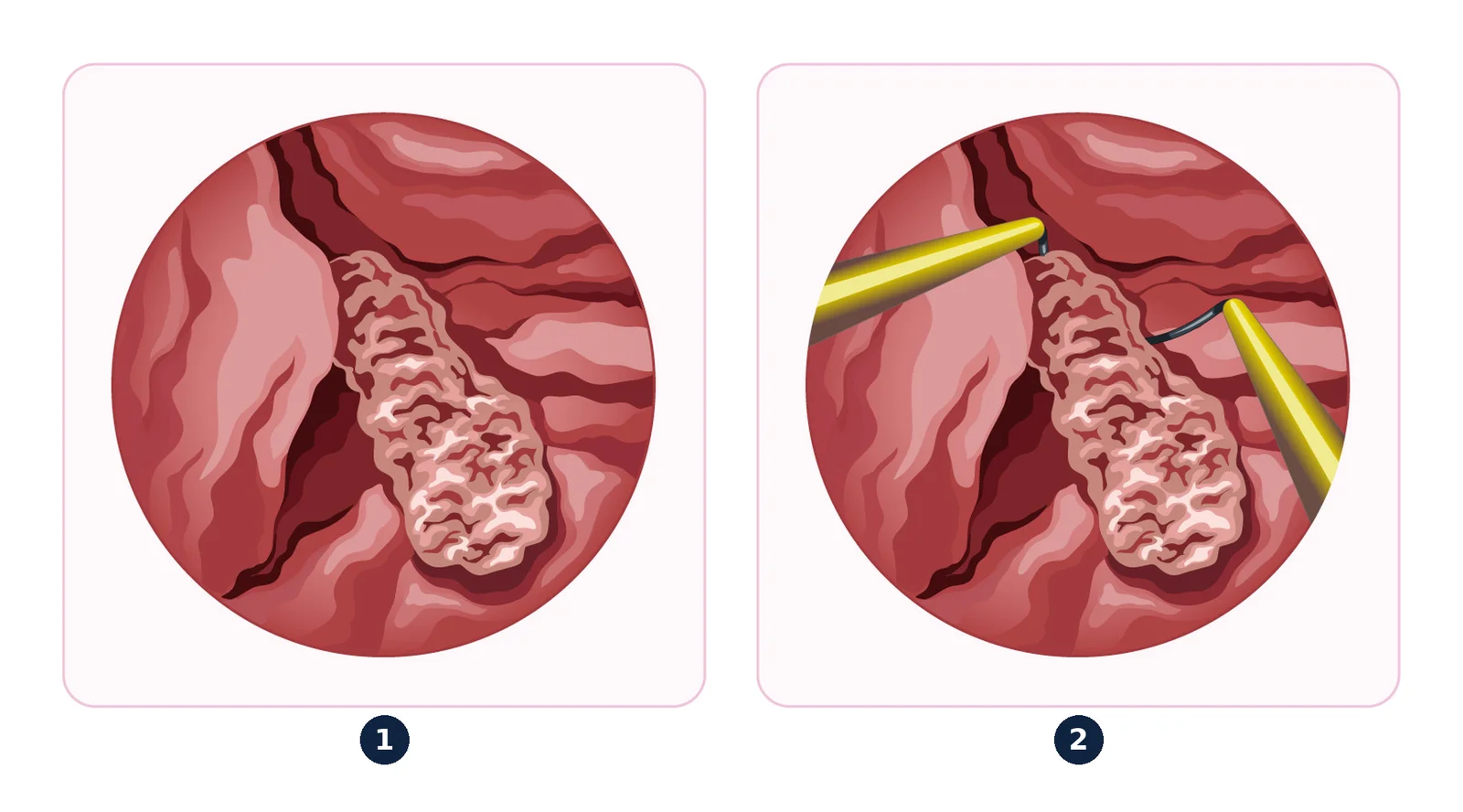
| Letter | Cause | What to know |
|---|---|---|
| P | Endometrial polyp | Often causes bleeding between periods or after sex |
| A | Adenomyosis | Heavy, painful periods and an enlarged uterus |
| L | Leiomyoma (fibroid) | Fibroids that distort the uterine cavity cause the most bleeding |
| M | Malignancy and hyperplasia | Endometrial hyperplasia, cancer of the endometrium or cervix; looked for mainly according to age and risk factors |
| C | Coagulopathy | Clotting disorder (for example von Willebrand disease), considered especially when periods have been heavy since the very first ones |
| O | Ovulatory dysfunction | Irregular cycles, common in adolescence, perimenopause and polycystic ovary syndrome |
| E | Endometrial | A local problem of the endometrium, sometimes endometritis (inflammation or infection) |
| I | Iatrogenic | Anticoagulants, copper IUD, bleeding on the pill or implant, menopausal hormone therapy |
| N | Not yet classified | Rare causes, such as a caesarean scar defect (isthmocele) |
Causes vary with age
- In adolescence: cycles without ovulation are common in the first few years. However, very heavy periods from the very first ones should prompt a check for a clotting disorder.
- Between 20 and 40: polyps, fibroids, adenomyosis and contraception-related bleeding are the main causes.
- In perimenopause: cycles become irregular, but abnormal bleeding at this age means the endometrium should be checked, because the risk of hyperplasia increases.
Several causes may coexist. A small fibroid found on ultrasound does not necessarily explain the bleeding on its own.
Could abnormal bleeding mean I am pregnant?
With any unusual bleeding in a woman of childbearing age, the first step is to rule out pregnancy, even if you use contraception. A pregnancy test (beta-hCG) is done whenever there is any doubt.
Bleeding in early pregnancy may occur in a normal pregnancy, a miscarriage or an ectopic pregnancy, which is an emergency.
Which tests are used to find the cause of heavy periods?
- A consultation: length and heaviness of periods, date of last period, contraception, medicines, family history of bleeding, impact (tiredness, breathlessness).
- A gynaecological examination, including a speculum examination of the cervix. Cervical screening is checked or done if not up to date, but it is not enough to explain bleeding.
- A blood test: full blood count to look for anaemia, ferritin to assess iron stores, beta-hCG, and clotting tests if your history suggests it.
- A pelvic ultrasound, through the abdomen and vagina: according to the French College of Gynaecologists and Obstetricians (CNGOF), this is the first-line imaging test. It looks for fibroids, polyps, adenomyosis and a thickened endometrium.
- Saline infusion sonography or diagnostic hysteroscopy, if an abnormality of the uterine cavity is suspected.
- An endometrial biopsy, depending on age, risk factors for endometrial cancer (excess weight, diabetes, cycles without ovulation, tamoxifen treatment) and the ultrasound appearance.
What are the treatments for heavy periods?
Treatment depends on the cause, how heavy the bleeding is, your age, whether you want a pregnancy, and any contraindications. The 2022 CNGOF guidelines set out the options for each situation.
Medical treatments
- Levonorgestrel hormonal IUD: it greatly reduces flow and also provides contraception. It can replace a copper IUD that causes heavy periods.
- Tranexamic acid: taken only during periods, it reduces blood loss but is not a contraceptive. It must not be used if you have a history of thrombosis.
- Combined pill or progestogens: they regulate the cycle and reduce flow, provided there are no contraindications (in particular smoking after 35, history of thrombosis, migraine with aura).
- Anti-inflammatory drugs during periods, if there is no contraindication.
- Iron for anaemia or iron deficiency, as tablets or by infusion depending on the situation.
Surgical and radiological treatments
- Operative hysteroscopy: removal of a polyp or a fibroid inside the cavity, with no scar on the abdomen.
- Myomectomy by laparoscopy or open surgery: removal of fibroids while keeping the uterus.
- Endometrial ablation: for women who no longer plan a pregnancy.
- Uterine artery embolisation: an interventional radiology technique for some fibroids. It is generally not offered as first-line treatment if you plan a pregnancy.
- Hysterectomy: removal of the uterus, considered when other treatments have failed or are not suitable.
A precancerous lesion or cancer requires specific care, decided at a multidisciplinary team meeting.
When is heavy bleeding an emergency?
Call 15 (SAMU) or 112 in France, or your local emergency number, or go to the emergency department if you have:
- very heavy bleeding that soaks through a pad or tampon in less than an hour, for several hours in a row;
- fainting, dizziness, marked paleness, breathlessness or a racing heart;
- severe lower abdominal pain, especially if you could be pregnant;
- bleeding with fever;
- bleeding during a known pregnancy: contact your maternity unit’s emergency department.
See a doctor promptly, though not as an emergency, if you have bleeding after sex, bleeding after menopause, or unusual tiredness that may be due to anaemia. See also our article on bleeding after menopause.
How can I manage heavy periods day to day?
While waiting for tests, keep a record over two or three cycles of how long your periods last, how many pads or tampons you use, and whether you pass clots. This diary helps with the diagnosis.
Iron deficiency is common and often overlooked. It causes tiredness, breathlessness, hair loss and poor concentration. It can be corrected, but it comes back if the cause of the bleeding is not treated.
The tests, including the ultrasound scan, can be carried out at the practice. The average waiting time for an appointment is one week to 10 days, except during holiday periods (via Doctolib or on 01 43 79 59 79).
Would you like a medical opinion?Appointments in Paris 16th or 5th, or by video consultation.
Book an appointmentFrequently asked questions
How many pads or tampons a day is too many?
There is no universal number. Changing protection almost every hour, getting up at night or needing double protection are signs of heavy periods that should be checked by a doctor.
Is bleeding between periods always serious?
No, it is often benign (polyp, bleeding on contraception, ovulation problems). It should still be investigated, because it can also reveal a lesion of the cervix or endometrium.
Do fibroids always cause heavy periods?
No. Many fibroids cause no symptoms at all. Those that distort the uterine cavity are the most likely to cause bleeding.
Can a copper IUD make periods heavier?
Yes, it can make periods longer and heavier. If this bothers you, other contraceptive methods, including the hormonal IUD, can be discussed.
References
- Brun JL, et al. Prise en charge des saignements utérins anormaux : recommandations pour la pratique clinique du CNGOF. [Management of women with abnormal uterine bleeding: CNGOF clinical practice guidelines] Gynécologie Obstétrique Fertilité & Sénologie, 2022. doi:10.1016/j.gofs.2022.02.078 — PMID 35248756
- Munro MG, et al. The two FIGO systems for normal and abnormal uterine bleeding symptoms and classification of causes of abnormal uterine bleeding in the reproductive years: 2018 revisions. International Journal of Gynaecology and Obstetrics, 2018. doi:10.1002/ijgo.12666 — PMID 30198563
- Bofill Rodriguez M, et al. Progestogen-releasing intrauterine systems for heavy menstrual bleeding. Cochrane Database of Systematic Reviews, 2020. doi:10.1002/14651858.CD002126.pub4 — PMID 32529637

Dr Olivier KadochObstetrician-gynaecologist and gynaecological surgeon in Paris, seeing patients in Paris 16th and at the Centre de la Femme Paris 5. Former chef de clinique-assistant (senior registrar) at the Paris public hospitals (AP-HP); individually accredited by the French National Authority for Health (HAS). RPPS 10003957809. Background and practice locations
A question about your situation?Appointments at the practice or by video consultation, usually within one week to 10 days.
Book an appointmentGeneral information article: it does not replace a medical consultation. In an emergency, call 15 or 112 in France, or your local emergency number.