Gynaecological laparoscopy: indications, procedure and recovery
In brief
Laparoscopy (keyhole surgery) is a surgical technique that allows the surgeon to operate inside the abdomen through a few small incisions, using a camera and fine instruments, under general anaesthetic. In gynaecology, it is used to diagnose and treat ovarian cysts, endometriosis, ectopic pregnancy and fibroids, or to perform a hysterectomy. Compared with open surgery (laparotomy), it causes less pain and allows a faster return to normal activities (2023 Cochrane review); the hospital stay generally ranges from day surgery to a few days, depending on the procedure.
What is a laparoscopy?
Laparoscopy is a minimally invasive surgical approach. Instead of opening the abdomen (laparotomy), the surgeon inserts a camera through the navel and fine instruments through other small incisions. The operation is carried out while watching a screen that magnifies the organs.
It can be used both to make a diagnosis, when examination and imaging have not been enough, and to treat, during the same procedure, many conditions of the uterus, fallopian tubes, ovaries and peritoneum. It is one of the surgical approaches described on our Gynaecological surgery page.
When is a laparoscopy recommended?
| Purpose | Examples |
|---|---|
| Diagnosis | Unexplained pelvic pain; suspected pelvic infection; pelvic mass needing further assessment; fertility investigations (tubal patency, adhesions); confirming endometriosis when earlier tests are negative |
| Treatment of the ovaries and fallopian tubes | Ovarian cyst (cystectomy), adnexal torsion, ectopic pregnancy, tubal sterilisation, tubal repair surgery |
| Treatment of the uterus | Myomectomy (removal of fibroids), hysterectomy, sacrocolpopexy for prolapse |
| Endometriosis and adhesions | Removal or destruction of lesions, division of adhesions |
| Cancer care | Some operations for endometrial or ovarian cancer, following specialist protocols |
According to the French endometriosis guidelines from the French College of Gynaecologists and Obstetricians (CNGOF) and the French National Authority for Health (HAS), diagnostic laparoscopy is useful for women with symptoms or infertility when earlier tests are negative, with biopsies to confirm the lesions.
How do I prepare for a laparoscopy?
- Surgical consultation: explanation of the planned procedure, the alternatives and the risks, and consent.
- Anaesthetic consultation, which is compulsory before the operation. Mention any breathing or heart problems: the gas used to inflate the abdomen may be less well tolerated in these situations.
- Medication: tell us about anticoagulants, antiplatelet drugs and contraception; adjustments may be needed.
- Fasting as instructed by the anaesthetist.
- Shower the evening before or the morning of surgery, following the hospital’s protocol, paying particular attention to the navel.
- Smoking: stopping is advised to reduce complications.
- Practical arrangements: the procedure takes place at Hôpital privé Geoffroy Saint-Hilaire (Paris 5th), Clinique de la Muette (Paris 16th) or Clinique Ambroise Paré (Neuilly-sur-Seine), usually under general anaesthesia; admission arrangements (day case or short stay depending on the procedure) are explained at the consultation.
What happens during a laparoscopy?
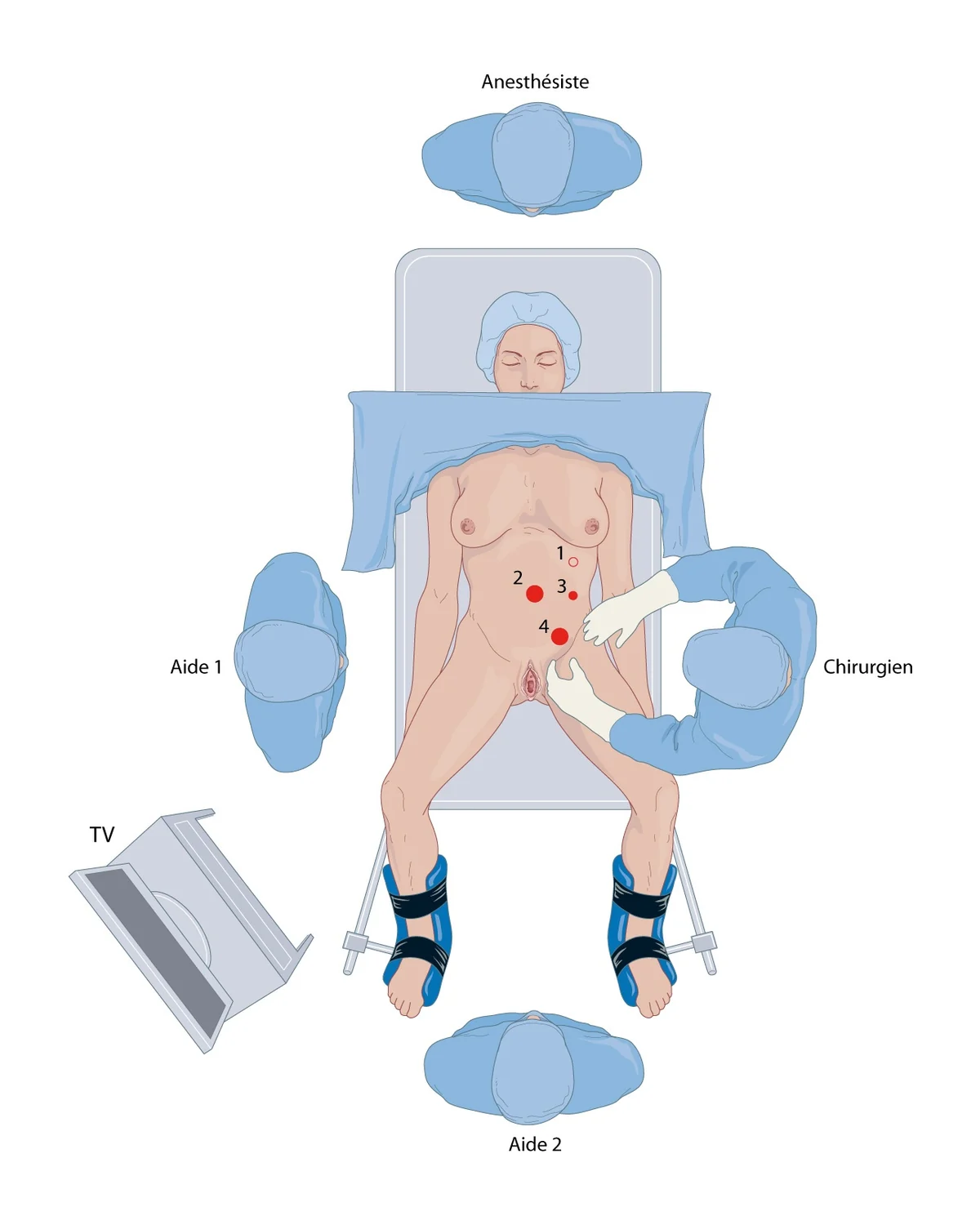
- General anaesthetic, lying on your back.
- Creating the working space: the abdomen is inflated with carbon dioxide gas (pneumoperitoneum), usually through the navel, to lift the abdominal wall.
- Inserting the ports (trocars): a port of about 10 mm in the navel for the camera, then one to three ports of about 5 mm in the lower abdomen for the instruments.
- Examination and surgery guided by the screen.
- End of the operation: the gas is released, the instruments removed and the small incisions closed with stitches or skin glue.
The length of the operation depends on the procedure performed; it is explained at the consultation. A Cochrane review of laparoscopic entry techniques shows that serious complications related to inserting the instruments are rare, whichever technique is used.
What is recovery like after a laparoscopy?
- Hospital stay: as a guide, from day-case surgery to several days, depending on the procedure (day surgery to 2 days for ovarian or tubal surgery, 2 to 3 days for a myomectomy, 2 to 4 days for a hysterectomy, 1 to 7 days for endometriosis surgery depending on its extent).
- Pain: usually moderate, around the scars and in the abdomen. Shoulder pain is common: caused by leftover gas irritating the diaphragm, it goes away on its own within a few days.
- Wound care: you can shower from the next day; baths and swimming pools should generally be avoided for 2 weeks after ovarian or tubal surgery, 3 to 4 weeks after endometriosis surgery and 4 weeks after a myomectomy or hysterectomy (instructions tailored to your situation are given in writing before the procedure).
- Time off work, exercise and sex: as a guide, 7 to 21 days off work depending on your job after ovarian or tubal surgery, 2 to 4 weeks after a myomectomy, 2 to 6 weeks after endometriosis surgery depending on its extent, about 1 month after a hysterectomy; exercise after about 3 weeks for ovarian surgery, 1 to 3 weeks after a myomectomy, after the post-operative check for endometriosis surgery, and no heavy lifting for 6 weeks after a hysterectomy; sex when pain allows after ovarian surgery, after 1 to 2 weeks for a myomectomy, 3 to 4 weeks for endometriosis and 4 to 8 weeks for a hysterectomy. These guidelines are tailored to each patient at the consultation.
- Follow-up appointment: generally 4 to 6 weeks after the procedure (sooner if needed), with the results of the tissue analysis.
Waking up and the first few hours
You wake up in the recovery room, where your blood pressure, pain and bleeding are monitored. You have a drip for a few hours; a urinary catheter is sometimes inserted during the operation and removed soon afterwards. You are offered something to drink and then to eat as soon as possible, and helped to get up the same day. Nausea is possible after the anaesthetic and can be treated. If you go home the same day, someone must accompany you and stay with you the first night; you must not drive that day.
Before you leave, the team gives you your prescriptions (painkillers, anticoagulants if needed), written instructions and a number to call if there is a problem. The results of the tissue analysis are not available on the day: they are given to you at the follow-up appointment.
A 2023 Cochrane review shows that, for hysterectomy, women return to normal activities sooner after laparoscopy than after open surgery.
What are the risks of a laparoscopy?
All surgery carries risks, which are explained to you according to the planned procedure.
Risks related to the gas (pneumoperitoneum)
- carbon dioxide passing into the bloodstream, continuously monitored by the anaesthetist;
- breathing or heart strain, especially with asthma, chronic bronchitis, obesity or heart disease;
- gas embolism, which is rare but serious.
Risks related to the ports and instruments
- injury to the bowel, a blood vessel, the bladder or a ureter, which is rare and may need immediate repair or a further operation;
- conversion to open surgery if there is a difficulty or complication;
- burns from the electrosurgical instruments, which are rare;
- bruising or infection of a wound; more rarely, a hernia at a port site.
General risks
- related to the general anaesthetic;
- deep vein thrombosis and pulmonary embolism, prevented by getting up early and sometimes by an anticoagulant;
- risks specific to the procedure performed (for example, reduced ovarian reserve after removal of an ovarian cyst).
Laparoscopy or open surgery: what is the difference?
| Laparoscopy | Laparotomy (open surgery) | |
|---|---|---|
| Incisions | A few incisions of 5 to 10 mm | An incision several centimetres long |
| Pain after the operation | Usually less | Greater |
| Recovery | Faster | Longer |
| Main uses | Most gynaecological operations | Very large masses, extensive adhesions, some emergencies or some cancers |
Laparoscopy is not always possible: the choice depends on your health, your previous surgery and the condition to be treated.
When should I seek urgent care after a laparoscopy?
Contact the surgeon or the on-call team straight away, day or night, if you have:
- severe abdominal pain or pain that gets worse instead of better, especially after 24 to 48 hours;
- fever or shivering;
- persistent vomiting, a very swollen abdomen, or you cannot pass wind;
- heavy bleeding from the vagina or a wound;
- a wound that is red, hot, painful or oozing;
- pain or swelling in a calf.
If you are short of breath, have chest pain or feel faint, call 15 (SAMU) or 112 in France, or your local emergency number.
Frequently asked questions
Why do my shoulders hurt after a laparoscopy?
The gas used to inflate the abdomen irritates the diaphragm, and this pain is felt in the shoulders. It is common and usually goes away within a few days.
Will the scars be visible?
They are small, one often hidden in the navel and the others in the lower abdomen. They generally fade over time.
Can I go home the same day?
Yes, for many procedures such as a simple cystectomy or a diagnostic laparoscopy, done as day-case surgery. Longer operations require a short hospital stay.
Does laparoscopy reduce fertility?
The technique itself does not reduce fertility. Some procedures, such as removing ovarian cysts, can reduce ovarian reserve: this is discussed before surgery if you are planning a pregnancy. When to try for a pregnancy is discussed at the post-operative consultation.
How long is the recovery after a laparoscopy?
It depends on the procedure. As a guide, time off work ranges from 7 to 21 days depending on your job after ovarian or tubal surgery, 2 to 4 weeks after a myomectomy and about 1 month after a hysterectomy. Instructions tailored to your situation are given at the consultation.
How much does a laparoscopy cost?
The cost depends on the procedure performed. The fees are set out in a quote given to you before the operation.
References
- Ahmad G, et al. Laparoscopic entry techniques.. Cochrane Database Syst Rev, 2019. doi:10.1002/14651858.CD006583.pub5 — PMID 30657163
- Pickett CM, et al. Surgical approach to hysterectomy for benign gynaecological disease.. Cochrane Database Syst Rev, 2023. doi:10.1002/14651858.CD003677.pub6 — PMID 37642285
- Tardieu A, et al. [Diagnosis accuracy of endoscopy (laparoscopy, hysteroscopy, fertiloscopy, cystoscopy, colonoscopy) in case of endometriosis: CNGOF-HAS Endometriosis Guidelines].. Gynecol Obstet Fertil Senol, 2018. doi:10.1016/j.gofs.2018.02.024 — PMID 29530560

Dr Olivier KadochObstetrician-gynaecologist and gynaecological surgeon in Paris (16th and 5th arrondissements). Former chef de clinique-assistant (senior registrar) at the Paris public hospitals (AP-HP); individually accredited by the French National Authority for Health (HAS). RPPS 10003957809. Background and practice locations
A question about your situation?Appointments at the practice or by video consultation, usually within one week to 10 days.
Book an appointmentGeneral information article: it does not replace a medical consultation. In an emergency, call 15 or 112 in France, or your local emergency number.