Uterine fibroids: symptoms, and when should they be treated?
In brief
A uterine fibroid (or myoma) is a very common benign tumour of the uterine muscle; many cause no symptoms and only require monitoring. Treatment is discussed when it causes heavy periods, anaemia, pain, compression or difficulty conceiving. Among recent medical treatments, the combination of relugolix, estradiol and norethisterone acetate, in two randomised trials published in the New England Journal of Medicine, markedly reduced bleeding in 71 to 73% of women, compared with 15 to 19% on placebo.
What is a uterine fibroid?
A fibroid is a lump of muscular and fibrous tissue that develops in the wall of the uterus. It is benign: it is not a cancer and does not turn into cancer. Its growth depends on ovarian hormones (oestrogens and progesterone): it may grow during the reproductive years and generally shrinks after the menopause.
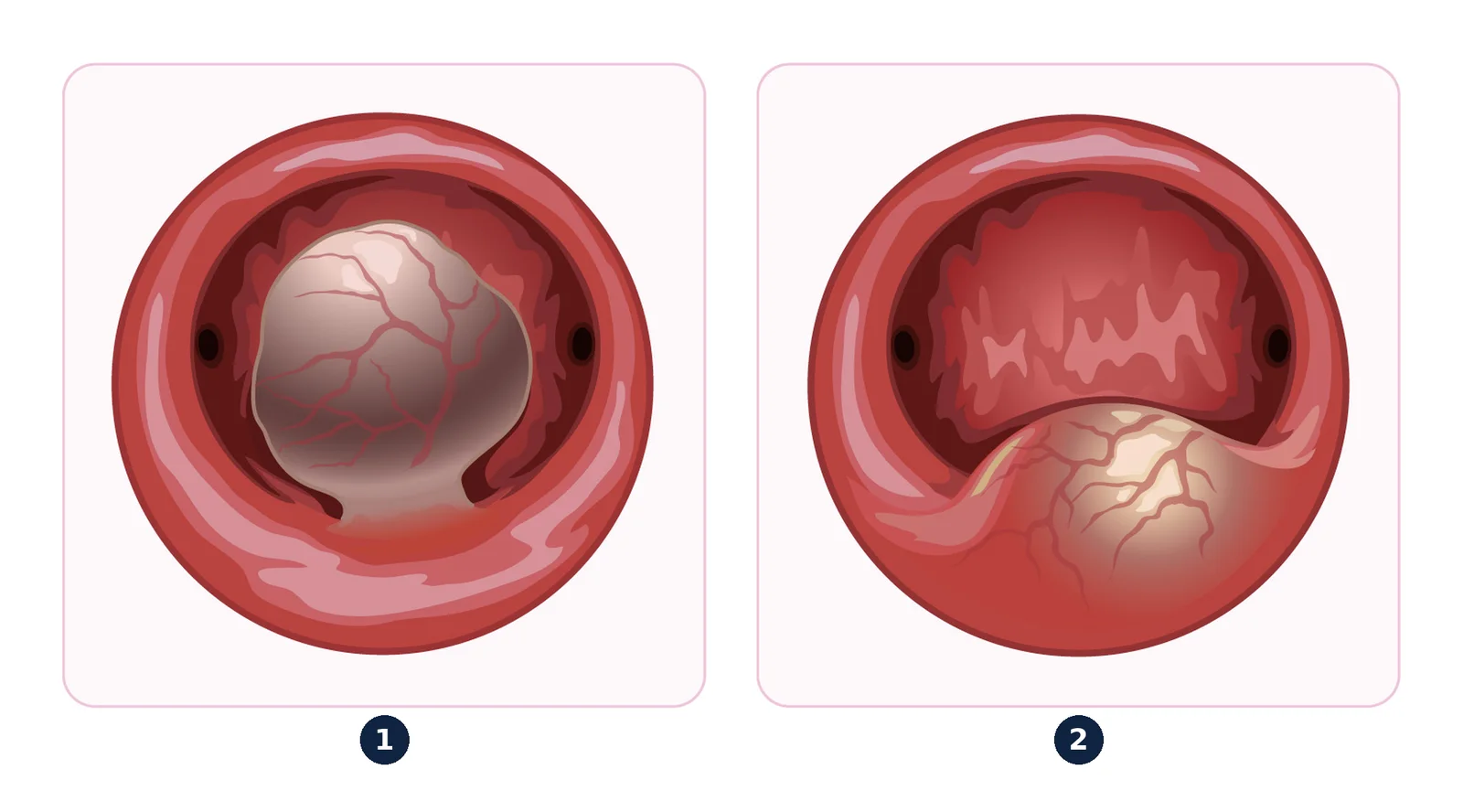
Fibroids are very common in women over 35. There may be just one or several, ranging from a few millimetres to more than 10 centimetres.
Their position is described by the FIGO classification, from 0 to 8:
- submucosal (types 0 to 2): they protrude into the uterine cavity;
- intramural (types 3 and 4): within the thickness of the muscle;
- subserosal (types 5 to 7): they grow towards the outside of the uterus.
This position matters more than size in understanding the symptoms.
What are the symptoms of a fibroid?
Many fibroids are discovered by chance, during a routine examination or scan. When they do cause symptoms, these are mainly:
| Symptom | Fibroids most often responsible |
|---|---|
| Heavy, prolonged periods, clots | Submucosal (0 to 2), sometimes intramural |
| Tiredness, breathlessness due to anaemia | Consequence of heavy periods |
| Bleeding between periods | Submucosal |
| Pelvic heaviness, swollen abdomen | Large, intramural or subserosal |
| Frequent need to urinate | Anterior fibroid pressing on the bladder |
| Constipation, rectal discomfort | Posterior fibroid |
| Pelvic pain, painful periods | Variable; acute pain in the event of red degeneration or torsion |
| Difficulty conceiving, miscarriages | Mainly submucosal |
Bleeding or pain should not be attributed to a fibroid straight away: other causes (polyp, adenomyosis, hormonal disorder, abnormality of the endometrium) may coexist.
How is the diagnosis made?
The key test is a pelvic ultrasound, by the abdominal and transvaginal routes. It shows the number of fibroids, their size and their FIGO type.
Depending on the situation, other tests may be offered:
- saline infusion sonohysterography or diagnostic hysteroscopy: to assess a fibroid close to the cavity;
- pelvic MRI: for multiple or large fibroids, before surgery or embolisation, or if the appearance is unusual;
- blood test: full blood count to look for anaemia, ferritin to assess iron stores;
- endometrial biopsy: for abnormal bleeding after 45 or in the presence of risk factors, so as not to miss another cause.
The guidelines of the CNGOF published in 2023 (French College of Gynaecologists and Obstetricians) on abnormal uterine bleeding set out this diagnostic strategy and the management of fibroids according to their type.
Should a fibroid that causes no symptoms be treated?
Generally, no. An asymptomatic fibroid that does not affect fertility simply requires monitoring, clinical and by ultrasound, at intervals adapted to its size and how it changes.
A few situations lead to treatment being discussed despite the absence of discomfort:
- a submucosal fibroid in a woman who wishes to become pregnant;
- rapid growth or an unusual appearance on imaging, which justifies a specialist opinion and often an MRI;
- a very large fibroid compressing a ureter (risk to the kidney).
As the menopause approaches, monitoring is often preferred: the fall in hormones generally leads to a reduction in the size of fibroids and in symptoms.
What medical treatments are available?
Medical treatments mainly aim to reduce bleeding. They do not make the fibroid disappear, and their effect generally stops when they are discontinued.
| Treatment | Main effect | Points to know |
|---|---|---|
| Tranexamic acid | Reduces menstrual blood loss | Taken only during periods; contraindicated in women with a history of thrombosis |
| Anti-inflammatories (NSAIDs) | Reduce bleeding and pain | Moderate effect |
| Progestogens, hormonal coil (levonorgestrel IUD) | Reduce bleeding | The IUD is less suitable if a fibroid distorts the cavity (risk of expulsion) |
| GnRH agonists (injections) | Put the ovaries at rest, reduce size | Effects of artificial menopause; short-term use, often before surgery |
| Relugolix combined with estradiol and norethisterone acetate (daily tablet) | Greatly reduces bleeding | The hormonal add-back limits hot flushes and bone loss; does not reduce the size of the fibroid |
| Ulipristal acetate | Formerly used to reduce bleeding and size | Use now very restricted because of rare cases of serious liver damage |
| Iron | Corrects anaemia | Always added if stores are low |
Relugolix combination therapy was evaluated in the LIBERTY 1 and 2 trials (770 women): 73% and 71% of patients had a reduction in bleeding to less than 80 ml per cycle and by at least 50%, compared with 19% and 15% on placebo. Bone density was comparable to placebo. However, the size of the fibroid itself did not decrease significantly. Prescribing conditions and reimbursement should be checked during the consultation.
Ulipristal acetate has had its use heavily restricted by the European health authorities following cases of serious liver damage. It is no longer a first-line treatment.
Combined oestrogen-progestogen contraception or menopausal hormone therapy is not contraindicated simply because of a fibroid.
When should embolisation or surgery be considered?
When symptoms persist despite medical treatment, when that treatment is poorly tolerated or contraindicated, or when the fibroid is too large, an interventional treatment is discussed:
- operative hysteroscopy: resection of a submucosal fibroid through the natural passages, without an incision;
- myomectomy by laparoscopy or laparotomy: removal of the fibroids while preserving the uterus;
- uterine artery embolisation: an interventional radiologist blocks the arteries that supply the fibroids, without surgery;
- hysterectomy: removal of the uterus, a definitive solution for women with no plans for pregnancy.
The choice depends on the FIGO type, the number and size of the fibroids, the wish for pregnancy, age and the patient’s preferences (see myomectomy or embolisation).
Can a fibroid be a cancer?
A fibroid is benign. There is, however, a rare malignant tumour of the uterine muscle, uterine sarcoma, which can look like a fibroid on ultrasound. Rapid growth, particularly after the menopause, an unusual appearance on MRI or bleeding after the menopause should lead to a specialist opinion. This rare possibility explains the precautions taken before certain surgical techniques such as morcellation.
When should you seek urgent care?
Seek medical advice promptly or call 15 (SAMU) or 112 in France, or your local emergency number, in the event of:
- very heavy bleeding (a pad or tampon soaked in less than an hour, for several hours in a row);
- fainting, dizziness, breathlessness or marked pallor, possible signs of severe anaemia;
- sudden, intense pelvic pain, particularly with fever or vomiting (red degeneration or torsion of a pedunculated fibroid);
- inability to pass urine.
Would you like a medical opinion?Appointments in Paris 16th or 5th, or by video consultation.
Book an appointmentFrequently asked questions
Can a fibroid disappear on its own?
It does not disappear, but it often shrinks after the menopause, when the hormones that stimulate it fall. Before the menopause, it can remain stable for a long time.
My fibroid is growing: should it be operated on?
Not necessarily. The decision is based on symptoms and impact rather than on size alone. Rapid growth does, however, justify a specialist opinion and often an MRI.
Does the pill make fibroids grow?
French guidelines do not contraindicate combined oestrogen-progestogen contraception in women with fibroids. The choice of contraception is discussed according to bleeding and other medical history.
Does a fibroid prevent you from having a child?
Only certain fibroids, especially those that distort the uterine cavity, reduce the chances of pregnancy. This subject is covered in detail in the article fibroids, pregnancy and fertility.
How long do I have to wait for a consultation?
The average waiting time for an appointment is one week to 10 days, except during holiday periods (Doctolib or 01 43 79 59 79). In the event of heavy bleeding with fainting, seek urgent care without waiting for the appointment.
References
- Brun JL, et al. Management of women with abnormal uterine bleeding: Clinical practice guidelines of the French National College of Gynaecologists and Obstetricians (CNGOF). Eur J Obstet Gynecol Reprod Biol, 2023. doi:10.1016/j.ejogrb.2023.07.001 — PMID 37499278
- Al-Hendy A, et al. Treatment of Uterine Fibroid Symptoms with Relugolix Combination Therapy. N Engl J Med, 2021. doi:10.1056/NEJMoa2008283 — PMID 33596357
- Marret H, et al. Therapeutic management of uterine fibroid tumors: updated French guidelines. Eur J Obstet Gynecol Reprod Biol, 2012. doi:10.1016/j.ejogrb.2012.07.030 — PMID 22939241

Dr Olivier KadochObstetrician-gynaecologist and gynaecological surgeon in Paris, seeing patients in Paris 16th and at the Centre de la Femme Paris 5. Former chef de clinique-assistant (senior registrar) at the Paris public hospitals (AP-HP); individually accredited by the French National Authority for Health (HAS). RPPS 10003957809. Background and practice locations
A question about your situation?Appointments at the practice or by video consultation, usually within one week to 10 days.
Book an appointmentGeneral information article: it does not replace a medical consultation. In an emergency, call 15 or 112 in France, or your local emergency number.