Urinary and anal leakage after childbirth: causes and treatments
In brief
According to a 2020 Cochrane review, about one woman in three has urinary leakage after giving birth (postpartum urinary incontinence), and up to one in ten leaks wind or stools (anal incontinence). It often improves on its own in the first few months. If urinary leakage persists 3 months after the birth, or if there is anal incontinence, the CNGOF (French College of Gynaecologists and Obstetricians) recommends pelvic floor rehabilitation; surgery is only considered if this fails.
Are urinary and anal leaks after childbirth common?
Yes. According to a 2020 Cochrane review, about one woman in three has urinary incontinence after giving birth, and up to one in ten has anal incontinence, meaning leakage of wind or stools, or difficulty holding on. Many women keep quiet about these problems out of embarrassment, even though they can be treated.
In the first weeks, the pelvic floor gradually recovers and some of the leakage goes away by itself. This is why assessment and treatment are mainly discussed at the postnatal check and in the months that follow.
Why can childbirth cause bladder or bowel leakage?
The pelvic floor is the group of muscles and tissues that closes the bottom of the pelvis and supports the bladder, uterus and rectum. During pregnancy, it carries the growing weight of the uterus and softens under the effect of hormones. During a vaginal birth, it is strongly stretched.
- Muscles and ligaments can be overstretched or injured, which reduces support for the bladder and urethra: leakage then happens on exertion (coughing, sneezing, laughing, sport).
- The pelvic floor nerves, particularly the pudendal nerve, can be stretched as the baby's head descends. Control of the sphincters is then less effective, often temporarily.
- The anal sphincter, the muscle that holds in wind and stools, can be torn in a severe perineal tear (known as a third- or fourth-degree tear).
What increases the risk?
- a birth with forceps or ventouse (vacuum);
- a prolonged pushing stage;
- a large baby;
- a tear of the anal sphincter;
- excess weight or chronic constipation.
A caesarean section does not fully protect against leakage, because pregnancy itself puts strain on the pelvic floor. The French College of Gynaecologists and Obstetricians (CNGOF) does not recommend offering a caesarean solely to prevent incontinence.
Can leakage after childbirth be prevented?
Several measures, recommended by the CNGOF in 2018, aim to protect the perineum during birth:
- perineal massage in late pregnancy can be offered to women who wish to try it;
- as the baby is born, the delivery of the head is controlled and the perineum supported by hand, which reduces the risk of a sphincter tear;
- routine episiotomy is not recommended, because it does not protect the sphincter during a normal birth; it can be useful during an assisted (instrumental) birth (see episiotomy);
- after the birth, the perineum is carefully examined to detect and repair any sphincter injury.
Pelvic floor exercises started early in pregnancy, in a woman with no leakage, reduce the risk of urinary leakage in late pregnancy and in the months after birth, according to the Cochrane review. A midwife or physiotherapist can teach you how to do them.
Do I need pelvic floor rehabilitation after giving birth?
Contrary to a widespread belief, rehabilitation is not recommended routinely for women with no symptoms, according to the CNGOF. It is, however, indicated in these situations:
| Situation | CNGOF recommendation |
|---|---|
| No leakage | Routine rehabilitation not recommended |
| Urinary leakage persisting 3 months after birth | Pelvic floor muscle training recommended, whatever the type of leakage |
| Anal incontinence | Rehabilitation recommended |
| Prolapse or pain during sex | Rehabilitation not recommended for these reasons alone |
In France, rehabilitation is carried out by a midwife or a physiotherapist. It is based on learning to contract the pelvic floor muscles voluntarily, with exercises to continue at home. Biofeedback or electrical stimulation can complement the hands-on work. Dr Kadoch can refer you to a suitable rehabilitation professional.
Abdominal muscle rehabilitation usually comes after pelvic floor rehabilitation, so as not to increase pressure on a pelvic floor that is still fragile.
How do I do pelvic floor exercises correctly?
Many women think they are contracting their pelvic floor when they are actually squeezing their buttocks or thighs, or bearing down. This is why a first session with a midwife or physiotherapist is useful: an examination checks that the contraction is correct.
The general principles are:
- lie down with your knees bent, and relax your abdomen, buttocks and thighs;
- squeeze and lift inwards the area around the vagina and anus, as if holding in both wind and urine;
- keep breathing normally, without holding your breath;
- relax completely between contractions;
- learn to tighten your pelvic floor just before an effort: coughing, sneezing, lifting.
This last reflex, often called "the knack", is useful in daily life. Do not use stopping your urine flow as a regular exercise: it can disturb bladder emptying. Regularity matters more than intensity, and progress takes several weeks.
What other treatments are there for leakage after childbirth?
Lifestyle measures
- lose weight if you are overweight;
- treat constipation: drink enough, eat fibre, do not strain on the toilet;
- avoid repeatedly lifting heavy loads in the first weeks;
- return to sport gradually, starting with low-impact activities.
Surgery
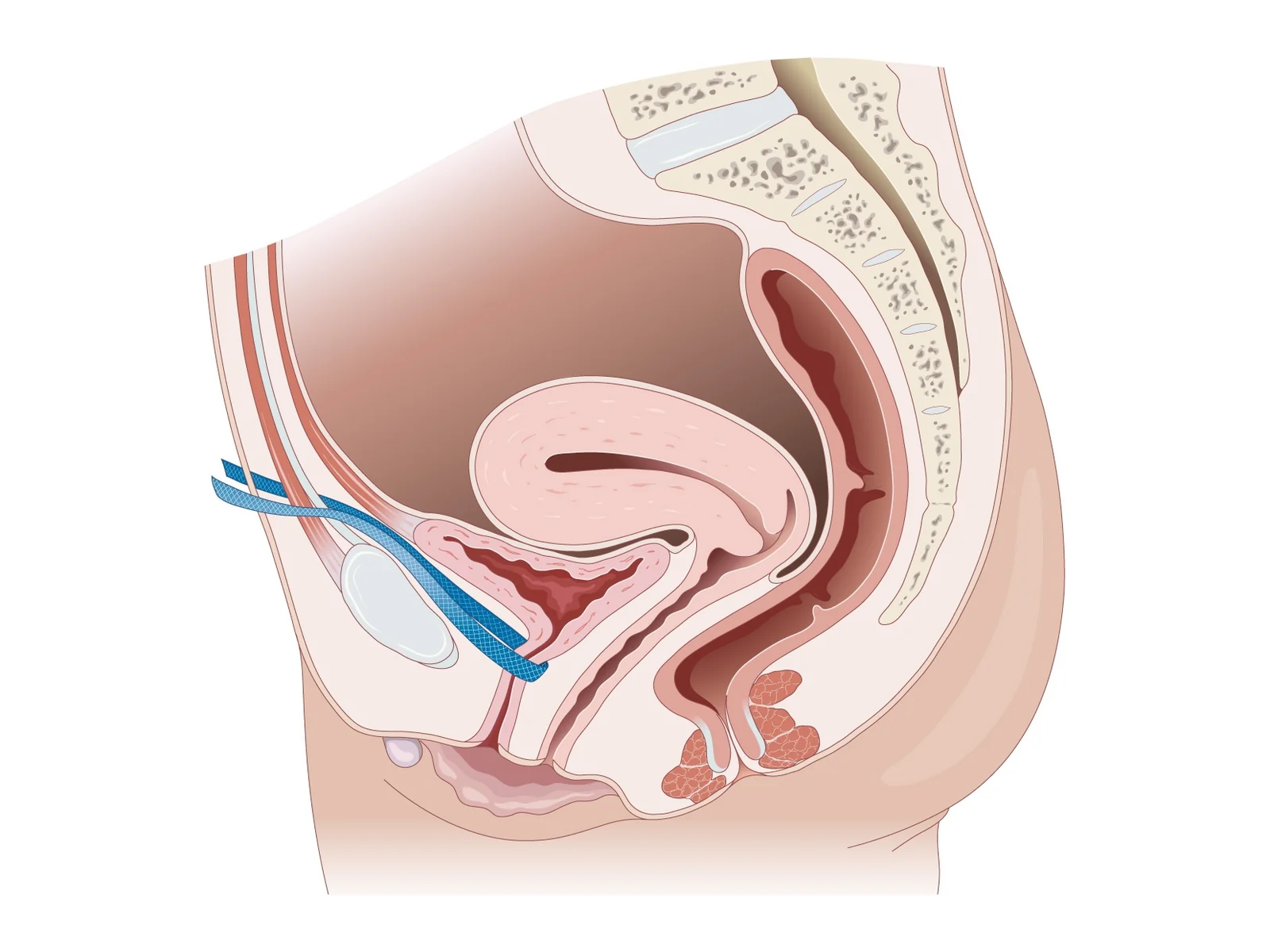
When stress urinary leakage persists despite properly conducted rehabilitation, and only after a clinical examination and often urodynamic tests, an operation may be offered. The most common technique is placing a tape (sling) under the urethra. It is generally considered well after the birth, and preferably once you no longer plan another pregnancy. See surgery for stress urinary incontinence.
For anal incontinence linked to a sphincter injury, specialist tests (endoanal ultrasound, manometry) and an opinion from a proctologist or colorectal surgeon are needed.
When should I see a doctor about leakage after childbirth?
Mention it at your postnatal check, or see a doctor sooner if you have:
- repeated urinary leakage, even slight, that bothers you;
- difficulty holding in wind or stools, or soiling;
- a feeling of a lump or heaviness in the vagina;
- persistent pain in the perineum or the scar;
- pain during sex.
Seek care promptly if you cannot pass urine, have a fever, or if your perineal scar is red, swollen or opening.
Frequently asked questions
Does urinary leakage after childbirth go away on its own?
It often improves in the first weeks or months. If it persists three months after the birth, pelvic floor rehabilitation is recommended.
When should I start pelvic floor rehabilitation?
In France, it is usually prescribed at the postnatal check, a few weeks after the birth, once the tissues have healed. The exact timing depends on your situation.
Will another pregnancy make the leakage worse?
It is possible, especially if there is an anal sphincter injury. The way you give birth next time is then discussed with your obstetrician.
Can I go back to running after giving birth?
Yes, but gradually, after checking that your pelvic floor holds up under effort. If you leak during sport, rehabilitation is useful before returning to high-impact activities.
What should I do if I leak wind or stools?
Mention it without waiting, at your postnatal check or before. The CNGOF recommends pelvic floor rehabilitation for anal incontinence. If an anal sphincter injury is suspected, specialist tests (endoanal ultrasound, anorectal manometry) and an opinion from a proctologist or colorectal surgeon are needed.
References
- Woodley SJ, et al. Pelvic floor muscle training for preventing and treating urinary and faecal incontinence in antenatal and postnatal women.. Cochrane Database Syst Rev, 2020. doi:10.1002/14651858.CD007471.pub4 — PMID 32378735
- Sénat MV, et al. Postpartum practice: guidelines for clinical practice from the French College of Gynaecologists and Obstetricians (CNGOF).. Eur J Obstet Gynecol Reprod Biol, 2016. doi:10.1016/j.ejogrb.2016.04.032 — PMID 27155443
- Ducarme G, et al. Perineal prevention and protection in obstetrics: CNGOF clinical practice guidelines.. J Gynecol Obstet Hum Reprod, 2019. doi:10.1016/j.jogoh.2018.12.002 — PMID 30553051

Dr Olivier KadochObstetrician-gynaecologist and gynaecological surgeon in Paris (16th and 5th arrondissements). Former chef de clinique-assistant (senior registrar) at the Paris public hospitals (AP-HP); individually accredited by the French National Authority for Health (HAS). RPPS 10003957809. Background and practice locations
A question about your situation?Appointments at the practice or by video consultation, usually within one week to 10 days.
Book an appointmentGeneral information article: it does not replace a medical consultation. In an emergency, call 15 or 112 in France, or your local emergency number.