Surgery for stress urinary incontinence in women
In brief
When pelvic floor rehabilitation is not enough, surgery for stress urinary incontinence (leaking urine on effort) most often means fitting a mid-urethral sling (TVT or TOT): a thin synthetic tape placed without tension under the urethra through a small vaginal incision. It is the most widely studied operation for this condition: according to the 2017 Cochrane review, 62 to 98% of women report being cured in the short term, depending on the study and the route used. It carries specific risks, which should be discussed before deciding.
What is stress urinary incontinence?
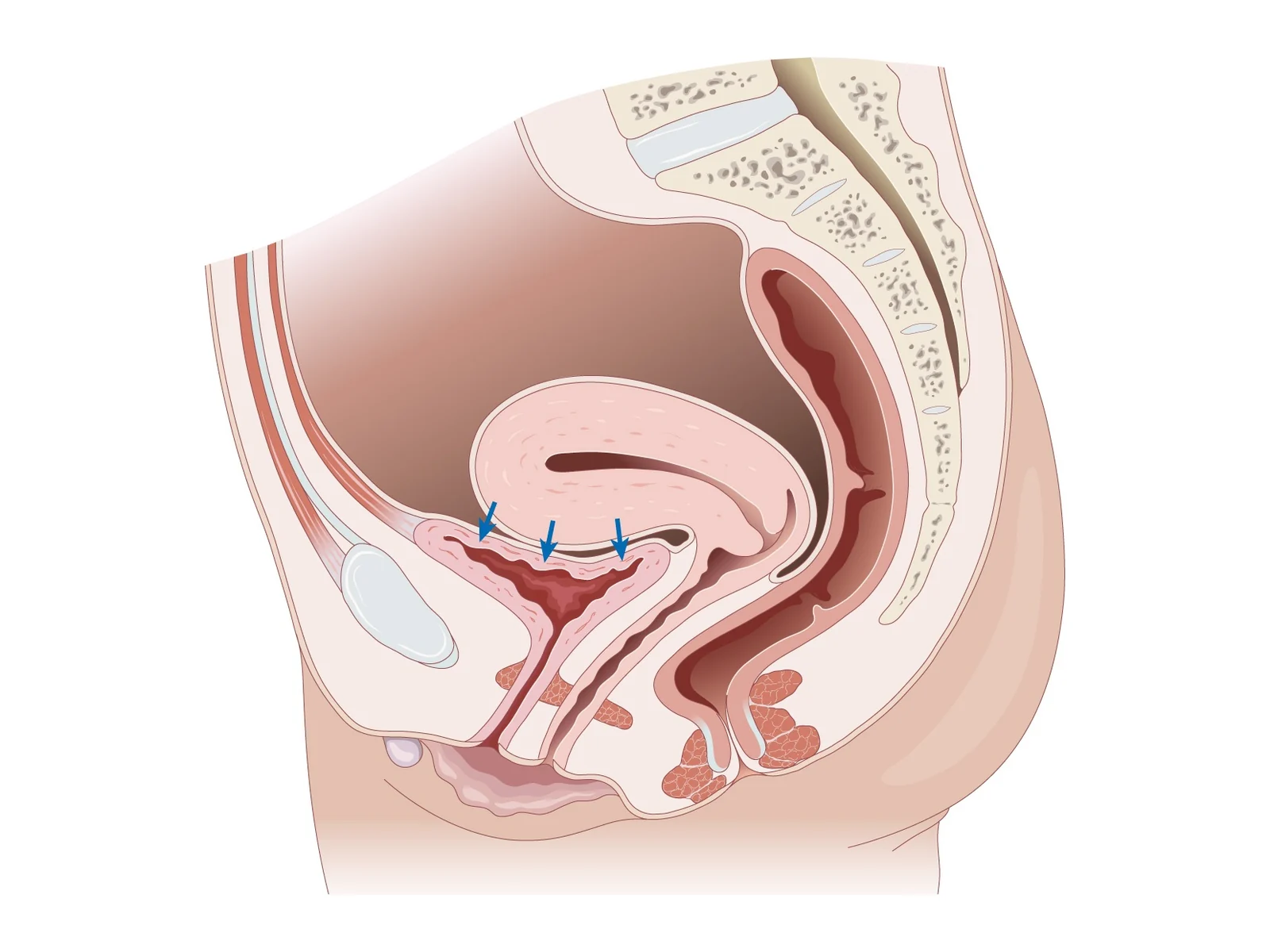
Stress urinary incontinence means leaking urine during physical effort: coughing, sneezing, laughing, lifting, running or jumping. It is most often caused by weak support of the urethra, which becomes too mobile when abdominal pressure rises, and less often by weakness of the sphincter itself.
Pregnancy, childbirth, menopause, excess weight and chronic cough are the main contributing factors. Causes and non-surgical treatments are covered in our article on stress urinary incontinence after menopause; the various gynaecological operations are described on our Gynaecological surgery page.
When should I consider surgery for stress incontinence?
Surgery is not the first treatment. The first steps are:
- pelvic floor rehabilitation with a physiotherapist or a midwife;
- lifestyle measures: losing weight if overweight, stopping smoking, treating constipation, adapting physical effort.
Surgery is discussed when:
- leaks continue despite well-conducted rehabilitation;
- the incontinence is severe and disabling from the outset;
- it has a significant impact on your work, social, sporting or sex life;
- and you want a more lasting treatment, having been informed of the benefits and risks.
Wishing to have a pregnancy later is not an absolute contraindication, but a pregnancy can affect the result: it is often better to wait until you have completed your family.
What tests are needed before incontinence surgery?
The assessment includes a detailed history (type of leaks, associated urgency, number of pads used), often a bladder diary, a gynaecological examination with a full bladder and a cough test, a check for associated prolapse and measurement of the urine left in the bladder after voiding. A urine test rules out infection.
Urodynamic testing is not routine: for simple, demonstrated stress incontinence, a randomised trial published in the New England Journal of Medicine showed no benefit from carrying it out before surgery. It is useful, however, with mixed symptoms, bladder emptying problems, failure of previous surgery or suspected sphincter weakness.
How does a mid-urethral sling (TVT or TOT) work?
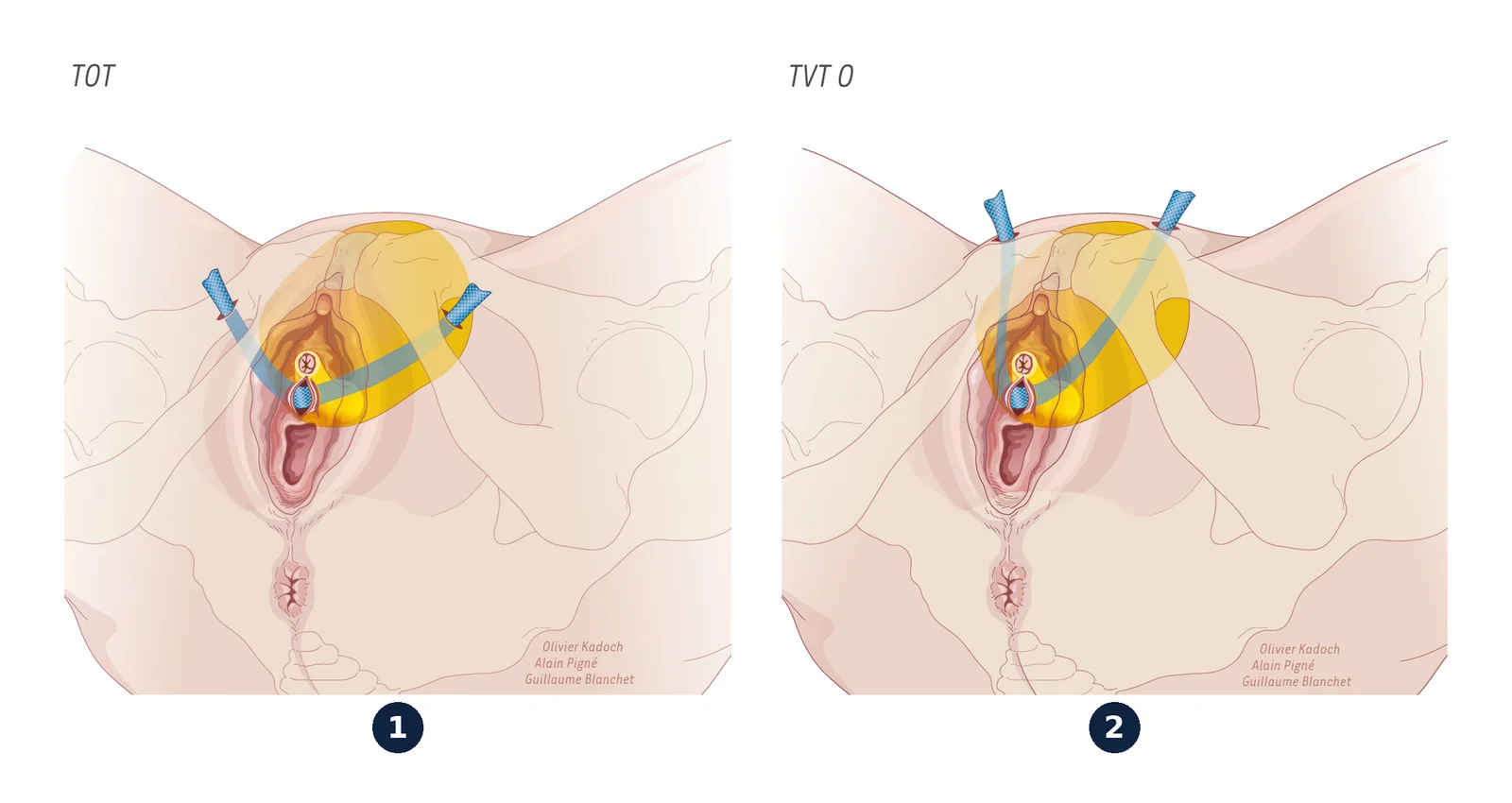
The sling is a thin tape of knitted polypropylene, placed without tension under the middle part of the urethra through a small incision in the front wall of the vagina. At rest it does not press; during effort, the urethra presses against it, which prevents leakage. Tissue then grows around the tape, which stays in place long term.
| Technique | Path of the tape | Points to know |
|---|---|---|
| TVT (retropubic route) | Passes behind the pubic bone and comes out through two small incisions above the pubis | Higher risk of bladder injury and difficulty passing urine; less groin pain |
| TOT (transobturator route) | Passes through the obturator openings of the pelvis and comes out through two small incisions in the groin crease | Fewer bladder injuries; more groin pain, usually temporary |
According to the 2017 Cochrane review (81 trials, more than 12,000 women), both routes are similarly effective in the short term, with subjective cure rates of 62 to 98% for the transobturator route and 71 to 97% for the retropubic route, depending on the study. Beyond five years, subjective cure rates range from 43 to 92% after TOT and from 51 to 88% after TVT; limited data suggest repeat surgery is more frequent after TOT. The choice of route depends on your situation and medical history.
The CNGOF places the mid-urethral sling, retropubic or transobturator, as the first-line operation when surgery is indicated; its risks and the risk of failure must be explained beforehand. In France, a ministerial order of 23 October 2020 regulates sling insertion: decision after multidisciplinary discussion, a trained surgeon, a written information leaflet, time to think it over and an implant card given to the patient.
What if the urethral sphincter is weak?
When examination and urodynamic testing show weakness of the urethral sphincter, with significant leaks even on slight effort and a urethra that moves little, a sling is less effective. Other options may be discussed case by case in specialist centres: bulking injections around the urethra, adjustable balloons and, more rarely, an artificial urinary sphincter. These techniques have their own indications, results and risks, which will be explained to you in detail if they apply to you.
What is recovery like and what are the risks of sling surgery?
The operation is performed under general or regional anaesthesia (spinal anaesthesia). As a guide:
- Hospital stay: day surgery or one night.
- Time off work: generally 1 to 2 weeks, depending on your work.
- Returning to exercise, lifting and sex: as a guide, generally no exercise or lifting for 6 weeks, and sex, baths and swimming can be resumed after about 4 weeks; instructions are tailored to each patient at the consultation.
- Follow-up appointment: generally 4 to 6 weeks after the operation (sooner if needed), to check that there is no urinary retention and that the leaks have stopped.
Before you go home, we check that you can pass urine normally and that your bladder empties well. Mild local discomfort, relieved by simple painkillers, is usual for the first few days.
Documented risks
| Complication | What you need to know |
|---|---|
| Difficulty passing urine, retention | Usually temporary; sometimes a temporary catheter or loosening of the tape is needed |
| Bladder injury | More common with the retropubic route (4.5% versus 0.6% with the transobturator route in the Cochrane review); usually without lasting effects if recognised during the operation |
| Groin or suprapubic pain | Groin pain is more common after TOT (6.4% versus 1.3%), usually short-lived |
| Tape exposure in the vagina | About 2% with both routes; may require further surgery |
| New urgency, urinary tract infections | Possible after the operation; usually treated with medication |
| Chronic pain, pain during sex | Rare, but should be reported promptly |
| Recurrence of leaks | Possible over time; further treatment can be offered |
When should I seek urgent care after sling surgery?
Contact the surgical team straight away if you have:
- inability to pass urine or a very weak stream with a feeling of a full bladder;
- fever, burning when passing urine, lower back pain;
- heavy vaginal bleeding or a growing bruise;
- pain that gets worse instead of better, in the vagina, groin or thigh;
- later on: abnormal discharge, bleeding, a feeling of a foreign body in the vagina, pain during sex for you or your partner.
If you feel faint, are short of breath or have chest pain, call 15 (SAMU) or 112 in France, or your local emergency number.
Frequently asked questions
Can the sling be removed?
Yes, if there is a complication, part or all of the sling can be removed surgically, with a risk that the leaks come back. This is done by teams experienced in this type of surgery.
Can incontinence and prolapse be treated at the same time?
Yes, it is possible. Before prolapse surgery, the CNGOF recommends a cough test to look for incontinence hidden by the prolapse, and urodynamic tests if there are urinary symptoms. Whether to treat both at once or in two stages is decided with you.
Does a sling also treat urgency?
No. It treats leaks on effort. Urgency needs other treatments and can sometimes persist or appear after the operation.
Do I need pelvic floor exercises after the operation?
Rehabilitation is not compulsory after a sling, but keeping your pelvic floor strong and avoiding excessive strain help preserve the result. Your doctor will advise you according to your situation.
Can I get pregnant after sling surgery?
Yes, pregnancy is still possible, but pregnancy and childbirth can affect the result: it is often better to wait until you have completed your family before the operation. The time to wait before a pregnancy is discussed at the post-operative consultation.
How much does the operation cost?
The fees for the operation are set out in a written estimate given to you before surgery.
References
- Ford AA, et al. Mid-urethral sling operations for stress urinary incontinence in women. Cochrane Database Syst Rev, 2017. doi:10.1002/14651858.CD006375.pub4 — PMID 28756647
- Fritel X, et al. Diagnosis and management of adult female stress urinary incontinence: guidelines for clinical practice from the French College of Gynaecologists and Obstetricians. Eur J Obstet Gynecol Reprod Biol, 2010. doi:10.1016/j.ejogrb.2010.02.041 — PMID 20236751
- Nager CW, et al. A randomized trial of urodynamic testing before stress-incontinence surgery. N Engl J Med, 2012. doi:10.1056/NEJMoa1113595 — PMID 22551104

Dr Olivier KadochObstetrician-gynaecologist and gynaecological surgeon in Paris (16th and 5th arrondissements). Former chef de clinique-assistant (senior registrar) at the Paris public hospitals (AP-HP); individually accredited by the French National Authority for Health (HAS). RPPS 10003957809. Background and practice locations
A question about your situation?Appointments at the practice or by video consultation, usually within one week to 10 days.
Book an appointmentGeneral information article: it does not replace a medical consultation. In an emergency, call 15 or 112 in France, or your local emergency number.