After operative hysteroscopy: recovery, bleeding, getting back to normal
In brief
After operative hysteroscopy, most women go home the same day and return to normal activities within a few days; moderate bleeding and period-like pain are usual for a few days. In a prospective study of 13,600 hysteroscopies, the complication rate was 0.95% for operative procedures, uterine perforation being the most common. Fever, heavy bleeding or pain that gets worse should prompt you to seek medical advice without delay.
What happens just after operative hysteroscopy?
Operative hysteroscopy treats an abnormality inside the uterus (polyp, submucosal fibroid, adhesions, septum) using a camera passed through the vagina and cervix, without any incision on the abdomen. It is most often performed as a day-case procedure.
When you leave the operating theatre, you are monitored in the recovery room and then in the day-surgery unit. The team checks:
- that there is no heavy bleeding;
- that pain is under control;
- that you are able to pass urine;
- that you have no nausea and are able to eat and drink.
You are allowed home once these criteria are met (usually a few hours: you go home the same day). After general or regional anaesthesia, you must not drive on the same day and someone must accompany you home. It is advisable not to stay alone on the first night.
How long does the bleeding last?
Some blood loss is normal after the procedure. It comes from the treated area and from the distension fluid used during the operation.
| Period | What is usual | What should alert you |
|---|---|---|
| First 24 to 48 hours | Moderate bleeding, sometimes with small clots; pinkish or watery discharge | More than one pad per hour for 2 hours |
| Days 3 to 10 | Brownish or pinkish discharge that decreases | Bleeding that increases again |
| 2 to 4 weeks | Light discharge possible, especially after fibroid resection | Foul-smelling discharge, fever |
| Following periods | May be slightly heavier or delayed | No periods after treatment of adhesions |
How long the bleeding lasts depends on the procedure: it is often brief after removal of a polyp, and longer after resection of a fibroid or septum. Use sanitary pads rather than tampons or a menstrual cup as long as the bleeding continues.
Is the pain severe?
Pain is generally moderate. It resembles period cramps, caused by contractions of the uterus, and eases markedly within 24 to 48 hours. Shoulder pain is possible if a laparoscopy was performed at the same time.
Simple painkillers (paracetamol, anti-inflammatories unless contraindicated) are usually enough; your treatment is explained at the consultation. Pain that gets worse instead of better, or that comes with fever, is not normal.
When can I return to work, sport and other activities?
Recovery is quick because there is no scar on the abdomen. The timing varies according to the procedure performed and your job.
| Activity | General guide | For your situation |
|---|---|---|
| Light household activities | From the next day | — |
| Office work | Usually 1 to 3 days | 2 to 4 days |
| Physical work | Often a few days more | 7 to 10 days |
| Sport | Gradual return after a few days, depending on bleeding | — |
| Baths, swimming pool, sexual intercourse | Once the bleeding has stopped, to limit the risk of infection | About 15 days |
Showers are allowed from the same day.
What are the possible risks and complications?
Operative hysteroscopy is a safe procedure, but not risk-free. A prospective study conducted in 82 Dutch hospitals on 13,600 hysteroscopies recorded the complications:
| Type of procedure | Complication rate |
|---|---|
| Diagnostic hysteroscopy | 0.13% |
| Operative hysteroscopy (all procedures) | 0.95% |
| Polyp removal | 0.38% |
| Myomectomy (fibroid) | 0.75% |
| Endometrial resection | 0.81% |
| Treatment of adhesions | 4.48% |
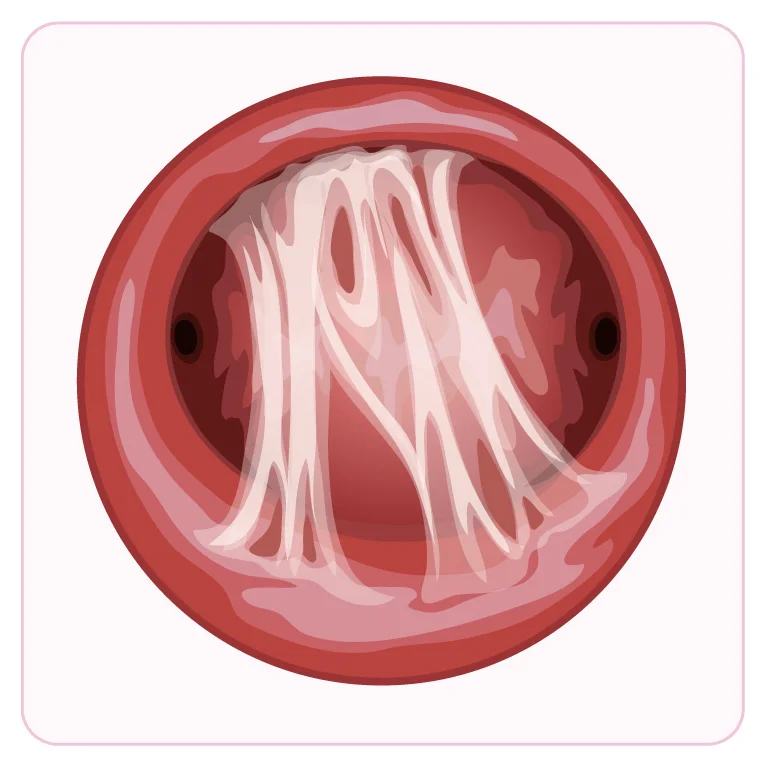
The most common complication was uterine perforation (0.76%); about half occurred when the instrument was being inserted. Other possible complications are:
- infection of the uterus or tubes (endometritis, salpingitis), which shows up a few days later as fever, pain and foul-smelling discharge;
- haemorrhage, which is rare;
- fluid overload: the fluid used to distend the uterus can pass into the bloodstream. The guidelines of the CNGOF (French College of Gynaecologists and Obstetricians) set a maximum tolerated volume (2,000 ml for saline, 1,000 ml for salt-free solutions) and a distension pressure below 120 mmHg; this volume is monitored continuously during the procedure;
- the formation of adhesions inside the uterus (synechiae), especially after resection of fibroids or a septum.
According to the same guidelines, when a perforation occurs with an electrical instrument, the procedure is stopped and a laparoscopy is performed to check that the bowel has not been injured.
Is any treatment needed after the procedure?
Usually not, apart from painkillers. The CNGOF guidelines do not recommend routine antibiotics for diagnostic hysteroscopy. Specific treatment may be prescribed in certain situations, for example hormone treatment after division of extensive adhesions. This will be explained to you on a case-by-case basis.
When is the follow-up appointment?
A post-operative consultation is used to go over the operative report, the result of the microscopic analysis (histopathology) of the tissue removed, and the next steps in your care. It generally takes place 4 to 6 weeks after the procedure (sooner if needed).
A follow-up hysteroscopy may be offered a few weeks later in certain situations: after treatment of adhesions, after resection of a septum or a large fibroid, or before an embryo transfer. It is often done in the consulting room, with a small-calibre hysteroscope.
When can I consider a pregnancy?
The waiting time depends on what was treated:
- after removal of a polyp, the endometrium heals quickly;
- after resection of a fibroid extending into the muscle, or of adhesions, a longer wait and sometimes a check of the uterine cavity are recommended.
The wait before a new pregnancy or an embryo transfer is discussed at the post-operative consultation.
Hysteroscopic resection of a submucosal fibroid does not generally create a scar comparable to that of an abdominal myomectomy; the question of a vaginal birth therefore arises differently. It is discussed during the consultation.
When should I seek urgent care?
Call 15 (SAMU) or 112 in France, or your local emergency number, or go to a gynaecological emergency department, in the event of:
- heavy bleeding: more than one pad soaked per hour for 2 hours, or repeated large clots;
- fever above 38 °C, shivering;
- severe abdominal pain that is increasing, or a hard abdomen;
- foul-smelling discharge;
- feeling faint, breathlessness, confusion, unusual headache or repeated vomiting in the hours following the procedure.
For a non-urgent question: the practice, on 01 43 79 59 79 (and outside opening hours, 15).
Would you like a medical opinion?Appointments in Paris 16th or 5th, or by video consultation.
Book an appointmentFrequently asked questions
Is it normal to have watery discharge after a hysteroscopy?
Yes. Some of the fluid used to distend the uterus drains out in the following hours, sometimes tinged with blood. This discharge decreases quickly.
Will my periods change?
The first periods after the procedure may be slightly delayed or heavier. After treatment of adhesions, absent periods should be reported, as they may indicate a recurrence. After endometrial resection for heavy periods, the periods are deliberately reduced.
Can I fly after operative hysteroscopy?
The procedure does not in itself rule out air travel after a few days. It is nonetheless sensible to avoid a long-distance trip in the first few days, the period when a complication is most likely to appear.
When will I get the result of the analysis?
The tissue removed is examined under the microscope. The result is given at the post-operative consultation, or earlier if it requires prompt management.
Can the hysteroscopy be repeated if necessary?
Yes. The procedure can be repeated, for example if a polyp or adhesions recur, or when a large fibroid is removed in two stages.
How much does operative hysteroscopy cost?
The fees for the procedure are set out in a written estimate, given to you at the consultation before the operation.
References
- Deffieux X, et al. Hysteroscopy: guidelines for clinical practice from the French College of Gynaecologists and Obstetricians. European Journal of Obstetrics & Gynecology and Reproductive Biology, 2014. doi:10.1016/j.ejogrb.2014.04.026 — PMID 24835861
- Jansen FW, et al. Complications of hysteroscopy: a prospective, multicenter study. Obstetrics and Gynecology, 2000. doi:10.1016/s0029-7844(00)00865-6 — PMID 10908775

Dr Olivier KadochObstetrician-gynaecologist and gynaecological surgeon in Paris, seeing patients in Paris 16th and at the Centre de la Femme Paris 5. Former chef de clinique-assistant (senior registrar) at the Paris public hospitals (AP-HP); individually accredited by the French National Authority for Health (HAS). RPPS 10003957809. Background and practice locations
A question about your situation?Appointments at the practice or by video consultation, usually within one week to 10 days.
Book an appointmentGeneral information article: it does not replace a medical consultation. In an emergency, call 15 or 112 in France, or your local emergency number.