Uterine adhesions (Asherman's syndrome): causes and treatment
In brief
Uterine adhesions (synechiae) are bands of scar tissue that stick the walls of the uterus together, most often after curettage or surgery on the uterine cavity; they are called Asherman’s syndrome when they cause symptoms such as lighter or absent periods, infertility or miscarriages. Hysteroscopy is the most accurate examination for diagnosis and also allows treatment, which consists of cutting the adhesions under direct vision. Recurrence is common, estimated at 30 to 66% of treated women according to the international AAGL/ESGE guidelines (American Association of Gynecologic Laparoscopists / European Society for Gynaecological Endoscopy), hence the importance of checking the cavity after the procedure.
What is a uterine adhesion?
The uterine cavity is lined by the endometrium, a mucous membrane with a superficial layer, shed with each cycle during periods, and a deep layer, called the basal layer, which allows it to rebuild. When this basal layer is damaged, the two sides of the cavity can heal against each other: this is an adhesion.
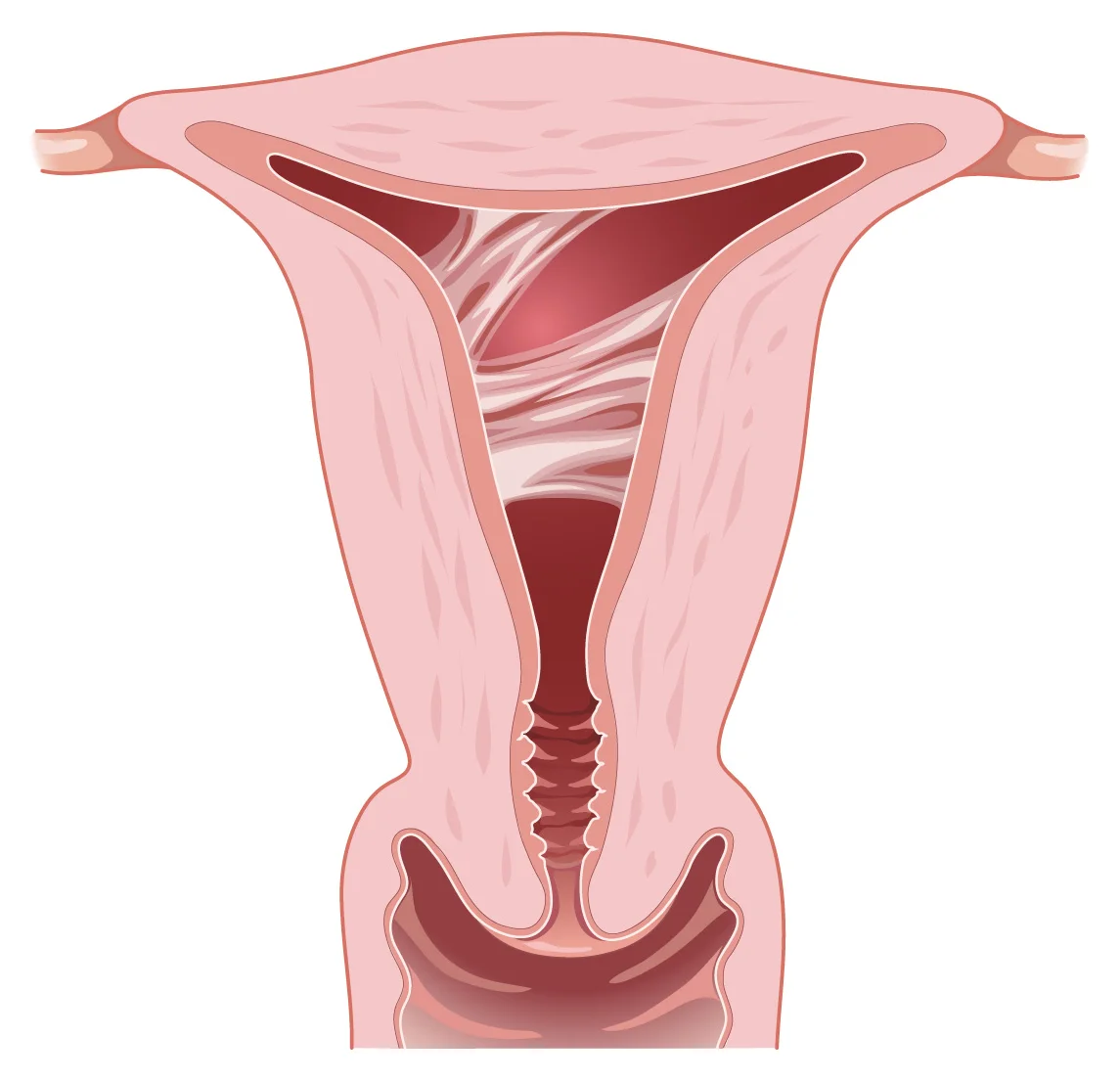
The adhesions may be:
- thin and limited, like simple strands;
- thick and fibrous, occupying part of the cavity;
- extensive, to the point of almost completely closing the cavity or the cervix.
The terms "uterine adhesions" and "Asherman’s syndrome" are often used interchangeably. The AAGL/ESGE guidelines reserve the term Asherman’s syndrome for adhesions associated with symptoms. Adhesions discovered by chance, causing no problems at all, do not necessarily have any consequences.
What are the causes?
The main cause is trauma to the endometrium, particularly in a uterus that has recently been pregnant, a period when the lining is very fragile.
| Circumstance | Examples |
|---|---|
| Procedure on a pregnant or recently pregnant uterus | Suction or curettage after miscarriage or termination of pregnancy; curettage for retained placenta or haemorrhage after childbirth |
| Surgery on the uterine cavity | Resection of submucosal fibroids, especially multiple ones; septum resection; myomectomy with opening of the cavity |
| Other treatments | Uterine artery embolisation; uterine compression sutures for postpartum haemorrhage |
| Infection | Endometritis (role debated) |
The AAGL/ESGE guidelines stress that the risk varies with the procedure: it is lowest after removal of a polyp, which only affects the lining, and highest after resection of several fibroids or of facing surfaces. The risk also seems higher when the procedure is performed "blind" (curettage) rather than under direct vision.
Which symptoms should suggest adhesions?
Symptoms often appear in the months following the procedure responsible:
- much lighter periods (hypomenorrhoea) or no periods (amenorrhoea), although the hormonal cycle is normal;
- cyclical pain at the time periods should occur, when the blood cannot flow out (haematometra);
- difficulty conceiving;
- recurrent miscarriages.
If periods are absent after curettage, a new pregnancy must first be ruled out, then adhesions looked for.
How is the diagnosis made?
The gynaecological examination is usually normal. The diagnosis relies on exploring the cavity.
| Examination | Role according to the AAGL/ESGE guidelines |
|---|---|
| Diagnostic hysteroscopy | Most accurate examination: shows the presence, extent and appearance of the adhesions and the condition of the endometrium |
| Hysterosalpingography | Alternative screening test; sensitivity of around 75 to 81%, but many false positives |
| Saline infusion sonography | Performance close to that of hysterosalpingography |
| 2D or 3D ultrasound | May point to the diagnosis (thin, interrupted endometrium); 3D ultrasound is more informative |
| MRI | Not recommended routinely for this diagnosis |
Diagnostic hysteroscopy can be performed in the consulting room, without anaesthesia, with a small-calibre instrument, according to the guidelines of the CNGOF (French College of Gynaecologists and Obstetricians); this is how it is performed at the practice. It also makes it possible to grade the adhesions according to their severity, which is useful because the prognosis depends on it.
Is treatment always needed?
No. Adhesions are not life-threatening. According to the AAGL/ESGE guidelines, treatment is offered when there are symptoms: pain, infertility, recurrent miscarriages, menstrual disorders or retention of blood in the uterus.
For a woman who wants to become pregnant but does not want a procedure, a spontaneous pregnancy remains possible, but it may take a long time.
How is the treatment carried out?
The recommended treatment is hysteroscopic adhesiolysis: the adhesions are cut under direct vision, using small scissors, the tip of the hysteroscope, or electrical or laser energy.
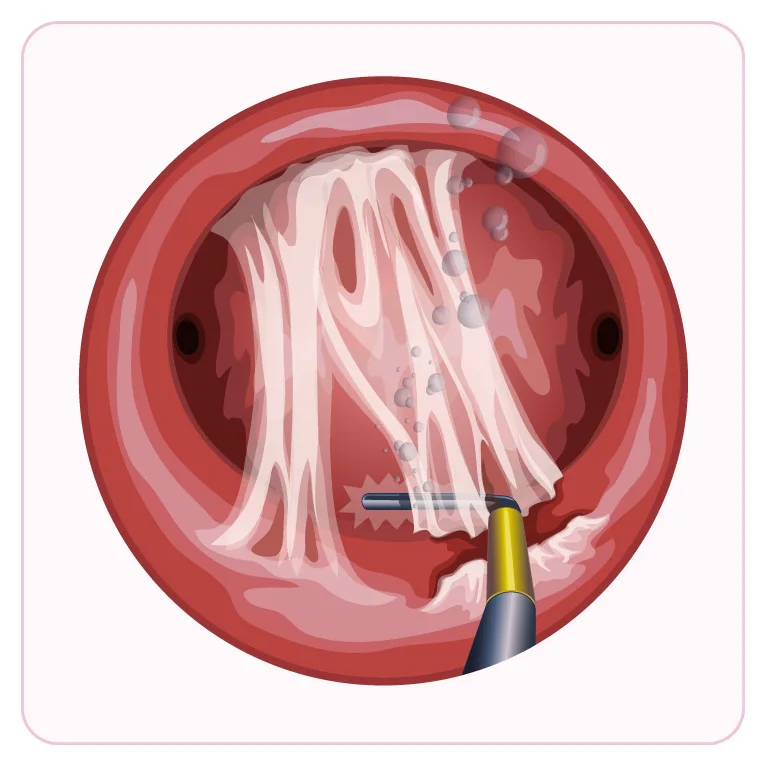
Principles of the procedure:
- it is performed through the natural passages, with no incision in the abdomen;
- mechanical instruments (scissors) are often preferred to limit further damage to the endometrium;
- mild adhesions can be treated in the consulting room; extensive forms require anaesthesia (most often general) and an experienced surgeon, and are treated at Hôpital privé Geoffroy Saint-Hilaire (Paris 5th), Clinique de la Muette (Paris 16th) or Clinique Ambroise Paré (Neuilly-sur-Seine);
- for severe forms, ultrasound or laparoscopic guidance may be added;
- "blind" curettage no longer has a role, as it neither shows the adhesions nor protects the remaining endometrium.
The denser and more lateral the adhesions, the more difficult the division and the higher the risk of perforation of the uterus; the usual recovery is described in the article on recovery after operative hysteroscopy.
How can the risk of recurrence be reduced?
Recurrence is common: around one woman in three for mild to moderate forms, and two in three for severe forms, according to the AAGL/ESGE guidelines. Several methods aim to prevent the walls from sticking together again during healing:
| Method | Principle | Level of evidence |
|---|---|---|
| Intrauterine balloon or catheter | Keeps the walls apart for a few days | Reduces adhesions; few data on fertility |
| Hyaluronic acid gel | Protective film over the lining | Reduces adhesions; effect on pregnancy unknown |
| Oestrogen treatment | Encourages regrowth of the endometrium | May reduce recurrence |
| Inert intrauterine device | Mechanical barrier | Copper or hormonal IUDs are not recommended for this indication |
A Cochrane review (low-quality evidence) found that these anti-adhesion treatments reduce the presence of adhesions at a second-look hysteroscopy (about one in nine treated women avoids a recurrence); no study has measured their effect on live births. The choice is made case by case and is discussed at the consultation.
Stem cell treatments or medicines intended to improve the blood supply to the endometrium remain at the research stage.
Why a second-look hysteroscopy?
Because recurrence is common and often has no symptoms at first, the AAGL/ESGE guidelines advise checking the cavity after treatment, preferably by hysteroscopy, usually after two to three cycles; the timing of this check is given to you at the post-operative consultation. If new adhesions are present, they can often be cut during the same examination, as long as they are still thin.
What are the chances of pregnancy after treatment?
The prognosis depends mainly on the initial severity and the quality of the remaining endometrium. The available data are mainly retrospective. In a series of 683 women with moderate to severe adhesions, reported in the AAGL/ESGE guidelines, 66% of those trying to conceive became pregnant, and 61% of these pregnancies resulted in a live birth.
After treatment of severe adhesions, the pregnancy must be followed carefully: the risk of abnormal placental attachment (placenta accreta), miscarriage and premature birth is higher. The interval before a new pregnancy is discussed at the post-operative consultation.
How can adhesions be prevented?
- When a procedure is needed on a recently pregnant uterus, prefer a technique under direct vision to "blind" curettage.
- For hysteroscopic surgery, limit the use of electrical energy on healthy endometrium.
- After high-risk surgery (multiple fibroids, septum), discuss an anti-adhesion method and a check of the cavity.
Would you like a medical opinion?Appointments in Paris 16th or 5th, or by video consultation.
Book an appointmentFrequently asked questions
Can you have adhesions without any symptoms?
Yes. Small adhesions can be discovered by chance during a hysteroscopy. Without symptoms or plans for pregnancy, they do not necessarily need treatment.
Can adhesions disappear on their own?
Thin adhesions can sometimes give way during a simple hysteroscopy, as distending the cavity is enough to break them. Thick adhesions do not disappear spontaneously.
Does curettage always cause adhesions?
No. Most women do not develop them. The risk is higher when the procedure is performed on a recently pregnant uterus and "blind".
Are several procedures needed?
For mild forms, a single procedure is often enough. For severe forms, several hysteroscopies may be needed to obtain a normal cavity.
Is IVF a solution if adhesions recur?
IVF does not get around the problem, because the embryo must implant in the endometrium. The aim is therefore first to restore a cavity and endometrium of good quality.
Can you get pregnant with uterine adhesions?
Yes, a natural pregnancy is still possible, but it may take a long time. After treatment, in a series of 683 women with moderate to severe adhesions reported in the AAGL/ESGE guidelines, 66% of those trying to conceive became pregnant. The timing of a new pregnancy is discussed at the post-operative appointment.
References
- AAGL Elevating Gynecologic Surgery. AAGL practice report: practice guidelines on intrauterine adhesions developed in collaboration with the European Society of Gynaecological Endoscopy (ESGE). Gynecological Surgery, 2017. doi:10.1186/s10397-017-1007-3 — PMID 28603474
- Bosteels J, et al. Anti-adhesion therapy following operative hysteroscopy for treatment of female subfertility. Cochrane Database of Systematic Reviews, 2017. doi:10.1002/14651858.CD011110.pub3 — PMID 29178172
- Deffieux X, et al. Hysteroscopy: guidelines for clinical practice from the French College of Gynaecologists and Obstetricians. European Journal of Obstetrics & Gynecology and Reproductive Biology, 2014. doi:10.1016/j.ejogrb.2014.04.026 — PMID 24835861

Dr Olivier KadochObstetrician-gynaecologist and gynaecological surgeon in Paris, seeing patients in Paris 16th and at the Centre de la Femme Paris 5. Former chef de clinique-assistant (senior registrar) at the Paris public hospitals (AP-HP); individually accredited by the French National Authority for Health (HAS). RPPS 10003957809. Background and practice locations
A question about your situation?Appointments at the practice or by video consultation, usually within one week to 10 days.
Book an appointmentGeneral information article: it does not replace a medical consultation. In an emergency, call 15 or 112 in France, or your local emergency number.