Septate uterus: diagnosis, miscarriage and septum resection
In brief
A septate uterus is a congenital malformation in which a wall of tissue, the septum, partly or completely divides the uterine cavity, while the outer shape of the uterus is normal. Three-dimensional ultrasound is the examination recommended by the European ESHRE/ESGE consensus to make the diagnosis in a woman with symptoms. In the international randomised TRUST trial, published in 2021, hysteroscopic resection of the septum did not increase the live birth rate (31% after surgery versus 35% without surgery), which led to questioning an operation that had long been offered routinely.
What is a septate uterus?
During embryonic life, the uterus forms from two ducts (the Müllerian ducts), which fuse and whose shared wall then disappears to form a single cavity. If this central wall is not completely reabsorbed, a septum remains: this is the septate uterus.
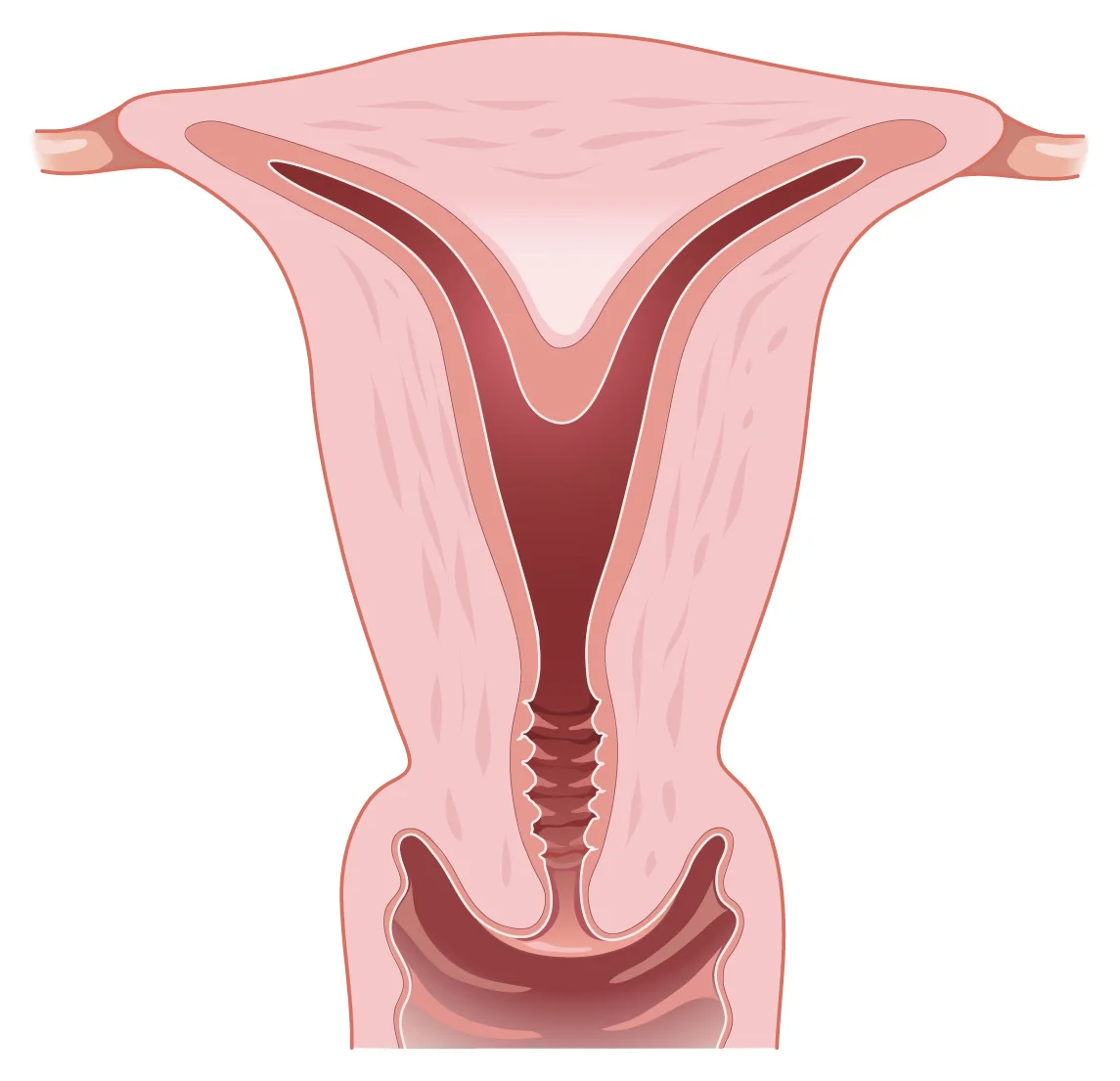
It is the most common uterine malformation. It is often discovered:
- during investigations for recurrent miscarriage;
- during an infertility work-up or before IVF;
- on a pregnancy ultrasound or one performed for another reason;
- sometimes at delivery (breech presentation, for example).
Many women with a septate uterus have no symptoms and have normal pregnancies.
How does the ESHRE/ESGE classification define a septum?
The consensus of the European Society of Human Reproduction and Embryology (ESHRE) and the European Society for Gynaecological Endoscopy (ESGE), published in 2013, proposed a classification based on anatomy. Malformations of the uterine body are divided into classes from U0 (normal uterus) to U6.
| Class | Name | Simplified description |
|---|---|---|
| U0 | Normal uterus | — |
| U1 | Dysmorphic uterus | Abnormal shape of the cavity (T-shaped, infantile), without a septum |
| U2 | Septate uterus | Normal outer contour, internal septum |
| U2a | Partial septum | The septum does not extend down to the cervix |
| U2b | Complete septum | The septum divides the cavity down to the cervix |
| U3 | Bicorporeal uterus (formerly bicornuate) | Indented outer contour |
| U4 | Hemi-uterus | Only one side developed |
| U5 | Aplastic uterus | Uterus absent or rudimentary |
| U6 | Unclassified | Anomaly that fits no other class |
The cervix and vagina are described separately: a septum may also be present in the cervix or the vagina.
In this classification, the uterus is called septate when the internal indentation exceeds 50% of the thickness of the uterine wall, with a normal outer contour. This definition differs from that of other learned societies (notably American ones), which are more restrictive: the same uterus may therefore be described as "septate" or "normal" depending on the system used.
How is the diagnosis made?
The Thessaloniki consensus (ESHRE/ESGE, 2015) sets out the diagnostic approach:
| Situation | Recommended examination |
|---|---|
| Woman without symptoms | Gynaecological examination and 2D ultrasound |
| Woman at risk (miscarriages, infertility) or suspected abnormality | 3D ultrasound |
| Complex malformation or diagnostic doubt | MRI and/or endoscopy (hysteroscopy, laparoscopy) |
3D ultrasound is the key examination: it reconstructs a "coronal" view of the uterus that shows both the cavity and the outer contour at the same time, making it possible to distinguish a septate uterus (normal outer contour) from a bicorporeal uterus (indented contour). This distinction used to be one of the main reasons for laparoscopy. 3D ultrasound is available at the practice.
Hysteroscopy shows the septum from the inside but gives no information on the outer shape of the uterus; hysterosalpingography has similar limitations. The consensus stresses that examinations should be performed and interpreted by experienced operators to avoid diagnostic errors, in either direction.
Does a uterine septum cause miscarriages?
Observational studies link a septate uterus with a higher risk of:
- miscarriage, particularly early miscarriage;
- preterm birth;
- abnormal presentation of the baby (breech);
- difficulty conceiving, less clearly.
The explanation often put forward is a poorer blood supply to the septum, which would hinder implantation of the embryo. These associations do not, however, prove that the septum is the cause, nor that removing it corrects this risk. That is precisely the question addressed by the TRUST trial.
What does the TRUST trial show?
The TRUST trial is the first randomised trial to have compared septum resection with no intervention in women wishing to become pregnant.
| Item | Trial data |
|---|---|
| Locations | 10 centres in the Netherlands, the United Kingdom, the United States and Iran, 2010–2018 |
| Women included | 80 women with a septate uterus and a history of infertility, miscarriage or preterm birth |
| Comparison | Hysteroscopic septum resection (n = 40) versus expectant management (n = 40) |
| Primary outcome | Live birth within 12 months |
| Result | 31% after surgery versus 35% without surgery (relative risk 0.88; 95% CI 0.47–1.65) |
| Complication | 1 uterine perforation in 39 operations (2.6%) |
The authors conclude that septum resection did not improve reproductive outcomes, consistent with a large cohort study published shortly before. They acknowledge a limitation: the number of participants remains modest, and recruitment took a long time.
Should a uterine septum still be operated on?
These results suggest no longer offering septum resection routinely. The decision is made case by case, with a clear explanation of current knowledge:
Arguments for not operating:
- no demonstrated improvement in the birth rate in the randomised trial;
- a low but real surgical risk (perforation, intrauterine adhesions);
- incidental finding in a woman with no relevant history.
Situations in which surgery may still be discussed:
- recurrent or late miscarriages with no other cause found after a full work-up;
- the patient's wish, once informed that there is no evidence of benefit.
A septum discovered by chance in a woman who has never had any difficulty does not, as a rule, justify surgery.
How is septum resection carried out?
When it is chosen, septum resection (also called septoplasty or hysteroscopic metroplasty) is performed by operative hysteroscopy, through the natural passages:
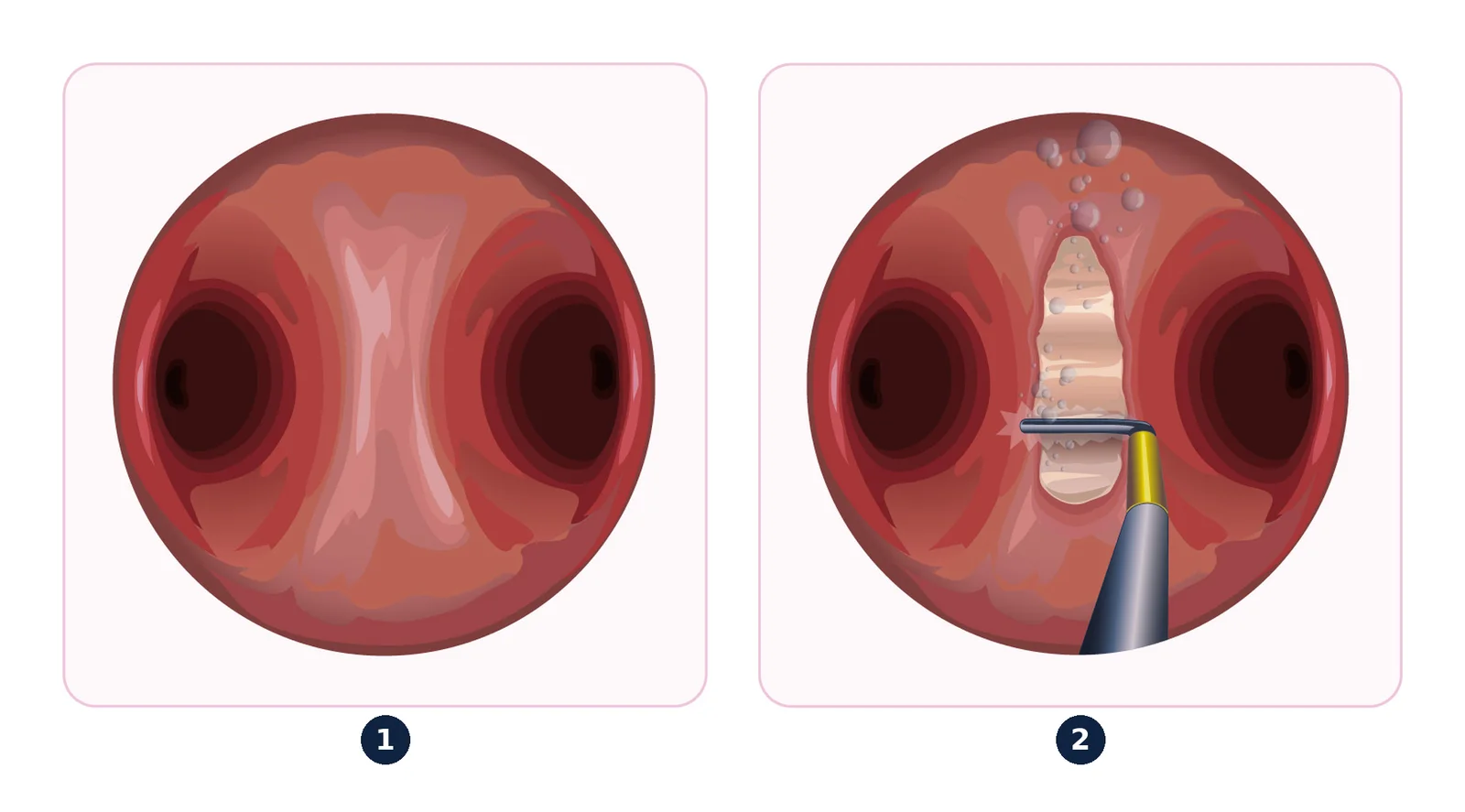
- the septum is incised from the bottom upwards, with scissors, an electrode or a laser, until the cavity has a normal shape;
- the septum is not removed but divided; its two halves retract into the walls;
- the procedure is performed under anaesthesia, general in most cases, most often as day surgery, at Hôpital privé Geoffroy Saint-Hilaire (Paris 5th), Clinique de la Muette (Paris 16th) or Clinique Ambroise Paré (Neuilly-sur-Seine);
- a follow-up hysteroscopy may be offered to check the cavity and the absence of adhesions.
The risks are those of operative hysteroscopy: perforation, bleeding, infection, and formation of adhesions (synechiae). Recovery is detailed in the article Operative hysteroscopy: recovery. The interval before a new pregnancy is discussed at the post-operative consultation.
And during pregnancy?
A woman with a septate uterus, whether operated on or not, can carry a pregnancy to term. Follow-up may pay particular attention to:
- the baby's presentation at the end of pregnancy;
- signs of threatened preterm labour;
- fetal growth.
The mode of delivery is discussed according to the obstetric situation; a septate uterus does not in itself require a caesarean.
Frequently asked questions
Are a septate uterus and a bicornuate uterus the same thing?
No. In a septate uterus, the outer shape is normal and only the cavity is divided. In a bicorporeal uterus (formerly "bicornuate"), the outer contour of the uterus is itself indented. The latter is not treated by hysteroscopy.
Does a uterine septum prevent pregnancy?
No, most women with a septum conceive without difficulty. Its role in infertility is debated and not clearly established.
Should the septum be removed before IVF?
This is no longer routine. The TRUST trial, which included infertile women, showed no benefit. The decision depends on each woman's history and is made after she has been informed of these data.
Can a septum be discovered during pregnancy?
Yes, particularly on the first-trimester ultrasound. No surgery is performed during pregnancy; the situation is reassessed afterwards if necessary.
Are uterine malformations hereditary?
They most often occur in isolation. A check for kidney malformations may be offered for certain uterine malformations, because the two develop at the same time in the embryo.
References
- Grimbizis GF, et al. The ESHRE/ESGE consensus on the classification of female genital tract congenital anomalies. Human Reproduction, 2013. doi:10.1093/humrep/det098 — PMID 23771171
- Grimbizis GF, et al. The Thessaloniki ESHRE/ESGE consensus on diagnosis of female genital anomalies. Human Reproduction, 2015. doi:10.1093/humrep/dev264 — PMID 26537921
- Rikken JFW, et al. Septum resection versus expectant management in women with a septate uterus: an international multicentre open-label randomized controlled trial. Human Reproduction, 2021. doi:10.1093/humrep/deab037 — PMID 33793794

Dr Olivier KadochObstetrician-gynaecologist and gynaecological surgeon in Paris (16th and 5th arrondissements). Former chef de clinique-assistant (senior registrar) at the Paris public hospitals (AP-HP); individually accredited by the French National Authority for Health (HAS). RPPS 10003957809. Background and practice locations
A question about your situation?Appointments at the practice or by video consultation, usually within one week to 10 days.
Book an appointmentGeneral information article: it does not replace a medical consultation. In an emergency, call 15 or 112 in France, or your local emergency number.