Bleeding after menopause: possible causes and tests
In brief
Any vaginal bleeding after menopause (postmenopausal bleeding), even slight or one-off, should be checked by a doctor promptly. The cause is usually benign (thinning of the lining, polyp, hormone therapy), but around 9% of these bleeds reveal endometrial cancer. A pelvic ultrasound is the first test; a biopsy or hysteroscopy is carried out if the endometrium is thickened or the bleeding comes back.
Why should bleeding after menopause always be investigated?
Menopause is defined as no periods for 12 consecutive months. After that, the endometrium (the lining of the uterus) no longer bleeds normally. Any bleeding, even a light pink or brownish trace, a single episode or bleeding after sex, is therefore abnormal.
Most causes are benign. But bleeding is the main warning sign of endometrial cancer: a meta-analysis of more than 40,000 women shows that 91% of endometrial cancers present with postmenopausal bleeding, and that 9% of women who bleed have endometrial cancer. Seeing a doctor early means these cancers are diagnosed at a stage when they can usually be cured. Our gynaecological cancer care page explains this care in more detail.
What causes bleeding after menopause?
| Cause | What points to it | Usual management |
|---|---|---|
| Vaginal or endometrial atrophy | Light bleeding, often after sex or exertion, with dryness and burning | Moisturisers, local oestrogen once another cause has been ruled out |
| Menopausal hormone therapy | Irregular bleeding, especially in the first months or after a change of treatment | Ultrasound, adjustment of treatment; investigation if it persists |
| Endometrial or cervical polyp | Irregular bleeding or brownish discharge | Removal by operative hysteroscopy and laboratory analysis |
| Endometrial hyperplasia | Thickened endometrium, excess weight, oestrogen without progestogen, tamoxifen | Biopsy; treatment depending on whether atypia is present |
| Endometrial cancer | Bleeding, even slight; thickened endometrium on ultrasound | Biopsy, then staging and treatment in a specialist centre |
| Cancer of the cervix, vulva or vagina | Bleeding after sex, visible lesion | Examination, smear test and biopsy of the lesion |
| Medicines | Anticoagulants, antiplatelet drugs | They make bleeding more likely but do not remove the need for investigation |
Submucosal fibroids, common before menopause, usually shrink afterwards and are a less frequent cause. Bleeding can also come from the urinary tract or the rectum: the doctor checks where it comes from.
What tests are done for postmenopausal bleeding?
- Consultation and gynaecological examination: time since menopause, treatments (hormones, tamoxifen, anticoagulants), medical history; speculum examination of the vulva, vagina and cervix to look for a lesion or atrophy.
- Pelvic and transvaginal ultrasound: this is the first-line test. It measures the thickness of the endometrium and looks for a polyp, a fibroid or an ovarian abnormality.
- Endometrial biopsy: a sample taken with a thin tube passed through the cervix, during the appointment. Analysis under the microscope confirms or rules out cancer.
- Diagnostic hysteroscopy: a thin camera passed through the cervix shows the inside of the uterus and allows targeted samples. It is used if a biopsy is not possible or inconclusive, or if a localised lesion is suspected.
- Saline infusion sonography: an ultrasound with saline injected into the uterus, which gives a clearer view of a polyp.
- Cervical smear test if screening is not up to date. It screens for cervical lesions but does not examine the endometrium: a normal smear does not rule out endometrial cancer.
What does endometrial thickness on ultrasound mean?
In a postmenopausal woman who is bleeding, a thin endometrium is reassuring. French guidelines (French College of Gynaecologists and Obstetricians, CNGOF, and GEMVi, 2021), written for bleeding on menopausal hormone therapy, use a threshold of 4 mm: after a single episode with an endometrium of 4 mm or less, monitoring is possible; above 4 mm, or if bleeding recurs, further investigations (hysteroscopy and analysis of the endometrium) are recommended.
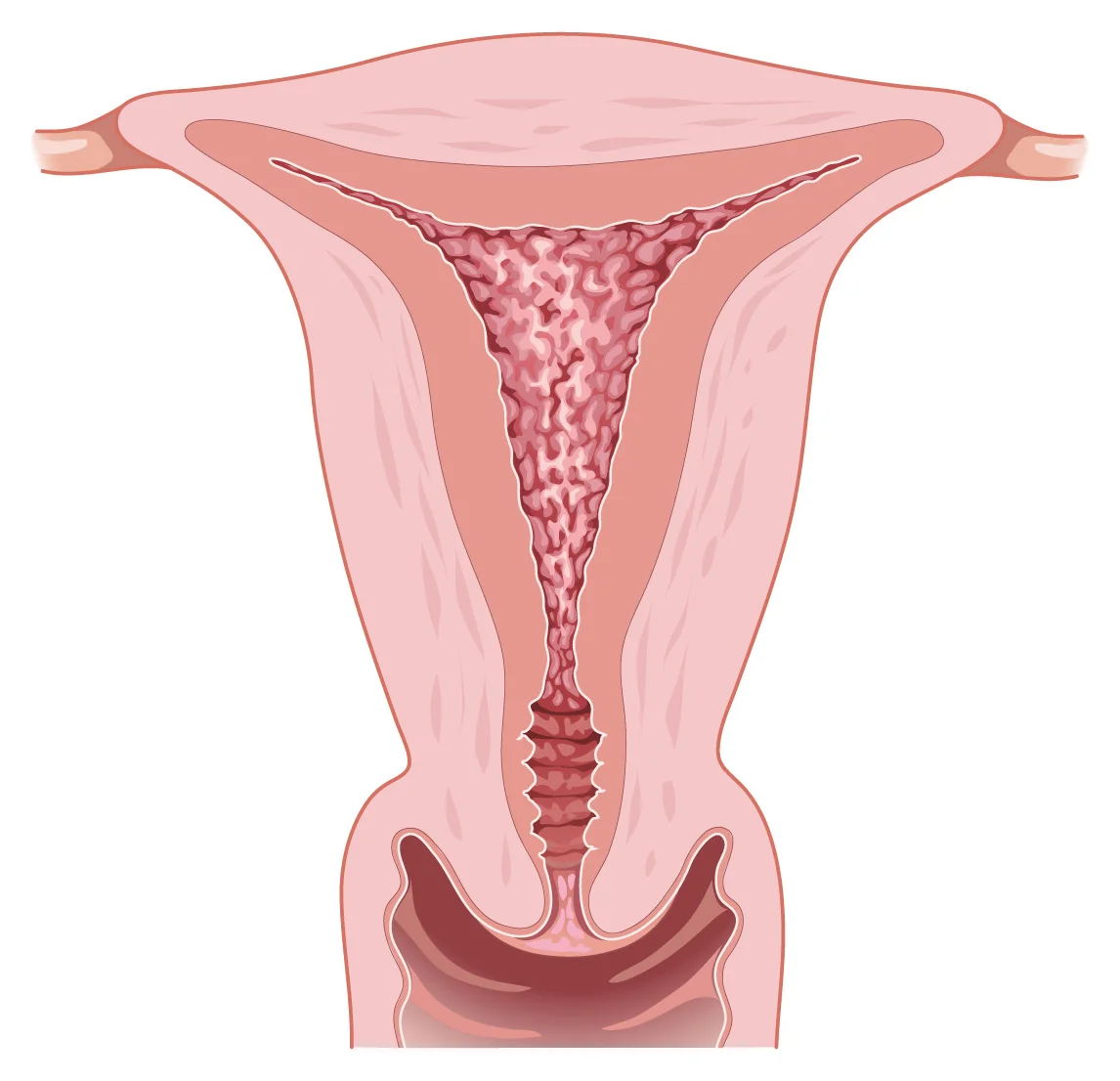
This threshold has limits: it is less reliable on sequential hormone therapy (the scan is then done at the end of the progestogen phase), on tamoxifen, or when the endometrium is hard to see. Bleeding that persists or comes back must be investigated, whatever the thickness measured.
What increases the risk of endometrial cancer?
Some situations make investigation all the more important, because they expose the endometrium to unopposed oestrogen or to an inherited predisposition:
- overweight and obesity, the most important factor: after menopause, fat tissue continues to produce oestrogen;
- diabetes and high blood pressure;
- oestrogen taken without a progestogen by a woman who still has her uterus;
- tamoxifen, used after breast cancer, which stimulates the endometrium;
- late menopause, never having been pregnant, polycystic ovary syndrome;
- family predisposition, particularly Lynch syndrome (bowel and endometrial cancers in the family, often at a young age).
On tamoxifen, the endometrium often looks thickened on ultrasound without any disease, which makes interpretation more difficult: any bleeding should be reported to your gynaecologist and your oncologist. Follow-up after cancer is covered in our article on follow-up after uterine cancer.
How is postmenopausal bleeding treated?
- Atrophy: vaginal moisturisers, lubricants, low-dose vaginal oestrogen once the diagnosis is confirmed (see vaginal dryness).
- Bleeding on hormone therapy: checking the treatment is taken correctly, adjusting the regimen; repeated bleeding is investigated.
- Polyp: removal by operative hysteroscopy, through the vagina with no incision, with routine analysis of the polyp.
- Hyperplasia: progestogen treatment and monitoring, or hysterectomy depending on atypia and the overall situation.
- Endometrial cancer: staging (notably pelvic MRI), then treatment, most often surgery (hysterectomy with removal of the ovaries and tubes, assessment of the lymph nodes), sometimes followed by radiotherapy or other treatments. The decision is made at a multidisciplinary team meeting, in line with European guidelines.
At the practice: the average waiting time for an appointment is one week to 10 days (except during holiday periods); the ultrasound and, if needed, diagnostic hysteroscopy can be carried out at the practice.
When is postmenopausal bleeding an emergency?
Bleeding after menopause calls for a prompt appointment, within a few days. Go to A&E or, in France, call 15 (SAMU) or 112 (or your local emergency number) if you have:
- heavy bleeding (soaking a pad in less than an hour, large clots);
- faintness, pallor, breathlessness, palpitations;
- severe abdominal pain or fever;
- heavy bleeding while on anticoagulants.
Outside these situations, do not let several weeks go by: note the date, amount and circumstances of the bleeding, as well as your current treatments, and bring this information to your appointment.
Frequently asked questions
Should I see a doctor for a single small spot of blood after menopause?
Yes. Even slight, one-off bleeding after menopause should be reported and investigated, at the very least with an examination and a pelvic ultrasound.
Is a normal smear test enough to reassure me?
No. A smear test screens for lesions of the cervix, not of the endometrium. It does not replace an ultrasound or an endometrial biopsy.
Is bleeding on menopausal hormone therapy normal?
Bleeding can occur at the start of treatment or depending on the regimen used. It should still be reported: an ultrasound is done, and further tests are offered if it persists or the endometrium is thickened.
Can the bleeding come from somewhere other than the uterus?
Yes. Atrophy of the vagina or vulva, a lesion of the cervix, or bleeding from the urinary tract or haemorrhoids can be mistaken for it. A clinical examination helps identify where the bleeding comes from.
Is an endometrial biopsy painful?
It causes a brief cramp, similar to period pain. It is done during the appointment, without general anaesthesia; you may be advised to take a painkiller beforehand.
References
- Clarke MA, et al. Association of Endometrial Cancer Risk With Postmenopausal Bleeding in Women: A Systematic Review and Meta-analysis. JAMA Internal Medicine, 2018. doi:10.1001/jamainternmed.2018.2820 — PMID 30083701
- Hamdaoui N, et al. Prise en charge des effets indésirables sous traitement hormonal de la ménopause : saignements utérins anormaux. Recommandations pour la pratique clinique du CNGOF et du GEMVi. [Management of abnormal uterine bleeding on menopausal hormone therapy: CNGOF and GEMVi guidelines] Gynécologie Obstétrique Fertilité & Sénologie, 2021. doi:10.1016/j.gofs.2021.03.028 — PMID 33757921
- Concin N, et al. ESGO-ESTRO-ESP guidelines for the management of patients with endometrial carcinoma: update 2025. The Lancet Oncology, 2025. doi:10.1016/S1470-2045(25)00167-6 — PMID 40744042

Dr Olivier KadochObstetrician-gynaecologist and gynaecological surgeon in Paris (16th and 5th arrondissements). Former chef de clinique-assistant (senior registrar) at the Paris public hospitals (AP-HP); individually accredited by the French National Authority for Health (HAS). RPPS 10003957809. Background and practice locations
A question about your situation?Appointments at the practice or by video consultation, usually within one week to 10 days.
Book an appointmentGeneral information article: it does not replace a medical consultation. In an emergency, call 15 or 112 in France, or your local emergency number.