Overdue pregnancy: definition, risks and care
In brief
A pregnancy is called prolonged from 41 weeks of pregnancy (weeks of amenorrhoea) and post-term from 42 weeks. The risk for the baby increases gradually day by day. This is why close monitoring starts at 41 weeks and induction of labour is usually offered between 41 weeks and 42 weeks + 6 days.
When is a pregnancy considered overdue?
A pregnancy lasts between 40 weeks and 41 weeks + 3 days of pregnancy (weeks of amenorrhoea). The French College of Gynaecologists and Obstetricians (CNGOF) uses three benchmarks. A birth is called term between 37 weeks and 41 weeks + 6 days. A pregnancy is called prolonged from 41 weeks. A post-term pregnancy as such begins at 42 weeks. For an overview of giving birth, see our page Giving birth in Paris.
In France, 15 to 20% of pregnant women reach 41 weeks, and about 1% go beyond 42 weeks.
Why a reliable pregnancy start date matters
Everything depends on the date the pregnancy started. It is set by the first-trimester scan, done between 11 weeks and 13 weeks + 6 days, by measuring the embryo's crown-rump length. This dating takes priority over the date of your last period, because it avoids wrongly believing that a pregnancy is prolonged and inducing labour for no reason. After IVF, the pregnancy start date is calculated from the egg collection.
Who is most likely to have an overdue pregnancy?
A prolonged pregnancy can happen to any woman, without any cause being found. However, some factors are more often associated with it:
- a first pregnancy;
- a previous prolonged pregnancy;
- being overweight or obese before pregnancy;
- a dating error, when no early scan was done.
Maternal age has sometimes been suggested, but studies disagree. Having one of these factors does not mean your pregnancy will go past term. Monitoring is the same for everyone from 41 weeks.
What are the risks of going overdue for baby and mother?
From 37 weeks, some risks increase steadily, without any sudden threshold. According to the CNGOF, perinatal mortality rises from about 0.7 per 1,000 at 37 weeks to 5.8 per 1,000 at 43 weeks. These figures remain low, but their increase justifies monitoring.
| Risk | What it means |
|---|---|
| Meconium aspiration | The baby passes its first stools (meconium) into the amniotic fluid and may breathe them in at birth. This risk increases between 38 and 42 weeks. |
| Reduced amniotic fluid | It may be a sign that the placenta is working less well and justifies an earlier birth. |
| Acidosis and low Apgar score | Signs of a lack of oxygen during labour. They become gradually more frequent after 38 weeks. |
| Large baby (macrosomia) | The baby keeps growing, which can make the birth more difficult (shoulder dystocia, tears). |
| Post-maturity syndrome | Rare: dry, wrinkled skin, loss of fat under the skin. The risk is higher if the baby was already small for its age. |
For the mother, the CNGOF states that the caesarean rate, especially for emergency caesareans, is about 1.5 times higher in a prolonged pregnancy. Perineal tears and haemorrhage after birth are also more frequent when the baby is large.
How is an overdue pregnancy monitored after 41 weeks?
From 41 weeks, the maternity unit offers monitoring two to three times a week, according to the CNGOF. Each visit includes:
- a recording of the baby's heart rate (CTG monitoring) for about thirty minutes;
- an ultrasound scan to measure the deepest pool of amniotic fluid;
- a clinical examination: blood pressure, fundal height, examination of the cervix.
The CNGOF recommends measuring the deepest pool rather than the amniotic fluid index (the sum of four measurements), because the latter leads to more inductions and caesareans without improving the babies' condition. Likewise, the Manning biophysical profile is no longer recommended for monitoring a prolonged pregnancy, for the same reasons. Umbilical artery Doppler is only useful in specific situations, for example when the baby is small for its age.
Between two checks, pay attention to your baby's movements. The arrangements for this monitoring are explained to you by the maternity unit where you are registered (Maternité Sainte-Félicité or Clinique Sainte-Thérèse).
When should labour be induced if I am overdue?
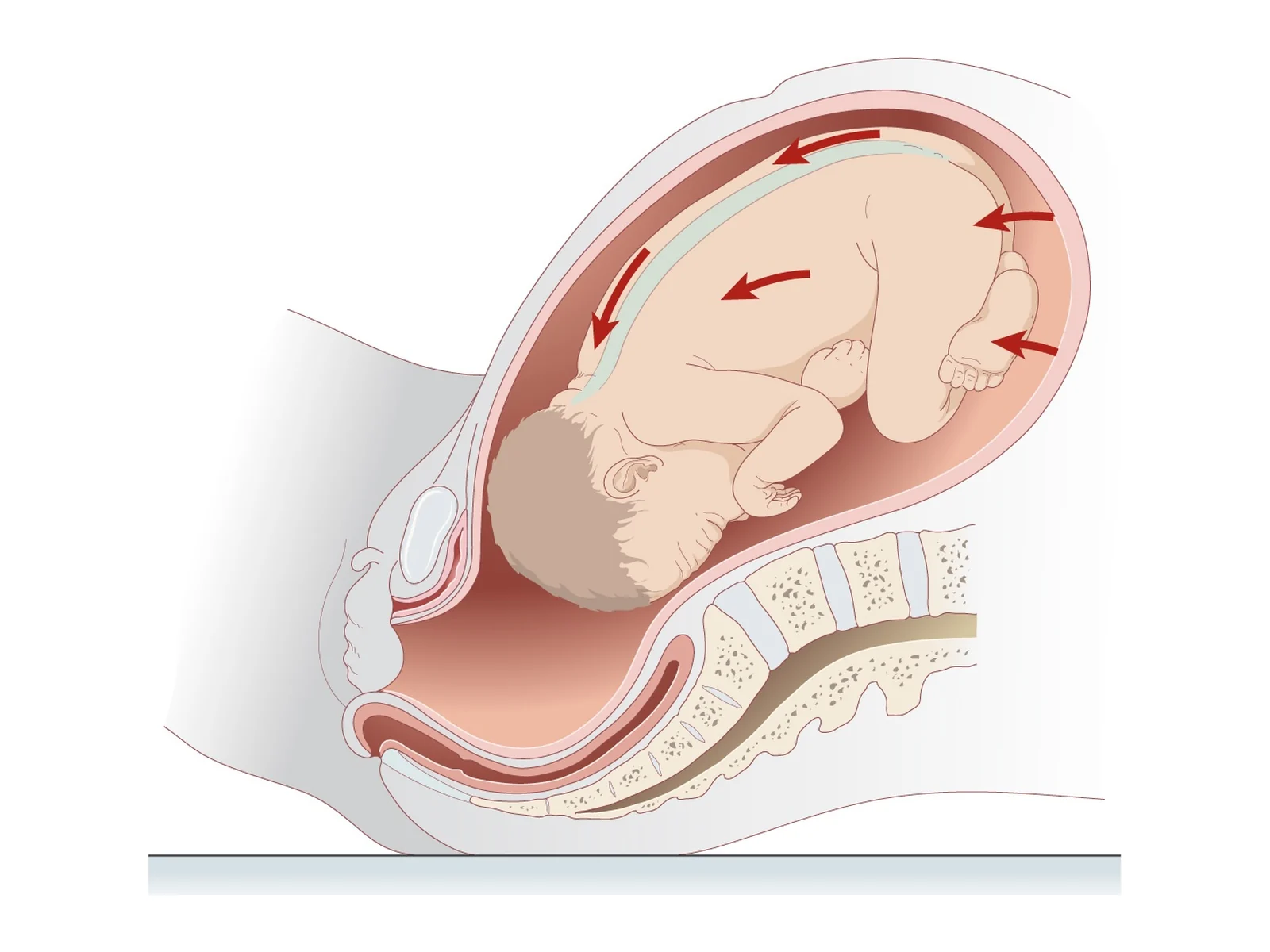
If there is no particular problem, the CNGOF states that induction can be offered between 41 weeks and 42 weeks + 6 days. The exact timing is decided with you, according to the state of your cervix, the monitoring results and your wishes. Waiting beyond 42 weeks carries a higher risk for the baby. This risk must be explained to you and weighed against the drawbacks of induction.
A 2020 Cochrane review of more than 21,000 low-risk women compared induction, most often after 41 weeks, with waiting. Induction was associated with fewer perinatal deaths (0.4 versus 3 per 1,000), slightly fewer caesareans and fewer admissions to neonatal intensive care. It did not increase the use of forceps or ventouse.
Dr Kadoch, who delivers his patients' babies at the Maternité Sainte-Félicité and the Clinique Sainte-Thérèse, discusses this timeline with you from the 9th-month appointment.
How is labour induced?
The method depends mainly on the state of the cervix, assessed by the Bishop score (dilation, length, consistency and position of the cervix, and the height of the baby's head).
- Membrane sweep: during a vaginal examination, the midwife or doctor gently separates the membranes around the cervix. This increases the chances of labour starting naturally within the week. It reduces the need for induction without increasing the risk of infection or caesarean.
- Ripening the cervix if it is closed or not favourable: vaginal prostaglandins (gel or slow-release device), low-dose misoprostol, or a balloon placed in the cervix (mechanical method). Misoprostol must not be used if you have a scar on the uterus.
- Induction itself if the cervix is favourable: artificial breaking of the waters and an oxytocin drip.
Induction does not mean a caesarean. In most cases, the baby is born vaginally (see what happens during a vaginal birth). A caesarean section remains indicated if a problem appears during monitoring or labour, or if a vaginal birth is not advisable.
When should I go to the maternity unit straight away?
Even between two scheduled checks, go immediately to the emergency department of your maternity unit if:
- your baby is moving less or has stopped moving;
- you are leaking fluid (your waters have broken), especially if it is green or brown;
- you are bleeding;
- you have a fever, a severe headache, blurred vision or pain under the ribs;
- you have regular, painful contractions.
If you feel faint or have heavy bleeding, call 15 or 112 in France, or your local emergency number.
Frequently asked questions
Is the due date at 41 weeks?
In France, the estimated due date is usually set at 41 weeks of pregnancy, which is 39 weeks after conception. Close monitoring therefore often starts on the due date itself.
Can I refuse induction of labour?
Yes. You can choose to continue monitoring after being informed of the risks. Beyond 42 weeks, the risk to the baby increases, and the team will explain this again at each check.
Can natural methods bring on labour?
No so-called natural method has been shown to work well enough to replace medical monitoring. A membrane sweep, done by a professional, is the only simple method with proven benefit.
Is induced labour more painful than spontaneous labour?
Contractions can be more intense when oxytocin is used. An epidural is available just as in spontaneous labour.
References
- Vayssière C, et al. Prolonged and post-term pregnancies: guidelines for clinical practice from the French College of Gynecologists and Obstetricians (CNGOF). Eur J Obstet Gynecol Reprod Biol, 2013. doi:10.1016/j.ejogrb.2013.01.026 — PMID 23434325
- Middleton P, et al. Induction of labour at or beyond 37 weeks' gestation. Cochrane Database Syst Rev, 2020. doi:10.1002/14651858.CD004945.pub5 — PMID 32666584

Dr Olivier KadochObstetrician-gynaecologist and gynaecological surgeon in Paris (16th and 5th arrondissements). Former chef de clinique-assistant (senior registrar) at the Paris public hospitals (AP-HP); individually accredited by the French National Authority for Health (HAS). RPPS 10003957809. Background and practice locations
A question about your situation?Appointments at the practice or by video consultation, usually within one week to 10 days.
Book an appointmentGeneral information article: it does not replace a medical consultation. In an emergency, call 15 or 112 in France, or your local emergency number.