Caesarean section: reasons, procedure and recovery
In brief
A caesarean section delivers the baby through an incision in the abdomen and uterus, most often under spinal or epidural anaesthesia, so the mother stays awake. It is planned when a vaginal birth carries more risks than benefits (placenta covering the cervix, three or more previous caesareans, a scar on the body of the uterus), or decided as an emergency during labour. After a caesarean, a vaginal birth is still possible in most cases.
What is a caesarean section?
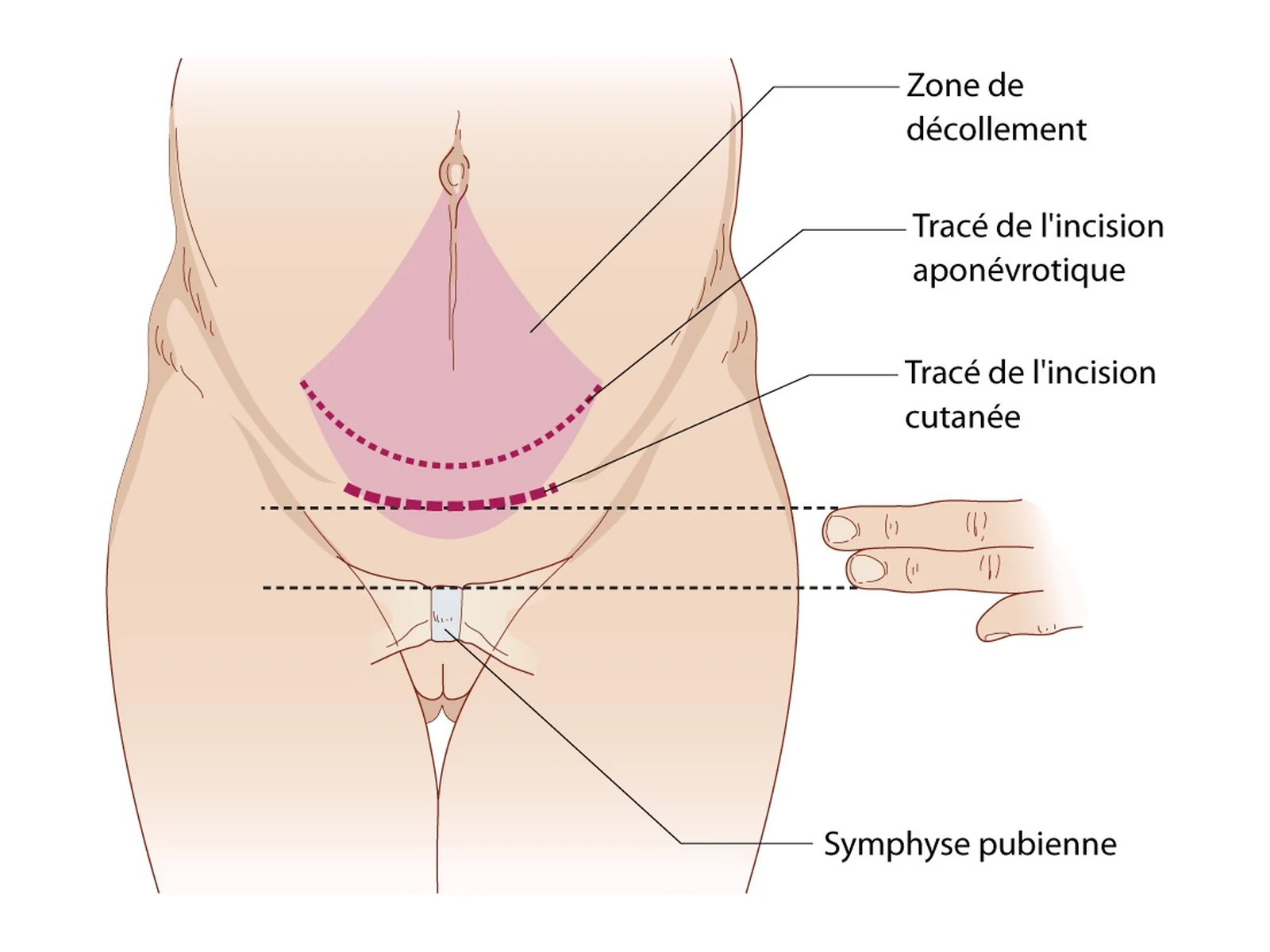
A caesarean section is an operation performed by an obstetrician-gynaecologist in the operating theatre. The baby is born through a low, horizontal incision just above the pubic bone, followed by an incision in the lower part of the uterus. It is most often done under regional anaesthesia: you are awake and can see your baby as soon as they are born.
There are planned (elective) caesareans, decided during pregnancy, and unplanned caesareans, decided during labour, sometimes as an emergency. For the overall organisation of the birth, see giving birth in Paris.
When is a planned caesarean recommended?
The decision is based on weighing benefits against risks, shared with you, ideally during the 8th month.
| Situation | Usual approach |
|---|---|
| One previous caesarean | Vaginal birth is possible and preferred in most cases according to the French College of Gynaecologists and Obstetricians (CNGOF); shared decision |
| Three or more caesareans, or a scar on the body of the uterus | Planned caesarean recommended |
| Breech position | According to the French National Authority for Health (HAS), breech alone is not a reason for a caesarean. External cephalic version (turning the baby from the outside of the abdomen) is offered; caesarean if the pelvis is unfavourable or the baby’s head stays tilted back, otherwise decided case by case |
| Placenta covering the cervix (placenta praevia) | Planned caesarean |
| Very high estimated foetal weight | Without diabetes: planned caesarean recommended from 5,000 g, decided case by case between 4,500 and 5,000 g. With diabetes: from 4,500 g. With a scarred uterus: from 4,500 g, especially without a previous vaginal birth |
| Twins | First twin head down: not a reason for a caesarean in itself; first twin breech: decided case by case |
| Genital herpes: first infection after 35 weeks | Planned caesarean recommended; a recurrence during pregnancy is not a reason for one |
| Certain maternal illnesses or foetal abnormalities | Decision with the specialist team |
According to the CNGOF, pelvic X-ray measurement (radiopelvimetry) is not useful for deciding on a trial of labour after a caesarean. Unless there is a specific reason, a planned caesarean is not performed before 39 weeks, to limit temporary breathing difficulties in the newborn.
Why might an emergency caesarean be needed?
During labour, a caesarean is decided when continuing towards a vaginal birth puts the mother or baby at risk:
- abnormal baby heart rate suggesting a lack of oxygen;
- failure to progress: the cervix stops dilating or the baby does not descend despite good contractions;
- failed induction;
- cord prolapse (the umbilical cord slips down ahead of the baby’s head);
- placental abruption or major bleeding;
- rupture or threatened rupture of a scarred uterus;
- genital herpes sores at the start of labour, depending on the type of episode.
The time between the decision and the birth is adapted to the degree of urgency. In a life-threatening emergency, a general anaesthetic may be needed.
What happens during a caesarean section?
- Preparation: an anaesthetic consultation beforehand for a planned caesarean; fasting as instructed; a drip and a urinary catheter are inserted; preventive antibiotics are given.
- Anaesthesia: most often a spinal anaesthetic, or a top-up of the epidural already in place during labour. General anaesthesia is reserved for contraindications and some emergencies.
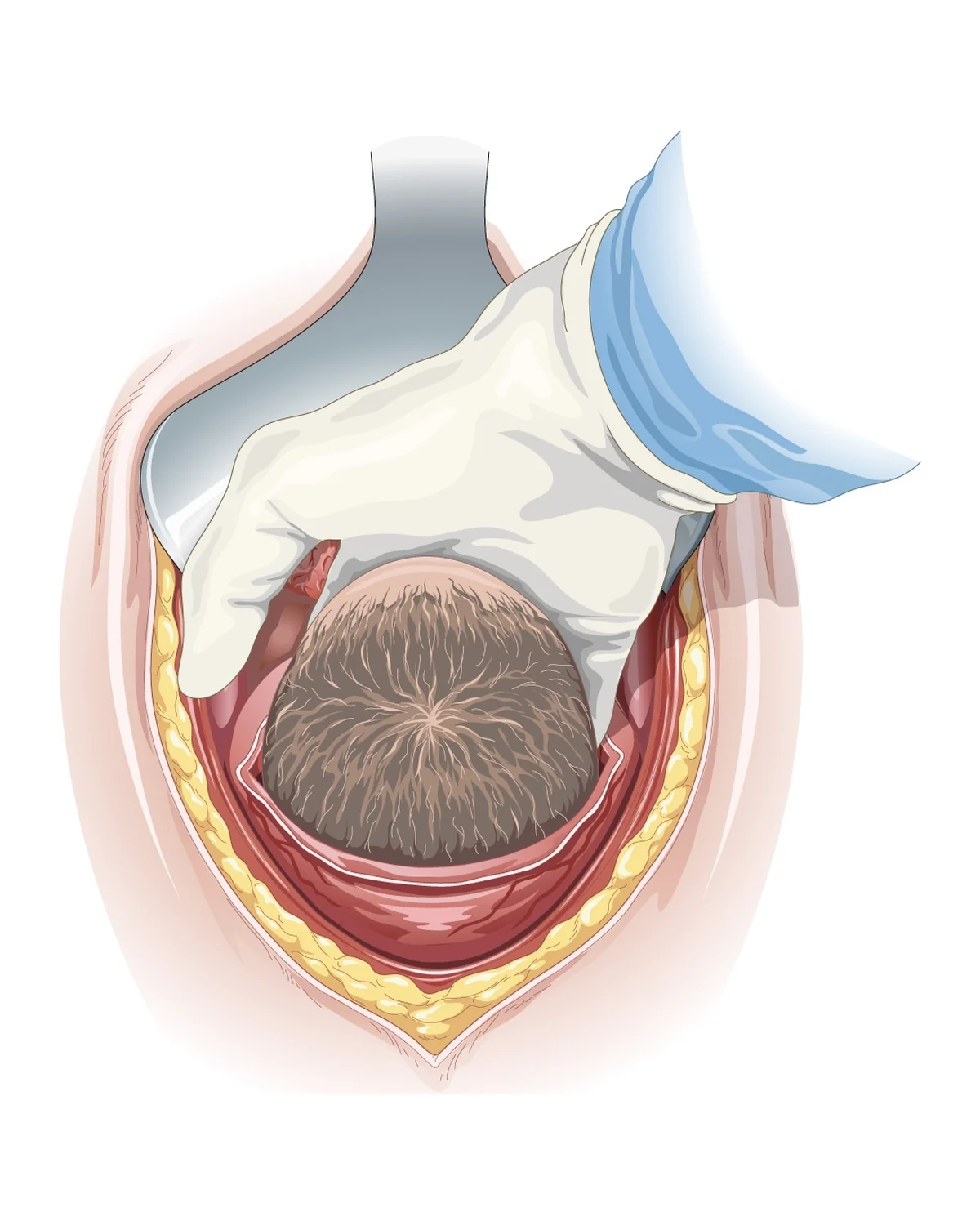
- The operation: incision of the skin, opening of the layers of the abdominal wall, a transverse incision in the lower uterus, birth of the baby within a few minutes, then delivery of the placenta and closure layer by layer. A sterile drape separates you from the operating area.
- Welcoming your baby: skin-to-skin contact can often begin in the theatre if you and your baby are both well.
- Monitoring in the recovery room for the first few hours, then return to your room.
Dr Kadoch delivers babies at Maternité Sainte-Félicité (Paris 15th) and Clinique Sainte-Thérèse (Paris 17th); your partner can be present.
What is recovery like after a caesarean?
- Pain: more marked in the first few days; it is treated with a combination of painkillers, preferably by mouth. These medicines are compatible with breastfeeding.
- Getting up and eating: early, often within the first few hours, to help recovery and reduce the risk of deep vein thrombosis.
- Preventing thrombosis: the CNGOF recommends compression stockings from the day of the caesarean and for at least 7 days, combined with anticoagulant injections depending on your risk factors.
- Breastfeeding: entirely possible; the team helps you find a comfortable position that protects the scar.
- Scar: keep it clean and dry; stitches or staples are either dissolvable or removed after a few days.
- Going home: the maternity stay is usually 72 to 96 hours after a vaginal birth (HAS 2014), 3 to 5 nights after a caesarean (see Giving birth in Paris). Avoid lifting heavy loads for a few weeks; you can drive again once you can brake without pain.
- Contraception: to be started no later than 21 days after the birth; see contraception after having a baby.
What are the benefits and risks of a caesarean?
A caesarean protects mother and baby when a vaginal birth would be dangerous. It is not without risk, however.
Risks during the operation
- haemorrhage, sometimes requiring transfusion, procedures to stop the bleeding and, very rarely, removal of the uterus;
- exceptionally, injury to the bladder, bowel, a ureter or a blood vessel.
Risks after the operation
- infection of the scar, the uterus or the urine;
- a haematoma in the abdominal wall;
- deep vein thrombosis and pulmonary embolism, hence routine prevention.
Consequences for future pregnancies
After a caesarean, later pregnancies carry a higher risk of uterine rupture, and abnormal placental attachment (placenta accreta); according to the CNGOF, maternal complications increase with the number of caesareans. This is one of the reasons why vaginal birth is encouraged whenever possible.
Can I have a vaginal birth after a caesarean (VBAC)?
Yes, in most cases. According to the CNGOF, after a caesarean, maternal complications are rare and similar whether you attempt a vaginal birth or have a planned caesarean; the balance of benefits and risks usually favours a trial of labour. It is particularly encouraged if you have already had a vaginal birth, or if labour starts spontaneously.
- The risk of uterine rupture is higher during labour and increases with induction: about 1% with oxytocin and 2% with vaginal prostaglandins, according to the CNGOF. Misoprostol is not recommended in this situation.
- The decision is shared with you, taking your risk factors into account. If, after being informed and thinking it over, you prefer another caesarean, your choice must be respected.
For what comes next, see vaginal birth.
When should I seek urgent care after a caesarean?
Contact the maternity unit straight away or go to the maternity emergency department if you have:
- a fever above 38 °C;
- a scar that is red, hot, swollen, oozing or opening;
- increasing abdominal pain, foul-smelling discharge;
- heavy bleeding or large clots;
- burning when passing urine;
- pain or swelling in a calf, shortness of breath, chest pain.
If you suddenly become short of breath, feel faint or have heavy bleeding, call 15 or 112 in France, or your local emergency number. See also fever after childbirth.
Frequently asked questions
Can I ask for a caesarean without a medical reason?
According to the HAS, a request alone is not a medical reason: the reasons behind it are discussed and recorded in your notes. If you are afraid of giving birth, personalised support and information about pain relief are offered. A doctor may decline to perform a caesarean without a medical reason, but must then refer you to a colleague.
How many caesareans can you have?
There is no fixed limit, but complications increase with each caesarean. After three caesareans, a planned caesarean is recommended for the next birth.
How long should I wait between a caesarean and another pregnancy?
There is no mandatory waiting period. Closely spaced pregnancies carry more risks; the timing of a new pregnancy should be discussed with your gynaecologist, who can also advise you on contraception in the meantime.
Is skin-to-skin contact possible after a caesarean?
Yes, in most cases, in the operating theatre or the recovery room, if you and your baby are both well.
How long does it take to recover from a caesarean?
You are entitled to maternity leave. As a general guide, sport can usually be resumed about 2 months after the birth, and sex once the bleeding has stopped and the scar is no longer painful, often 4 to 6 weeks afterwards. These guidelines are adapted to your situation at your postnatal check-up.
How much does a caesarean cost?
Fees for a birth, whether vaginal or by caesarean, are set out in a written quote given to you in advance at the consultation.
References
- Haute Autorité de santé (HAS). Indications de la césarienne programmée à terme [Indications for planned caesarean section at term]. Clinical practice guideline, January 2012. has-sante.fr
- Sentilhes L, et al. Delivery for women with a previous cesarean: guidelines for clinical practice from the French College of Gynecologists and Obstetricians (CNGOF). Eur J Obstet Gynecol Reprod Biol, 2013. doi:10.1016/j.ejogrb.2013.05.015 — PMID 23810846
- Sénat MV, et al. Postpartum practice: guidelines for clinical practice from the French College of Gynaecologists and Obstetricians (CNGOF). Eur J Obstet Gynecol Reprod Biol, 2016. doi:10.1016/j.ejogrb.2016.04.032 — PMID 27155443

Dr Olivier KadochObstetrician-gynaecologist and gynaecological surgeon in Paris (16th and 5th arrondissements). Former chef de clinique-assistant (senior registrar) at the Paris public hospitals (AP-HP); individually accredited by the French National Authority for Health (HAS). RPPS 10003957809. Background and practice locations
A question about your situation?Appointments at the practice or by video consultation, usually within one week to 10 days.
Book an appointmentGeneral information article: it does not replace a medical consultation. In an emergency, call 15 or 112 in France, or your local emergency number.