Ectopic pregnancy: symptoms, diagnosis and treatment
In brief
An ectopic pregnancy is a pregnancy that implants outside the uterus, almost always in a fallopian tube; it affects about 2% of pregnancies. It causes pain on one side of the lower abdomen and bleeding in early pregnancy, and it can lead to internal bleeding: it is an emergency. Depending on how active it is and on your symptoms, it is treated by monitoring alone, by an injection of methotrexate or by laparoscopy.
What is an ectopic pregnancy?
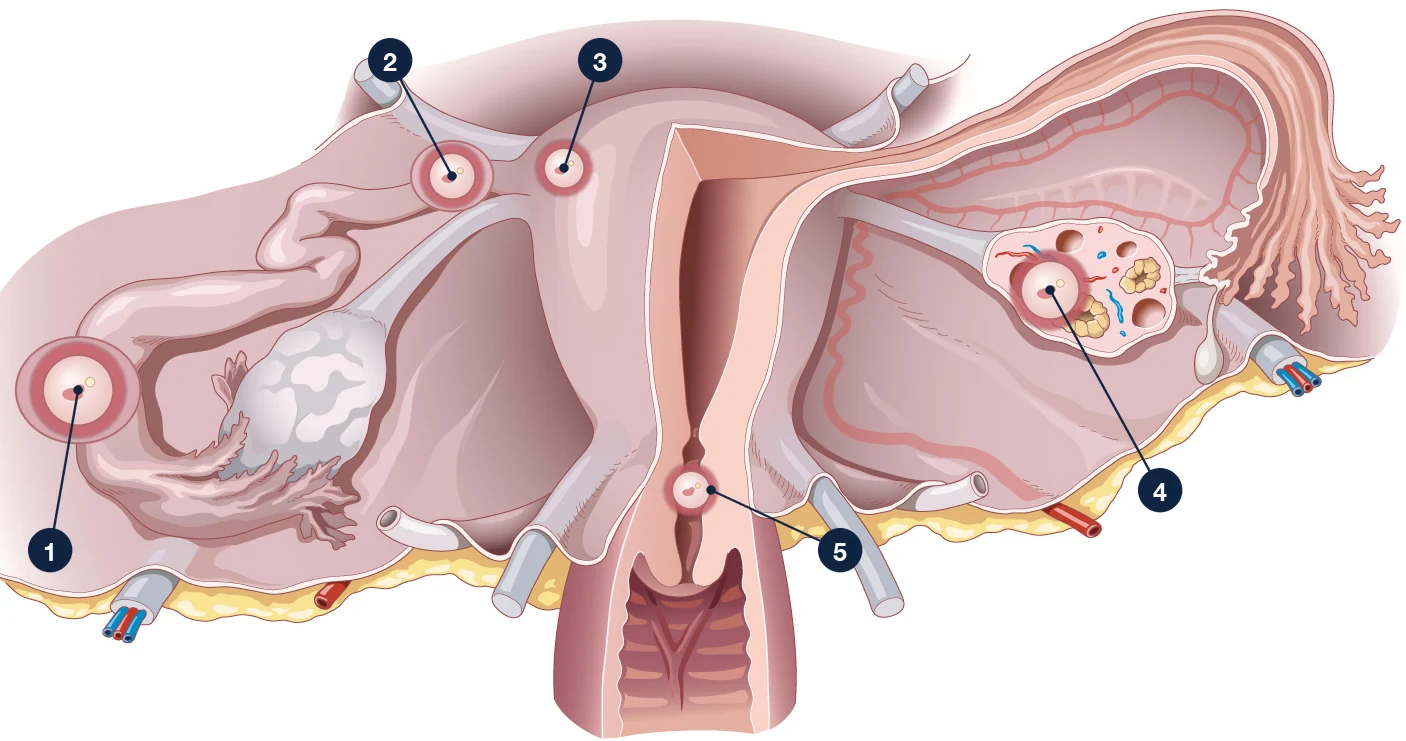
Normally, the fertilised egg travels down the fallopian tube and implants in the cavity of the uterus. In an ectopic pregnancy, it stops on the way. In 96 to 99% of cases, it implants in the tube (French College of Gynaecologists and Obstetricians, CNGOF, 2025). More rarely, it lodges in the ovary, the cervix, a caesarean scar or the abdomen. The tube cannot hold a growing pregnancy: it can rupture and cause internal bleeding. An ectopic pregnancy can never lead to the birth of a baby.
Ectopic pregnancy is one of the early pregnancy emergencies managed in the maternity units where we work, as described on our page Giving birth in Paris.
What are the symptoms of an ectopic pregnancy?
Signs usually appear between 5 and 10 weeks of pregnancy (weeks of amenorrhoea), sometimes even before you know you are pregnant:
- A late period or an unusual period, with a positive pregnancy test.
- Lower abdominal pain, often on one side only, sometimes severe.
- Light vaginal bleeding, often dark.
- Sometimes shoulder-tip pain, an urgent need to open your bowels or feeling faint, which may be signs of bleeding inside the abdomen.
These symptoms are not specific: they also occur with a miscarriage. This is why any bleeding or pain in early pregnancy must be checked. See also our article on bleeding in the first trimester.
Who is most at risk of an ectopic pregnancy?
An ectopic pregnancy can occur without any risk factor. However, some factors make it more likely, because they damage or slow down the tube:
- a previous ectopic pregnancy;
- a previous upper genital tract infection (salpingitis), particularly chlamydia;
- surgery on the tubes or in the pelvis;
- smoking, with an effect that depends on how much you smoke;
- a pregnancy conceived through assisted reproduction;
- a pregnancy occurring despite an IUD (coil) or tubal ligation: these methods greatly reduce the overall risk of pregnancy, but if a pregnancy does occur, it is more often ectopic.
How is an ectopic pregnancy diagnosed?
Diagnosis combines three elements:
- Clinical examination: blood pressure, pulse, feeling the abdomen and a gentle gynaecological examination.
- A blood test for the pregnancy hormone (hCG), often repeated 48 hours apart. In a normal pregnancy, the level rises clearly; a level that plateaus or rises slowly suggests an abnormal pregnancy.
- Transvaginal ultrasound: it looks for a pregnancy inside the uterus, a mass next to the ovary or blood in the abdomen.
Sometimes no pregnancy can be seen, either in the uterus or elsewhere: this is called a "pregnancy of unknown location". It is not yet a diagnosis. Close monitoring of hCG levels and a repeat scan make it possible to reach a conclusion within a few days: a normal pregnancy that is still too small to see, a miscarriage or an ectopic pregnancy.
During this waiting period, no treatment is given "just in case", because it could end a normal pregnancy. You leave with clear instructions and a number to call. It helps to know the date of your last period, the date of your positive test and your history (surgery, infection, IUD, assisted reproduction): this information guides the doctor. If the situation remains unclear despite several checks, a laparoscopy may be offered both to confirm the diagnosis and to treat at the same time.
How is an ectopic pregnancy treated?
Treatment depends on two questions: is the ectopic pregnancy causing symptoms, and is it "active" (high or rising hCG level, visible heartbeat)? The French guidelines from the CNGOF (2025) propose:
| Option | In which situations | What it involves |
|---|---|---|
| Monitoring alone (expectant management) | Ectopic pregnancy without symptoms and with little activity, low and falling hCG level | Clinical check and hCG test at 48 hours, then, if hCG has fallen by more than 15%, every week until the test is negative; stopped if hCG rises by more than 15% or if pain appears |
| Methotrexate | Ectopic pregnancy without rupture or major bleeding in the abdomen, in a patient who can be closely followed | Intramuscular injection, usually a single dose; repeated hCG tests over several weeks; no alcohol, anti-inflammatory drugs or folic acid during treatment unless advised otherwise |
| Laparoscopy | Ectopic pregnancy with symptoms, ruptured, very active, or when methotrexate is not suitable | Keyhole surgery under general anaesthetic; removal of the tube (salpingectomy) or opening of the tube to remove the pregnancy (salpingotomy) |
A ruptured ectopic pregnancy with internal bleeding is a surgical emergency. The principle of laparoscopy is explained in our article on gynaecological laparoscopy.
Keep or remove the tube? When the other tube is healthy, a large European randomised trial found no difference in the chances of a later natural pregnancy between the two techniques (Mol et al., Lancet 2014). Salpingotomy carries a higher risk of leftover pregnancy tissue requiring further treatment (7% versus less than 1% in this trial). The choice takes into account the condition of your tubes and your plans for a future pregnancy. If your blood group is rhesus negative, whether to give anti-D immunoglobulin is decided case by case with your team: French guidelines make no recommendation for ectopic pregnancy, as evidence is insufficient (see bleeding in the first trimester).
When is ectopic pregnancy pain an emergency?
If you are pregnant, or if your period is late, call 15 or 112 in France, or your local emergency number, or go to the gynaecological emergency department of the nearest maternity unit if you have:
- severe or worsening lower abdominal pain, especially on one side;
- feeling faint, dizziness, a sensation of passing out, pallor;
- shoulder pain with no obvious cause;
- heavy bleeding.
During methotrexate treatment or monitoring, any new pain means you must be seen the same day, even if an appointment is already booked.
Can I get pregnant after an ectopic pregnancy?
Yes. In the ESEP trial, about 6 in 10 women whose other tube was healthy had an ongoing natural pregnancy within three years, whichever surgical technique was used. However, the risk of another ectopic pregnancy is higher than in the general population. In your next pregnancy, see a doctor as soon as your test is positive: an hCG test and an early scan, at around 6 weeks, confirm that the pregnancy is inside the uterus.
After methotrexate treatment, the time to wait before another pregnancy is discussed at your appointment. The choice of contraception is discussed at your appointment, according to your history and your plans. If pregnancy takes time to happen, a fertility assessment may be offered. After a laparoscopy, sick leave is generally 7 to 21 days depending on your job, and sex can be resumed according to pain; these are guidelines only, as instructions are tailored to each patient at the consultation.
An ectopic pregnancy is also a pregnancy loss. It is normal to feel sadness or anxiety: talk about it, and psychological support can be offered.
Would you like a medical opinion?Appointments in Paris 16th or 5th, or by video consultation.
Book an appointmentFrequently asked questions
Can a urine pregnancy test detect an ectopic pregnancy?
A urine test is positive in an ectopic pregnancy just as in a normal pregnancy. It does not show where the pregnancy has implanted: only ultrasound and blood hCG monitoring can do that.
Is methotrexate harmful to fertility?
At the doses used for ectopic pregnancy, it does not affect future fertility. It requires blood tests until hCG becomes negative; the time to wait before conceiving is discussed at your appointment.
How long is the hospital stay after laparoscopy for an ectopic pregnancy?
As a guide, you generally go home the same day or after 1 to 2 days, depending on your health and the amount of bleeding. Time off work is generally 7 to 21 days depending on your job, exercise can be resumed after about 3 weeks and baths after 2 weeks; these instructions are tailored at the consultation.
Can an ectopic pregnancy be moved into the uterus?
No. No technique can transfer an ectopic pregnancy into the uterus. Treatment aims to protect the woman's health and preserve her fertility.
References
- Agostini A, et al. Therapeutic management of tubal ectopic pregnancies: Clinical practice guidelines of CNGOF and SCGP. Gynecol Obstet Fertil Senol, 2025. doi:10.1016/j.gofs.2025.10.023 — PMID 41183782
- Mol F, et al. Salpingotomy versus salpingectomy in women with tubal pregnancy (ESEP study): an open-label, multicentre, randomised controlled trial. Lancet, 2014. doi:10.1016/S0140-6736(14)60123-9 — PMID 24499812
- Doubilet PM, et al. Diagnostic criteria for nonviable pregnancy early in the first trimester. N Engl J Med, 2013. doi:10.1056/NEJMra1302417 — PMID 24106937

Dr Olivier KadochObstetrician-gynaecologist and gynaecological surgeon in Paris, seeing patients in Paris 16th and at the Centre de la Femme Paris 5. Former chef de clinique-assistant (senior registrar) at the Paris public hospitals (AP-HP); individually accredited by the French National Authority for Health (HAS). RPPS 10003957809. Background and practice locations
A question about your situation?Appointments at the practice or by video consultation, usually within one week to 10 days.
Book an appointmentGeneral information article: it does not replace a medical consultation. In an emergency, call 15 or 112 in France, or your local emergency number.