Prenatal diagnosis: screening, NIPT, amniocentesis and CVS
In brief
Prenatal diagnosis covers the tests that look for an abnormality in the baby during pregnancy. It starts with screening tests, which carry no risk and estimate a probability (scans, combined screening for Down syndrome, NIPT), followed if needed by diagnostic tests that give a definite answer (chorionic villus sampling, amniocentesis). None of these tests is compulsory: they are offered to you with clear information, and you remain free to accept or decline them. The risk of miscarriage linked to amniocentesis or chorionic villus sampling is low, around 0.2 to 0.3% (2019 meta-analysis).
What is the difference between prenatal screening and diagnosis?
This distinction is essential to understand your results.
- A screening test assesses a risk. It identifies pregnancies with a higher than average chance of an abnormality. A "high-risk" result does not mean the baby is affected, and a reassuring result does not rule it out completely.
- A diagnostic test gives an almost certain answer, by directly analysing the baby's chromosomes or genes. It requires a sample to be taken.
These tests are part of pregnancy care, presented on our page Giving birth in Paris. In France, your doctor must inform you before each one, and your written consent is required for Down syndrome screening and for any sampling procedure.
Which prenatal tests are offered to all pregnant women?
| Test | When? | What it shows |
|---|---|---|
| 1st trimester scan | Between 11 weeks and 13 weeks + 6 days | Dating, number of babies, nuchal translucency measurement, first visible abnormalities |
| Combined screening for Down syndrome | Same period, blood test on the day of the scan or shortly before | Calculation of a risk based on age, nuchal translucency and two blood markers (PAPP-A and free beta-hCG) |
| 2nd trimester serum markers | Between 14 weeks and 17 weeks + 6 days | Calculation of a risk if first-trimester screening could not be done |
| 2nd trimester scan | Around 20 to 25 weeks | Detailed examination of the baby's anatomy (anomaly scan) |
| 3rd trimester scan | Around 30 to 35 weeks | Growth, position of the baby and placenta, some late-appearing abnormalities |
Stages are expressed in weeks of pregnancy (weeks of amenorrhoea), counted from the first day of your last period. The second-trimester triple test, used for many years, has been replaced as the first-line test by first-trimester combined screening, which performs better. Down syndrome screening is explained in our article on Down syndrome screening.
What is NIPT and who is it offered to?
Non-invasive prenatal testing (NIPT) analyses, from a simple blood sample from the mother, fragments of cell-free DNA coming from the placenta. It performs very well for Down syndrome, with very few false positives (see our article on Down syndrome screening). It nevertheless remains a screening test: a positive result must always be confirmed by a sampling procedure before any decision is made.
In France, according to the French National Authority for Health (HAS, 2017), NIPT is offered and reimbursed when the risk calculated by combined screening is between 1/1000 and 1/51. Above 1/50, a diagnostic sampling procedure is offered straight away, with NIPT still possible if you prefer. It may also be offered in certain specific situations, such as a previous pregnancy affected by a trisomy.
In September 2024, the HAS recommended extending NIPT to detect other chromosomal abnormalities, notably trisomies 13 and 18, certain other trisomies and structural chromosomal abnormalities. When prescribing the test, your doctor will tell you which abnormalities the laboratory looks for.
How are chorionic villus sampling and amniocentesis done?
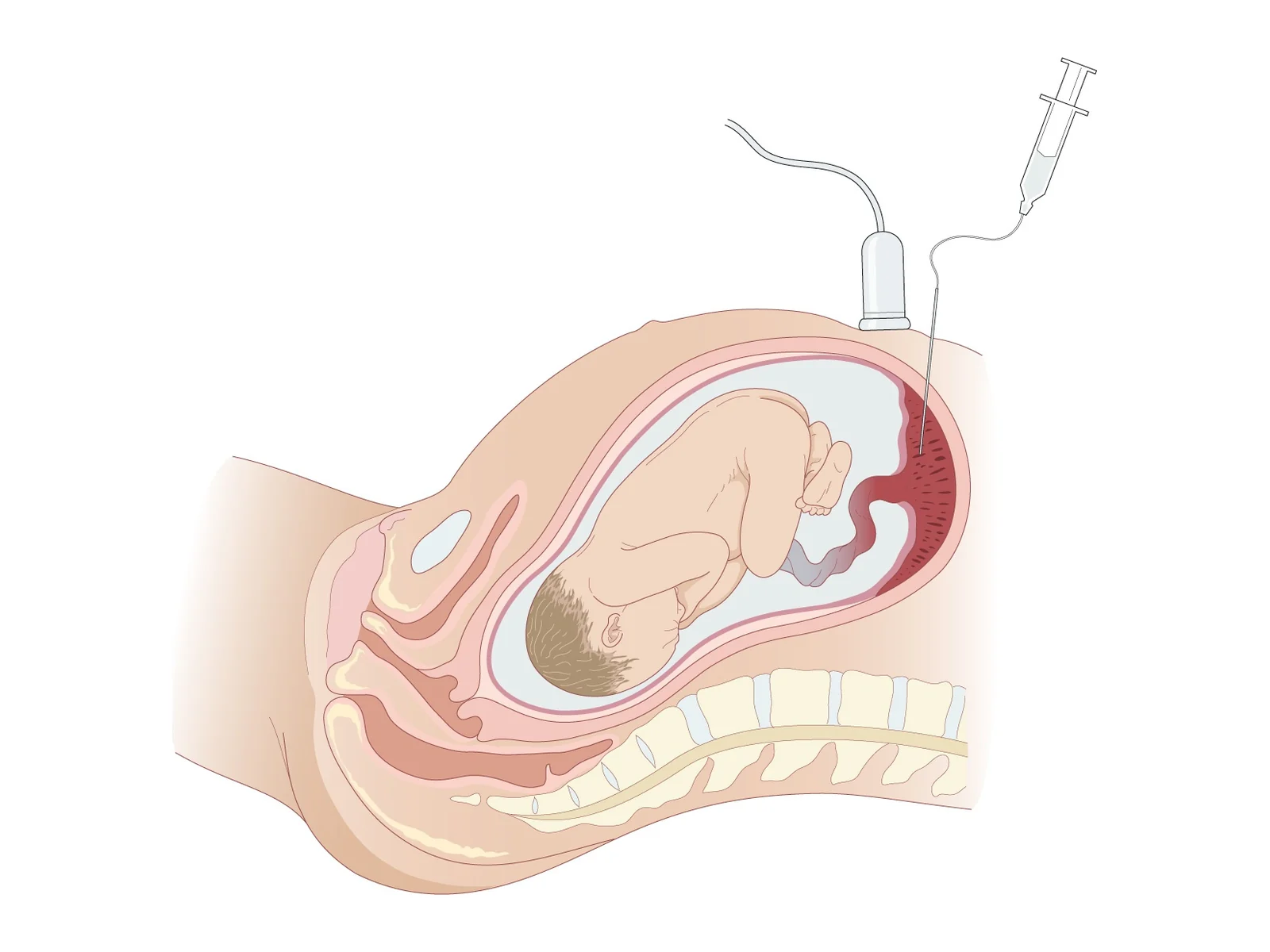
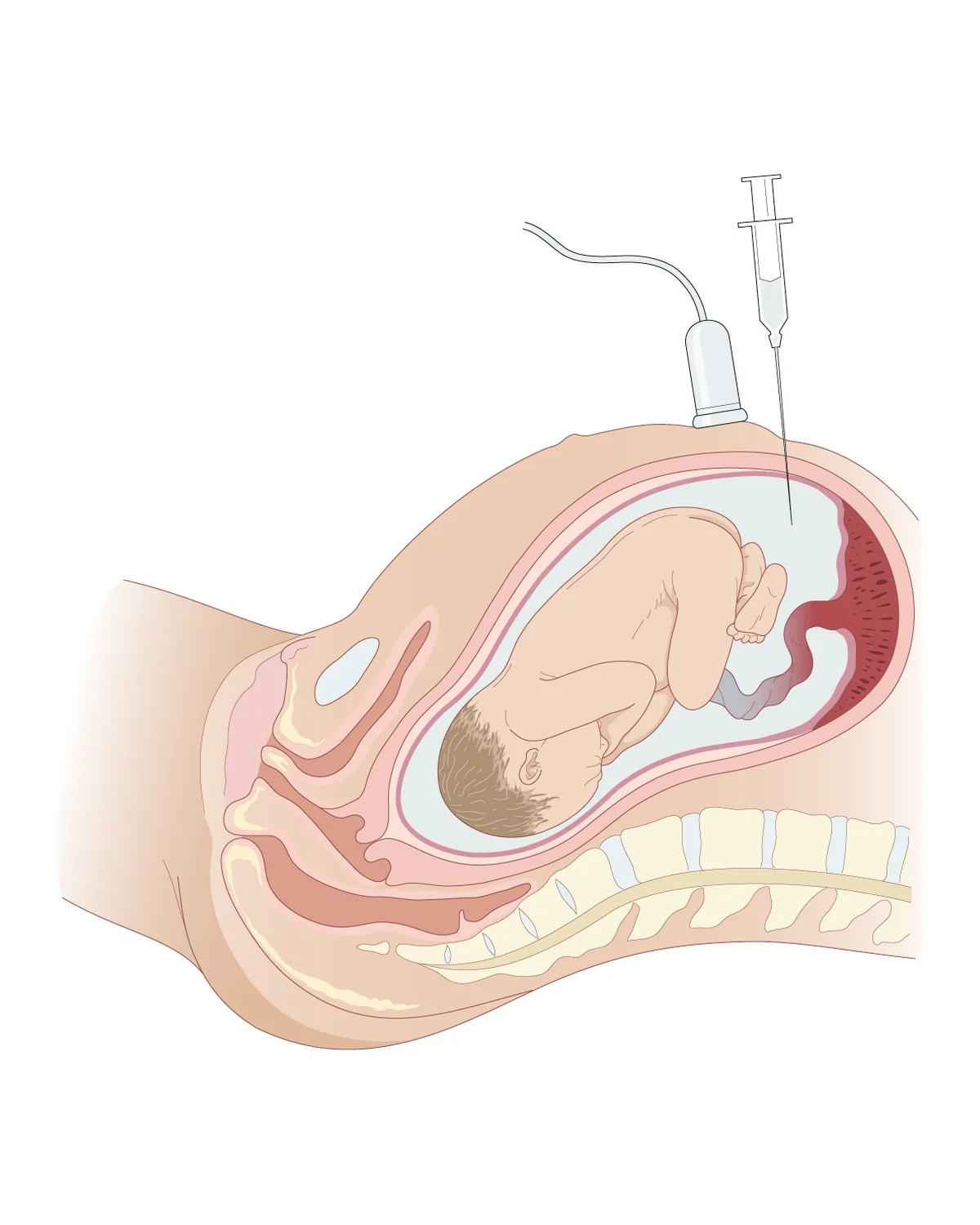
These two tests collect cells of foetal origin to study the chromosomes (karyotype or chromosomal microarray analysis), to look for a genetic disease already known in the family, or to detect an infection.
| Criterion | Chorionic villus sampling (CVS) | Amniocentesis |
|---|---|---|
| When? | From 11 weeks | From 15 weeks |
| How? | A small piece of placenta is taken with a fine needle through the abdomen, under ultrasound guidance | A few millilitres of amniotic fluid are taken with a fine needle through the abdomen, under ultrasound guidance |
| Results | Quick, useful if an early diagnosis is wanted | Rapid result for the main trisomies within a few days, full karyotype in about 2 to 3 weeks |
| Risk of miscarriage due to the procedure | About 0.2%, probably even lower | About 0.3%, probably even lower |
These figures come from a meta-analysis of more than 75,000 procedures: the risk of miscarriage attributable to the procedure is lower than the figure long quoted (1%), and becomes almost zero when compared with women who had the same level of risk to begin with (Salomon et al., 2019). If your blood group is rhesus D negative, prevention with anti-D immunoglobulin after the procedure will be explained to you: see our article on rhesus incompatibility in pregnancy.
Foetal blood sampling from the umbilical cord (cordocentesis), from about 20 weeks, is now reserved for very specific indications, such as assessing foetal anaemia before a transfusion in the womb, in a specialist centre.
Who should have amniocentesis or CVS?
Maternal age alone is no longer a reason for invasive testing. A diagnostic test is offered:
- when screening (combined or NIPT) shows a high risk;
- when the scan finds an abnormality;
- when there is a history of genetic disease or chromosomal abnormality in the couple or the family;
- in certain maternal infections during pregnancy, such as toxoplasmosis or cytomegalovirus.
What happens if an abnormality is found on a prenatal test?
In France, you are referred to a multidisciplinary prenatal diagnosis centre (CPDPN). Obstetricians specialising in foetal medicine, sonographers, geneticists, paediatricians, paediatric surgeons and psychologists work together there to assess the nature and severity of the abnormality and the options for care.
Most abnormalities detected lead to closer monitoring and a planned birth in a suitable maternity unit, sometimes with treatment or surgery for the newborn. Some treatments are even possible before birth. When the condition is particularly severe and incurable at the time of diagnosis, the couple may request a medical termination of pregnancy; in France, this is regulated by law and requires the opinion of the CPDPN. See our article on medical termination of pregnancy.
What are the limits of prenatal diagnosis?
No test can guarantee that a baby will be in perfect health. Some abnormalities are not visible on ultrasound, or appear late. Chromosome analysis does not detect all genetic diseases. Conversely, some tests can reveal a finding whose meaning is uncertain, which can be a source of worry.
Prenatal diagnosis also raises personal and ethical questions. You can decline a test, ask for time to think, or ask for psychological support at every stage. Ultrasound scans, including 3D ultrasound, are carried out at the practice, with an average waiting time of one week to 10 days (except during holiday periods); if needed, you are referred to an appropriate prenatal diagnosis centre.
When should I seek urgent care after amniocentesis or CVS?
After chorionic villus sampling or amniocentesis, taking it easy for 24 hours is often advised. Go to the emergency department of your maternity unit, or call 15 or 112 in France, or your local emergency number, if you feel faint, or if in the following days you notice:
- a leak of clear fluid from the vagina;
- bleeding;
- abdominal pain or contractions that persist;
- a fever or chills.
Frequently asked questions
Is Down syndrome screening compulsory?
No. It must be offered and explained to you, but you are free to accept or decline it. In France, your written consent is required.
Can NIPT replace amniocentesis?
No. NIPT is a highly effective screening test, but a positive result must be confirmed by a sampling procedure. Only analysis of foetal cells gives a diagnosis.
Does amniocentesis hurt?
Most women describe it as brief discomfort, similar to a blood test. It takes a few minutes and is done under continuous ultrasound guidance.
What does a 1 in 300 screening risk mean?
It means that out of 300 pregnancies with the same result, on average only one is affected by Down syndrome and 299 are not. This figure helps you decide whether a further test is worthwhile.
Is NIPT reimbursed?
It is covered when the risk calculated by combined screening is between 1/1000 and 1/51 (HAS, 2017). In other situations, your doctor will tell you before prescribing it whether the test is covered.
Is amniocentesis risky?
The risk of miscarriage linked to the procedure is low: about 0.3% after amniocentesis and 0.2% after chorionic villus sampling, and probably even lower according to a 2019 meta-analysis. Leaking fluid, bleeding, contractions or fever in the following days should prompt you to seek medical advice.
References
- HAS. Place des tests ADN libre circulant dans le sang maternel dans le dépistage de la trisomie 21 fœtale [Role of cell-free DNA testing in maternal blood in screening for foetal trisomy 21]. Public health recommendation, 2017. has-sante.fr
- Salomon LJ, et al. Risk of miscarriage following amniocentesis or chorionic villus sampling: systematic review of literature and updated meta-analysis. Ultrasound in Obstetrics & Gynecology, 2019. doi:10.1002/uog.20353 — PMID 31124209
- HAS. Examens basés sur l'ADN libre circulant réalisés dans le cadre du dépistage de la trisomie 21. Opportunité du repérage d'autres anomalies chromosomiques [Cell-free DNA testing in Down syndrome screening: detection of other chromosomal abnormalities]. Public health recommendation, 2024. has-sante.fr

Dr Olivier KadochObstetrician-gynaecologist and gynaecological surgeon in Paris (16th and 5th arrondissements). Former chef de clinique-assistant (senior registrar) at the Paris public hospitals (AP-HP); individually accredited by the French National Authority for Health (HAS). RPPS 10003957809. Background and practice locations
A question about your situation?Appointments at the practice or by video consultation, usually within one week to 10 days.
Book an appointmentGeneral information article: it does not replace a medical consultation. In an emergency, call 15 or 112 in France, or your local emergency number.