Down syndrome (trisomy 21): prenatal screening and risk by maternal age
In brief
In France, screening for Down syndrome (trisomy 21) is offered to every pregnant woman, whatever her age. It combines the mother's age, the nuchal translucency measurement on an ultrasound scan between 11 weeks and 13 weeks + 6 days, and a blood test. Then, depending on the calculated risk, a cell-free DNA test (NIPT, non-invasive prenatal testing) or a diagnostic sample (the only way to confirm the diagnosis) may be offered. The risk rises with maternal age, but most babies are born without a chromosomal anomaly, even after 40.
What is Down syndrome (trisomy 21)?
Down syndrome, or trisomy 21, is caused by an extra chromosome 21 in the body's cells. It usually results from a random error in how chromosomes are shared out when the egg forms. It causes a learning disability of variable severity and may be associated with malformations, particularly of the heart or digestive system.
Down syndrome causes no symptoms in the mother during pregnancy. It can only be suspected through screening and ultrasound, and only confirmed by analysing the baby's chromosomes. Screening is part of the antenatal care offered before giving birth in Paris, alongside the other tests of prenatal diagnosis.
What is the risk of Down syndrome by maternal age?
Maternal age is the main known risk factor. The table gives an estimate of the risk of having a baby with Down syndrome at birth, without screening, based on the model by Morris et al. using the national register for England and Wales.
| Mother's age at delivery | Estimated risk at birth |
|---|---|
| 20 | about 1 in 1,500 |
| 25 | about 1 in 1,340 |
| 30 | about 1 in 940 |
| 32 | about 1 in 700 |
| 35 | about 1 in 350 |
| 38 | about 1 in 150 |
| 40 | about 1 in 85 |
| 42 | about 1 in 55 |
| 45 | about 1 in 35 |
These figures are population averages, not an individual prediction. They also show that, even at 40, more than 98% of babies do not have Down syndrome. Because most births are to women under 35, a large share of babies with Down syndrome are born to younger mothers. That is why screening is offered to everyone, not on the basis of age alone.
Are there other risk factors?
Apart from age, the risk is higher after a previous pregnancy affected by Down syndrome, and when one parent carries a particular chromosomal rearrangement (balanced translocation), usually found by a karyotype test. In these situations, a genetics consultation is offered, ideally before pregnancy. The father's age, on the other hand, has only a small effect on this risk. Nothing the mother does during pregnancy causes Down syndrome: it is present from conception.
How does first-trimester combined screening work?
Screening is offered to every pregnant woman. It is not compulsory: you receive information, then give written consent if you wish to go ahead.
- Ultrasound scan between 11 weeks and 13 weeks + 6 days of pregnancy (weeks of amenorrhoea): measurement of the baby's length and of the nuchal translucency (the thickness of fluid under the skin at the back of the neck), by a registered sonographer taking part in a quality assurance programme.
- Blood test in the same period: measurement of two markers, PAPP-A and free β-hCG.
- Risk calculation by the laboratory, combining age, nuchal translucency and the markers.
If the first-trimester scan could not be done in time, second-trimester serum marker screening is possible between 14 weeks and 17 weeks + 6 days, though it is less accurate.
The result is a risk, for example "1 in 2,500". It does not tell you whether or not the baby is affected. The result is sent to you via Doctolib or by post, or given by telephone if it is urgent.
What happens after a high-risk or low-risk Down syndrome screening result?
In 2017, the French National Authority for Health (HAS) set out the role of cell-free DNA testing in the French screening strategy, restated in its 2024 recommendation. What happens next depends on the calculated risk:
| Combined risk | What is offered |
|---|---|
| Lower than 1 in 1,000 | No further tests; routine follow-up continues |
| Between 1 in 1,000 and 1 in 51 | Cell-free DNA test on the mother's blood (NIPT) |
| 1 in 50 or higher | Diagnostic sample for foetal karyotype straight away; NIPT may also be discussed |
| Nuchal translucency of 3.5 mm or more, or an anomaly on ultrasound | Specialist opinion and sample for chromosome analysis, whatever the calculated risk |
In France, these additional tests are covered by the Assurance maladie (the French national health insurance) when they are indicated.
NIPT, amniocentesis or CVS: what is the difference?
Cell-free DNA testing (NIPT)
A simple blood test from the mother allows fragments of DNA from the placenta to be analysed. It is a highly accurate screening test: according to a meta-analysis of 35 studies, it detects about 99.7% of Down syndrome cases with about 0.04% false positives. It carries no risk to the pregnancy. But a positive result must always be confirmed by a diagnostic sample, because the DNA analysed comes from the placenta, not directly from the baby. Sometimes no result can be given; a second sample or another test is then offered. In September 2024, the HAS recommended that this test may also detect chromosomal anomalies other than trisomy 21, notably trisomies 13 and 18, some rarer trisomies and some anomalies affecting a large segment of a chromosome. It also recommended offering it to women at increased risk of another chromosomal anomaly, for example after a previous affected pregnancy. Sex chromosome anomalies are outside this scope. Information and consent arrangements are set by the Agence de la biomédecine (French Biomedicine Agency).
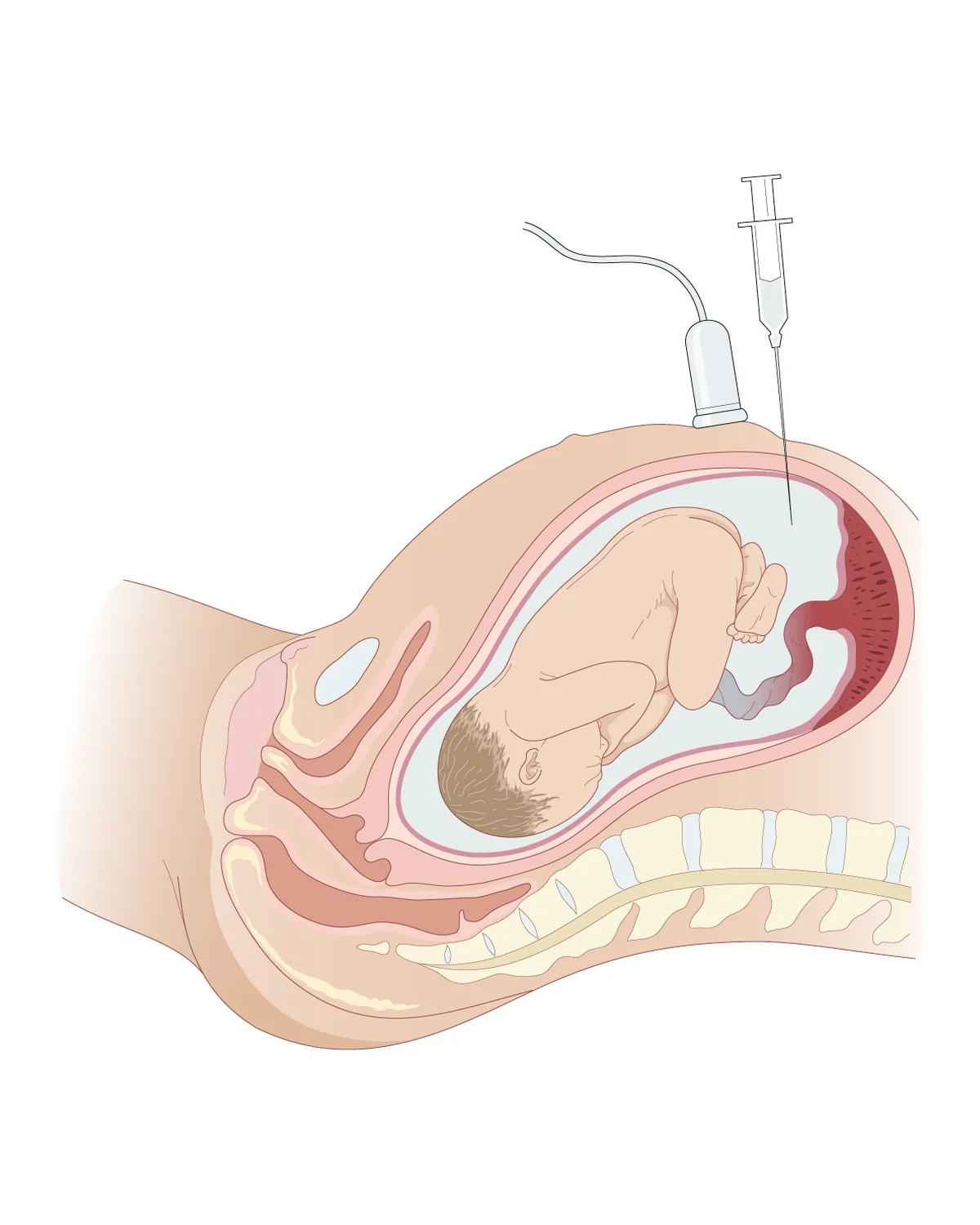
Diagnostic tests
- Chorionic villus sampling (CVS): a small piece of placenta is taken, usually from 11 weeks.
- Amniocentesis: amniotic fluid is taken with a fine needle under ultrasound guidance, from 15 weeks.
These tests establish the baby's karyotype and give a definite diagnosis. They carry a small risk of miscarriage, which is explained to you beforehand. If you are rhesus negative, an injection of anti-D immunoglobulin is given within 72 hours of the procedure (see the Kleihauer test and anti-D prevention).
When should I go to the maternity unit urgently?
After amniocentesis or CVS, mild discomfort in the lower abdomen is common. Go to the maternity emergency department if, in the following days, you have:
- leakage of clear fluid from the vagina;
- bleeding;
- fever or chills;
- contractions or abdominal pain that persists or gets worse.
More generally, at any stage of pregnancy, heavy bleeding, severe abdominal pain, fever, leaking fluid or reduced baby movements mean you should go to the maternity emergency department. If you feel seriously unwell, call 15 (SAMU) or 112 in France, or your local emergency number.
What if Down syndrome is confirmed?
The diagnosis is given at a dedicated consultation. Your case is presented to a multidisciplinary prenatal diagnosis centre (CPDPN), which brings together obstetricians, paediatricians, geneticists and psychologists. You receive full information about Down syndrome, the support available for the child, and family associations.
There are two possible choices, which belong to the couple, or to the woman: continuing the pregnancy with tailored follow-up and preparation for the baby's arrival, or requesting a termination of pregnancy for medical reasons, which French law allows in this situation. This is covered in detail in our article on termination of pregnancy for medical reasons. Whatever your decision, the team supports you without judgement.
Frequently asked questions
Is Down syndrome screening compulsory?
No. In France it is routinely offered with clear information, but you are free to accept or decline it. Your written consent is obtained before the tests.
Does a normal NIPT rule out every anomaly?
No. It makes trisomy 21, 18 or 13 very unlikely, but it does not look for all chromosomal anomalies or for malformations. The second- and third-trimester scans remain essential.
After 40, should I go straight to amniocentesis?
No. In France, age alone is no longer a reason for amniocentesis. Combined screening, followed by a cell-free DNA test if needed, avoids many unnecessary invasive tests.
Is screening possible with twins?
Yes, adapted screening exists, with a nuchal translucency measurement for each baby. Cell-free DNA testing can also be offered, although its performance is slightly less well established than in single pregnancies.
References
- Haute Autorité de santé (HAS). Examens basés sur l'ADN libre circulant réalisés dans le cadre du dépistage de la trisomie 21 : opportunité du repérage d'autres anomalies chromosomiques. Recommandation en santé publique. Saint-Denis : HAS, 2024. has-sante.fr
- Gil MM, et al. Analysis of cell-free DNA in maternal blood in screening for aneuploidies: updated meta-analysis. Ultrasound in Obstetrics & Gynecology, 2017. doi:10.1002/uog.17484 — PMID 28397325
- Morris JK, et al. Revised estimates of the maternal age specific live birth prevalence of Down's syndrome. Journal of Medical Screening, 2002. doi:10.1136/jms.9.1.2 — PMID 11943789

Dr Olivier KadochObstetrician-gynaecologist and gynaecological surgeon in Paris (16th and 5th arrondissements). Former chef de clinique-assistant (senior registrar) at the Paris public hospitals (AP-HP); individually accredited by the French National Authority for Health (HAS). RPPS 10003957809. Background and practice locations
A question about your situation?Appointments at the practice or by video consultation, usually within one week to 10 days.
Book an appointmentGeneral information article: it does not replace a medical consultation. In an emergency, call 15 or 112 in France, or your local emergency number.