Rhesus incompatibility in pregnancy: risks and prevention
In brief
Being Rhesus negative in pregnancy means that, if the baby is Rhesus positive, you can make antibodies that destroy the baby's red blood cells in a later pregnancy (anti-D alloimmunisation). This is prevented with anti-D immunoglobulin injections: at around 28 weeks, after the birth of a Rhesus-positive baby and, from 12 weeks, within 72 hours of any bleeding or blow to the abdomen. Before 12 weeks, the French College of Gynaecologists and Obstetricians (CNGOF) has recommended since 2024 that anti-D should no longer be given after a miscarriage, an abortion or bleeding.
What is Rhesus disease (red cell alloimmunisation)?
During pregnancy, and especially at birth, a few of the baby's red blood cells can pass into the mother's bloodstream. If they carry a molecule the mother does not have, her immune system may make antibodies against these red blood cells: this is called red cell alloimmunisation (haemolytic disease of the foetus and newborn).
The most familiar situation involves the Rhesus D factor: it concerns women whose blood group is Rhesus negative, a minority of the population. Other blood groups can be involved (Kell, little c, E…), more rarely. Your blood group and antibody screen are part of the first pregnancy check-up, described on our page Giving birth in Paris.
Alloimmunisation can also be triggered outside pregnancy, by a transfusion of incompatible blood.
Why is the first baby rarely affected?
On first exposure, the mother slowly produces only a few antibodies, usually after red blood cells pass across at the time of birth. The first baby is therefore usually spared.
The danger concerns later pregnancies with a Rhesus-positive foetus. The immune system, already "sensitised", reacts quickly and strongly. The anti-D antibodies cross the placenta and destroy the baby's red blood cells (haemolysis).
There is no risk if the father is also Rhesus negative, as the baby will then be Rhesus negative. But paternity cannot always be confirmed medically, and prevention is organised around the baby itself.
What are the risks of Rhesus incompatibility for the baby?
The destruction of red blood cells causes foetal anaemia, which can be more or less severe. Without treatment, severe anaemia can lead to heart failure in the foetus, widespread swelling (hydrops) and death in the womb.
After the birth, red blood cells continue to be destroyed for a few days, producing bilirubin. Significant jaundice can appear; without treatment, excess bilirubin can reach the brain (kernicterus). The newborn is therefore closely monitored and treated with phototherapy, or with an exchange transfusion in severe cases.
When alloimmunisation is known, care is provided together with a specialist centre: repeated antibody measurements, scans with Doppler of the foetal middle cerebral artery (which detects anaemia without an invasive procedure) and, if needed, blood transfusion to the foetus in the womb.
How is a Rhesus-negative pregnancy monitored?
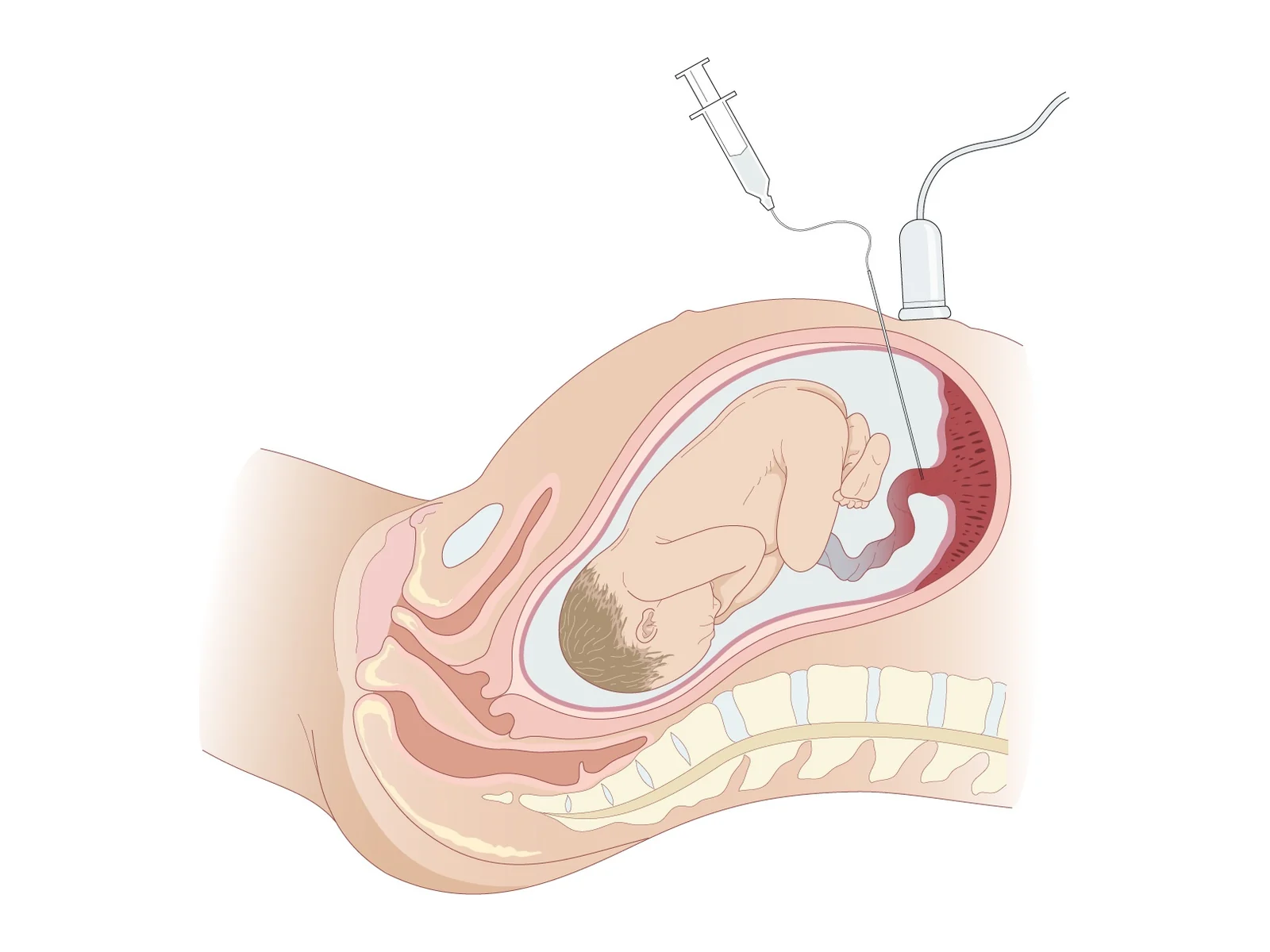
Monitoring relies on the red cell antibody screen (RAI), a blood test that detects antibodies against red blood cells.
| Your situation | When is the antibody screen done? |
|---|---|
| Rhesus negative | In the first trimester, then in the 6th, 8th and 9th months |
| Rhesus positive, previous transfusion | In the first trimester, then in the 6th, 8th and 9th months |
| Rhesus positive, no previous transfusion | In the first trimester; further checks according to the maternity unit's protocol |
The 6th-month antibody screen (around 28 weeks of pregnancy) must be taken before the anti-D injection, as the injection then makes the screen positive for several weeks without this being true alloimmunisation.
Foetal RhD genotyping
A simple blood test from the mother, usually from the end of the first trimester, can determine the baby's Rhesus group using foetal DNA circulating in the mother's blood. If the baby is Rhesus negative, anti-D injections are not needed. If the result is positive or inconclusive, prevention is given.
When is the anti-D injection given in pregnancy?
Prevention consists of injecting anti-D immunoglobulin (purified antibodies). It neutralises the baby's red blood cells that have passed into the mother before she makes her own antibodies. The French guidelines from the French College of Gynaecologists and Obstetricians (CNGOF) provide for:
- a routine injection at around 28 weeks (between 27 and 29 weeks) if the baby is Rhesus positive or its Rhesus group is unknown;
- an injection after the birth, within 72 hours, if the newborn is Rhesus positive. A Kleihauer test measures how much foetal blood has passed into the mother and allows the dose to be adjusted;
- from 12 weeks, an injection after any at-risk event, within 72 hours.
What are the at-risk events?
- from 12 weeks: miscarriage, abortion, termination of pregnancy for medical reasons;
- bleeding from 12 weeks;
- invasive procedures: amniocentesis, chorionic villus sampling, cervical stitch, external cephalic version (turning a breech baby);
- a fall or blow to the abdomen, a road accident;
- death of the baby in the womb.
What about before 12 weeks?
Since 2024, the CNGOF has recommended that anti-D immunoglobulin should not be given before 12 weeks after a miscarriage, a missed miscarriage, an abortion or bleeding in an ongoing pregnancy (weak recommendation, very low-quality evidence; see bleeding in the first trimester). For ectopic pregnancy, the evidence is insufficient: the decision is made case by case. Some teams still give it routinely, in line with the 2021 HAS (French National Authority for Health) factsheet on medical abortion; your doctor will explain the approach used.
Anti-D immunoglobulin is a product derived from human blood, treated with viral inactivation procedures. In a Cochrane review (two trials, more than 4,500 women), the injection during pregnancy reduced the passage of foetal blood detected by the Kleihauer test; a reduction in the immunisation rate was not demonstrated, and the evidence was of low quality.
What should I do if I am Rhesus negative in pregnancy?
- Mention your blood group from the start of the pregnancy and keep your blood group card (two determinations).
- Have all the prescribed antibody screens on the dates given.
- Ask whether foetal RhD genotyping is planned for you.
- After any bleeding, fall or blow to the abdomen, seek care quickly: from 12 weeks, the injection must be given within 72 hours.
- After the birth, check that the baby's blood group has been determined and that the injection has been given if the baby is Rhesus positive.
When should I go to the maternity unit urgently?
If you are Rhesus negative, any bleeding and any injury to the abdomen (fall, accident, blow) mean you should be seen the same day, even if you feel well. When alloimmunisation is known, reduced movements from the baby need immediate care.
Some signs should not wait for your next appointment. Go directly to your maternity unit's emergency department (open day and night), the one where you are registered (Maternité Sainte-Félicité or Clinique Sainte-Thérèse), if you have:
- any vaginal bleeding, even light;
- a leak of fluid, clear or coloured, from the vagina;
- regular or painful contractions before 37 weeks;
- fewer or no movements from the baby (once you usually feel them);
- a fever of 38 °C or more, shivering, or burning when passing urine with back pain;
- severe headaches, vision problems, pain under the right ribs or in the pit of the stomach, sudden swelling of the face or hands;
- severe or constant abdominal pain, a fall or a blow to the abdomen;
- intense itching of the palms and soles of the feet, especially at night.
If you feel faint, have heavy bleeding or very severe pain, call 15 (SAMU) or 112 in France, or your local emergency number.
Frequently asked questions
If the father is Rhesus negative, do I need the injection?
If the father is definitely Rhesus negative, the baby is too and there is no risk. In practice, foetal RhD genotyping on a blood sample from the mother can confirm this without relying on the father's blood group.
Is the anti-D injection harmful to the baby?
No. The doses used do not cause anaemia in the baby. It is a blood-derived product treated to ensure viral safety; side effects are rare and usually mild.
Do I need the anti-D injection in every pregnancy?
Yes. Anti-D immunoglobulin disappears within a few weeks and gives no lasting protection. Prevention must be repeated in each pregnancy, after each at-risk event and after each birth of a Rhesus-positive baby.
My antibody screen is positive after the 28-week injection: is this serious?
This is expected. The anti-D injection makes the antibody screen positive for several weeks. The laboratory must be told the date of the injection to interpret the result correctly.
Do I need an anti-D injection after an early miscarriage?
Before 12 weeks, the CNGOF has recommended since 2024 that it should not be given, including after an abortion or bleeding. From 12 weeks, the injection is given within 72 hours. Your doctor will explain the approach used by the team.
References
- CNGOF. [Recommendations for clinical practice. Prevention in maternofetal Rh immunization (December 2005)]. Gynecol Obstet Fertil, 2006. doi:10.1016/j.gyobfe.2006.02.007 — PMID 16644259
- McBain RD, et al. Anti-D administration in pregnancy for preventing Rhesus alloimmunisation. Cochrane Database Syst Rev, 2015. doi:10.1002/14651858.CD000020.pub3 — PMID 26334436
- Vigoureux S, et al. [Prevention of Rh D alloimmunization in the first trimester of the pregnancy: French College of Obstetricians and Gynecologists guidelines for clinical practice]. Gynecol Obstet Fertil Senol, 2024. doi:10.1016/j.gofs.2024.02.026 — PMID 38417789

Dr Olivier KadochObstetrician-gynaecologist and gynaecological surgeon in Paris (16th and 5th arrondissements). Former chef de clinique-assistant (senior registrar) at the Paris public hospitals (AP-HP); individually accredited by the French National Authority for Health (HAS). RPPS 10003957809. Background and practice locations
A question about your situation?Appointments at the practice or by video consultation, usually within one week to 10 days.
Book an appointmentGeneral information article: it does not replace a medical consultation. In an emergency, call 15 or 112 in France, or your local emergency number.