Laparoscopy or laparotomy: what are the differences?
In brief
Laparoscopy or laparotomy: laparoscopy (keyhole surgery) operates on the abdomen through three or four small 5 to 10 mm incisions, guided by a camera, whereas laparotomy (open surgery) opens the abdomen through an incision several centimetres long. For benign ovarian cysts, a Cochrane review of nine randomised trials shows that with laparoscopy complications are about three times less frequent, pain is lower and the hospital stay is about three days shorter. Laparotomy remains justified in certain situations: suspected ovarian cancer, a very large mass, a contraindication to laparoscopy or a difficulty discovered during the operation.
What is the technical difference between the two surgical approaches?
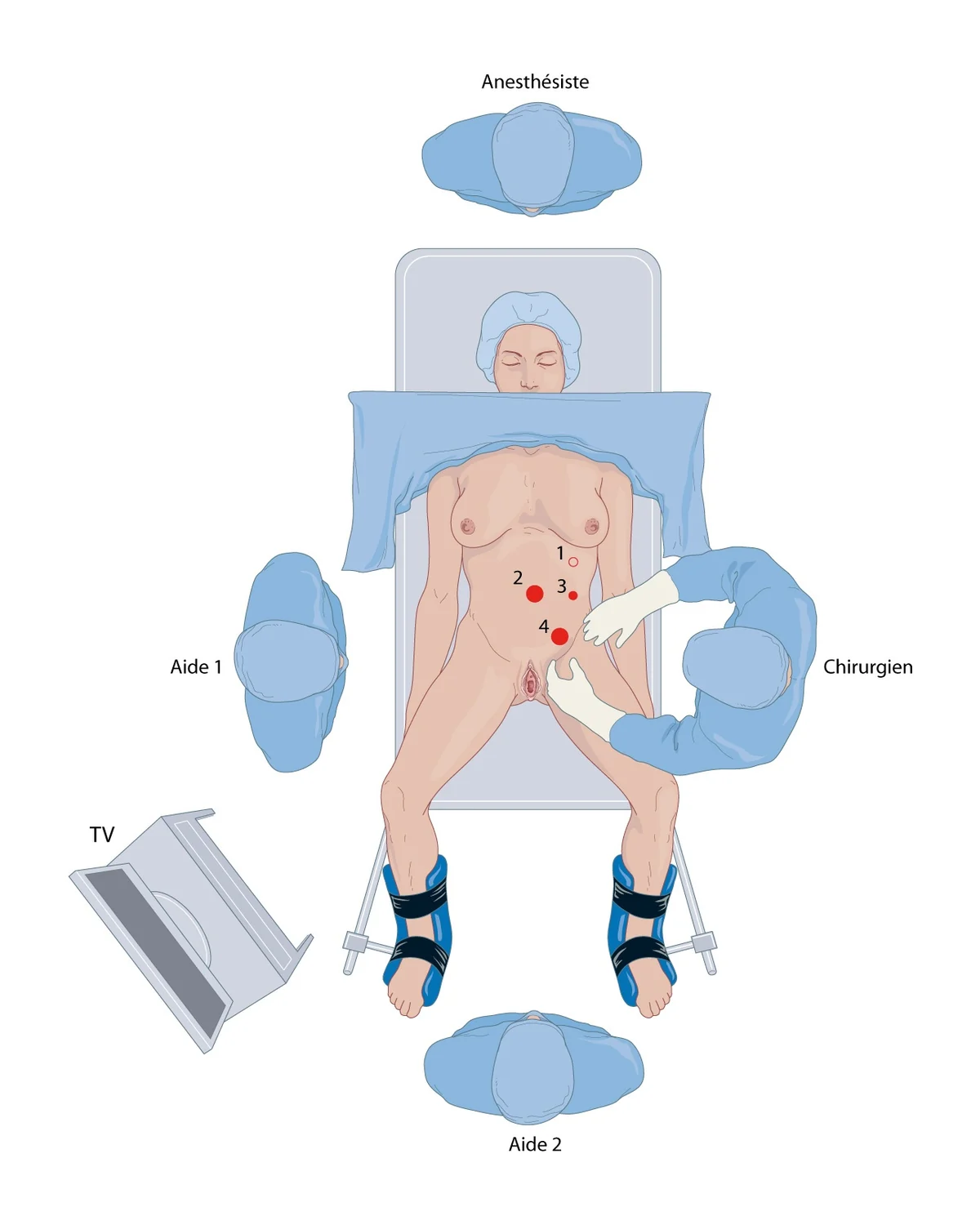
Laparoscopy (keyhole surgery)
Under general anaesthesia, the surgeon inflates the abdomen with carbon dioxide to create a working space. A telescope connected to a camera is inserted through the navel. Two or three other incisions a few millimetres long, in the lower abdomen, allow the instruments to be passed through. The surgeon operates while watching a screen, with a magnified view of the pelvic organs. The procedure is described in detail in the article on gynaecological laparoscopy.
Laparotomy
The surgeon opens the abdominal wall and works directly with their hands and instruments. Two incisions are used in gynaecology:
- the low horizontal incision (known as Pfannenstiel), above the pubic bone, the same as for most caesareans;
- the vertical midline incision, from the pubic bone towards the navel, or even above it, when wide access to the whole abdomen is needed, particularly in cancer surgery.
Other approaches
The vaginal route (vaginal hysterectomy) and hysteroscopy (surgery inside the uterus through the natural passages) do not open the abdomen.
What do studies show in favour of laparoscopy?
Two Cochrane reviews, which pool randomised trials, allow the two approaches to be compared reliably.
For benign ovarian tumours, the review by Medeiros et al. analysed nine trials (482 women). Compared with laparotomy, laparoscopy was associated with:
- fewer adverse events (surgical injury, fever, infection), with a risk about three times lower;
- less postoperative pain, and a much higher probability of being pain-free by the second day;
- a hospital stay about three days shorter on average;
- a lower total cost in the study that assessed it.
For hysterectomy for benign disease, the review by Aarts et al. (47 trials, 5,102 women) shows that return to normal activities is about two weeks quicker after laparoscopic hysterectomy than after abdominal hysterectomy, with fewer episodes of fever and wound infections. On the other hand, urinary tract injuries (bladder, ureter) were more frequent after laparoscopy. When the vaginal route is possible, it remains the preferred approach according to this review.
Comparison table: laparoscopy or laparotomy?
| Criterion | Laparoscopy | Laparotomy |
|---|---|---|
| Incisions | 3 to 4 incisions of 5 to 10 mm | One incision several centimetres long, horizontal or vertical |
| Pain after the operation | Lower; often shoulder pain caused by the gas, 24–48 h | More marked, related to the abdominal wound |
| Length of hospital stay | Shorter (nearly 3 days less on average for ovarian cysts) | Longer |
| Return to activities | Quicker (about 2 weeks sooner for hysterectomy) | Slower |
| Wound infection (hysterectomy) | Less frequent | More frequent |
| Fever, postoperative infection | Less frequent | More frequent |
| Urinary injury (hysterectomy) | Slightly more frequent | Slightly less frequent |
| Operating time | Often longer | Often shorter |
| Surgeon's view | Magnified, on screen; no direct touch | Direct, with palpation possible |
| Preferred indications | Benign cysts, endometriosis, ectopic pregnancy, benign hysterectomy, myomectomy depending on the case | Suspected ovarian cancer, very large mass, contraindication to or failure of laparoscopy |
The length of hospital stay depends on the operation performed; it is explained to you at the consultation.
In which situations is laparotomy still necessary?
Laparoscopy is the preferred approach for most benign gynaecological operations. Laparotomy remains indicated when:
- an ovarian tumour appears suspicious for cancer: the mass must then be removed without rupturing it and the whole abdomen explored. The Cochrane review points out that if the tumour turns out to be malignant, laparotomy is the appropriate approach; hence the importance of the work-up before the operation (ultrasound, sometimes MRI, CA 125 marker);
- the mass is very large (large cyst, greatly enlarged fibroid uterus) and cannot be removed safely through small incisions;
- the abdomen has already had extensive surgery, with widespread adhesions;
- the patient cannot tolerate pneumoperitoneum (gas insufflation) or the head-down position under anaesthesia, for example in severe heart or lung disease;
- massive internal bleeding requires very rapid action.
In advanced ovarian cancer, cytoreductive surgery is most often performed through a long midline incision. Strategies are discussed at a multidisciplinary team meeting (in France, RCP).
What is conversion to laparotomy?
An operation started by laparoscopy may be "converted" to laparotomy during the procedure. The usual reasons are extensive adhesions, bleeding that is difficult to control, injury to a nearby organ, or an unexpected finding (suspicious lesion). Conversion is a safety decision. The risk of conversion is explained to you before the operation, according to your situation, and you sign a consent form that allows for it.
Does laparoscopy have its own risks?
Yes, these risks are rare:
- injury when the instruments are inserted: bowel, bladder or major blood vessels;
- urinary injury (bladder, ureter), slightly more frequent during laparoscopic hysterectomy according to the Cochrane review;
- shoulder pain for one or two days, caused by residual gas;
- hernia at a port site, rare.
For benign hysterectomy, the CNGOF (French College of Gynaecologists and Obstetricians) guidelines recommend the vaginal or laparoscopic route rather than laparotomy, including when the uterus is large or in case of obesity. They also stress the importance of the surgeon's experience and of assessing the risk of cancer before any morcellation of the uterus or a fibroid.
What scars does each technique leave?
After laparoscopy, three or four scars of less than one centimetre remain: one in the navel, often barely visible, and two or three in the lower abdomen. After a horizontal laparotomy, the scar is usually below the bikini line; after a vertical incision, it is more visible. The scar gradually fades over several months. A thick or painful scar should be mentioned at the follow-up consultation.
What is recovery like?
After laparoscopy, walking is resumed the same day or the next day. Tiredness may last one to two weeks, longer after a hysterectomy. After laparotomy, the abdominal wall must heal: heavy lifting and abdominal exertion are avoided for several weeks.
As a guide, time off work is generally 1 to 4 weeks after laparoscopy depending on the procedure, and 4 to 8 weeks after laparotomy; it is adjusted at the consultation to the operation and your job.
How does the surgeon choose the approach?
The choice is based on:
- the probable nature of the lesion (benign or suspicious) on imaging;
- its size and location;
- your surgical and medical history;
- the team's experience and the equipment available;
- your preferences, once the benefits and risks have been explained. The Cochrane review on hysterectomy concludes that the surgical approach should be decided by the patient in discussion with her surgeon.
Operations take place at the Hôpital privé Geoffroy Saint-Hilaire (Paris 5th), the Clinique de la Muette (Paris 16th) or the Clinique Ambroise Paré (Neuilly-sur-Seine). A written quote is given to you before the operation.
When should you seek urgent care?
After laparoscopy as after laparotomy, call the surgeon or 15 (SAMU) or 112 in France, or your local emergency number, in case of:
- fever above 38.5 °C;
- abdominal pain that gets worse instead of better, hard or swollen abdomen;
- repeated vomiting, no passing of wind or stools;
- heavy bleeding or pus-like discharge from a scar;
- breathlessness, chest pain or a painful, swollen calf.
Frequently asked questions
Is laparoscopy a "minor" operation?
No. The incisions are small, but the procedure performed inside can be as major as with laparotomy (hysterectomy, excision of endometriosis). Anaesthesia is general and surgical risks exist.
Can a large ovarian cyst be removed by laparoscopy?
Often yes, if imaging is reassuring and the cyst can be removed in a bag without rupturing inside the abdomen. A very large or suspicious mass may justify a laparotomy.
Does a previous caesarean rule out laparoscopy?
No. One or more caesareans may leave adhesions, which the surgeon takes into account when placing the instruments. The CNGOF guidelines specify that a previous caesarean does not rule out vaginal hysterectomy either.
Why do my shoulders hurt after a laparoscopy?
The gas used to inflate the abdomen irritates the diaphragm, and this pain is felt in the shoulders. It usually disappears within 24 to 48 hours; walking helps to clear it.
What is recovery like after a laparotomy or a laparoscopy?
As a guide, the hospital stay is generally 3 to 6 days after a laparotomy (fibroid removal, hysterectomy), and ranges from day surgery to 4 days after a laparoscopy, depending on the procedure. After a laparotomy, sport is generally resumed after 6 to 12 weeks and sex after 4 to 8 weeks; baths are avoided for about 4 weeks. A post-operative appointment generally takes place 4 to 6 weeks after the operation: these guidelines are adjusted to your situation then, and the timing of any future pregnancy is discussed.
References
- Medeiros LR, et al. Laparoscopy versus laparotomy for benign ovarian tumour. Cochrane Database Syst Rev, 2009. doi:10.1002/14651858.CD004751.pub3 — PMID 19370607
- Aarts JW, et al. Surgical approach to hysterectomy for benign gynaecological disease. Cochrane Database Syst Rev, 2015. doi:10.1002/14651858.CD003677.pub5 — PMID 26264829
- Gauthier T, et al. Hysterectomy for benign gynaecological disease: Surgical approach, vaginal suture method and morcellation: Guidelines (CNGOF). J Gynecol Obstet Biol Reprod (Paris), 2015. doi:10.1016/j.jgyn.2015.09.032 — PMID 26527018

Dr Olivier KadochObstetrician-gynaecologist and gynaecological surgeon in Paris (16th and 5th arrondissements). Former chef de clinique-assistant (senior registrar) at the Paris public hospitals (AP-HP); individually accredited by the French National Authority for Health (HAS). RPPS 10003957809. Background and practice locations
A question about your situation?Appointments at the practice or by video consultation, usually within one week to 10 days.
Book an appointmentGeneral information article: it does not replace a medical consultation. In an emergency, call 15 or 112 in France, or your local emergency number.