Twin pregnancy: identical or non-identical twins, risks, care
In brief
A twin pregnancy carries a higher risk than a pregnancy with one baby, mainly of preterm birth, pre-eclampsia and growth restriction. The key point is chorionicity, meaning the number of placentas, which is determined at the first-trimester scan: it sets how often you have scans and the recommended timing of birth. A vaginal birth is recommended when the first twin is head down from 32 weeks.
What is the difference between identical and non-identical twins?
A twin pregnancy means two babies are developing in the uterus. In France, twins account for about 1.6% of births (French College of Gynaecologists and Obstetricians, CNGOF, 2026). They are more common after assisted reproduction and as maternal age increases. Their monitoring and birth require specific organisation, described on our page Giving birth in Paris.
Dizygotic (non-identical) twins
They come from two eggs fertilised by two sperm. They have different genetic make-ups, like any brothers and sisters, and can be of different sexes. Each has its own placenta and its own sac: the pregnancy is called dichorionic diamniotic. The two placentas may touch and look like one, but there is no exchange of blood between the babies.
Monozygotic (identical) twins
They come from a single fertilised egg that splits in two. They share the same genetic make-up and are the same sex. When the split happens determines the number of placentas and sacs, and this shapes the risks.
What is chorionicity and what is it used for?
The chorion is the membrane that forms the placenta. Chorionicity tells us whether or not the twins share a placenta. It determines the risks and how often you are monitored. It can be determined reliably at the first-trimester scan, ideally before 14 weeks of pregnancy (weeks of amenorrhoea), according to the International Society of Ultrasound in Obstetrics and Gynecology (ISUOG, 2025).
| Type of pregnancy | Placenta and sacs | Origin | Level of risk |
|---|---|---|---|
| Dichorionic diamniotic | Two placentas, two sacs | All non-identical twins; identical twins if the split happens within the first 3 days | The lowest among twin pregnancies |
| Monochorionic diamniotic | One shared placenta, two sacs | Identical twins, split between about day 4 and day 8 (the most common form in identical twins) | Intermediate: risk of twin-to-twin transfusion syndrome |
| Monochorionic monoamniotic | One placenta, a single sac | Identical twins, split between about day 8 and day 13; rare | High: the cords can become entangled |
| Conjoined twins | Babies partially joined | Incomplete split after day 13; exceptional | Very high, care in a specialist centre |
When twins share a placenta, blood vessels connect their two circulations. This is the source of the complications specific to monochorionic pregnancies.
What are the risks of a twin pregnancy?
The main risks are:
- Preterm birth: this is the most common complication. The cervix is monitored, but a preventive cervical stitch (cerclage) is not recommended for women expecting twins (CNGOF, 2016). See our article on preterm birth.
- High blood pressure and pre-eclampsia: the risk is increased; blood pressure and urine are checked at every appointment. Learn more about high blood pressure and pre-eclampsia.
- Growth restriction of one or both babies, and a difference in weight between the twins.
- Birth defects, slightly more frequent, particularly in identical twins.
- Gestational diabetes, anaemia, haemorrhage after birth: more frequent than with one baby.
Complications specific to monochorionic pregnancies
Twin-to-twin transfusion syndrome occurs when blood flows unevenly from one twin to the other through the shared placenta: one twin has too little amniotic fluid, the other too much. In severe forms before 26 weeks, laser coagulation of the connecting vessels by foetoscopy improves survival compared with repeated drainage of amniotic fluid (ISUOG, 2025). Other complications exist: selective growth restriction of one twin, and twin anaemia-polycythaemia sequence. They call for close ultrasound monitoring.
How is a twin pregnancy monitored?
Monitoring is based on the usual monthly appointments, described in our article on routine pregnancy care, with more frequent scans tailored to the type of twin pregnancy.
| Stage | Dichorionic pregnancy | Monochorionic pregnancy |
|---|---|---|
| First trimester (11-14 weeks) | Dating, chorionicity, nuchal translucency measurement | The same, with early detection of warning signs |
| How often scans are done | About every 4 weeks from 20 weeks (ISUOG) | Every 2 weeks from 16 weeks (ISUOG) |
| What is checked | Growth of both babies, cervix, placentas | Growth, amount of fluid in each sac, Doppler to detect transfusion and anaemia |
| Referral | Maternity unit suited to the level of risk | Link with a foetal medicine centre if a complication arises |
Screening for Down syndrome (trisomy 21) is possible in twins, using nuchal translucency and blood markers, and by analysing cell-free foetal DNA in the mother’s blood (NIPT) (ISUOG, 2025). The schedule of appointments and scans is set at the practice according to the type of twin pregnancy, in liaison with the maternity unit where you will give birth (Sainte-Félicité Maternity Unit or Clinique Sainte-Thérèse).
When and how are twins delivered?
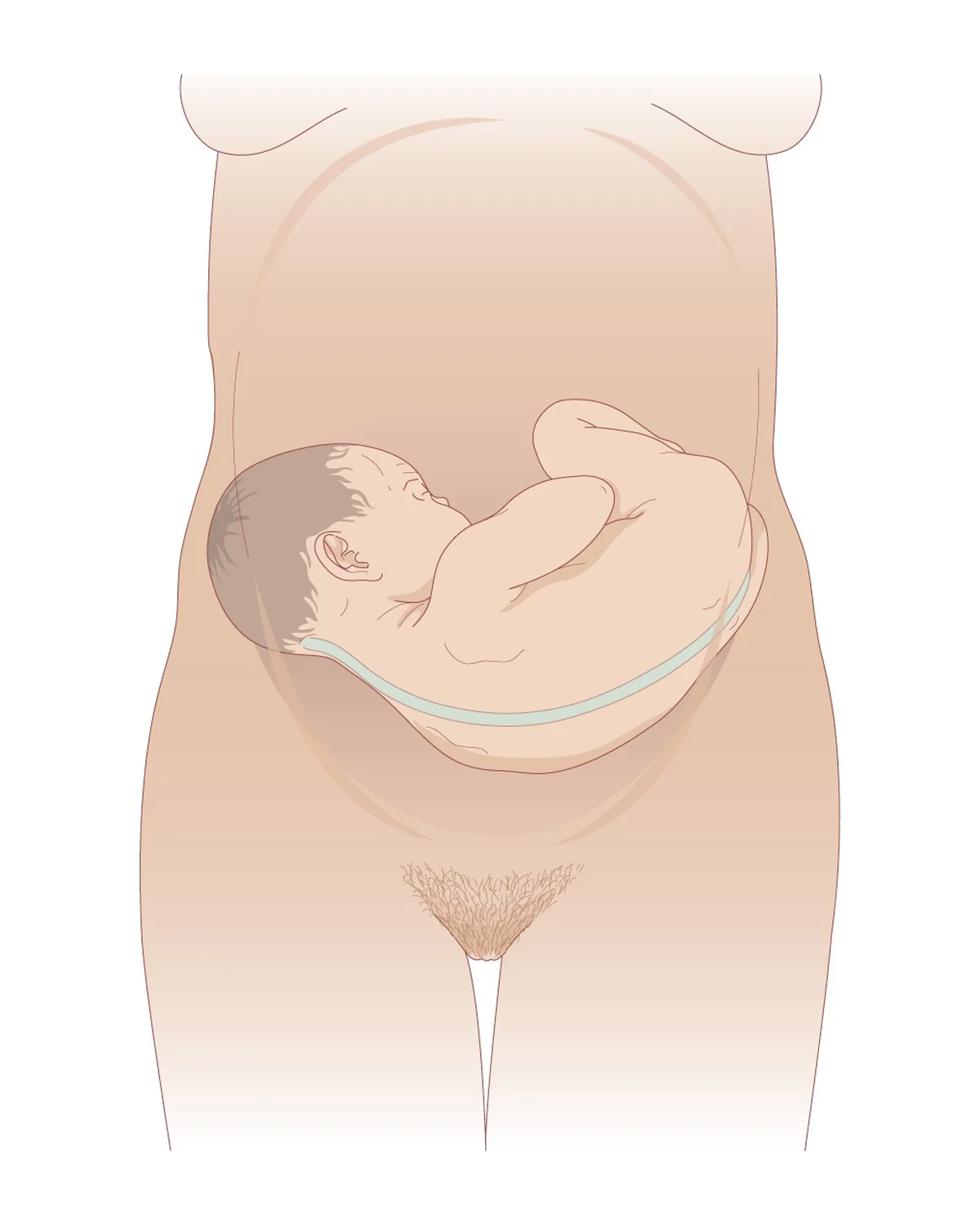
The guidelines of the French College of Gynaecologists and Obstetricians (CNGOF, 2026) set benchmarks for uncomplicated pregnancies:
- Dichorionic diamniotic: planned birth between 37 weeks and 38 weeks + 6 days.
- Monochorionic diamniotic: between 36 weeks and 37 weeks + 6 days.
- Monochorionic monoamniotic: between 33 weeks and 34 weeks + 6 days; the evidence is insufficient to recommend vaginal birth or caesarean, so the decision is made case by case.
When the first twin is head down and the pregnancy has reached 32 weeks, a vaginal birth is recommended, with a high level of evidence. If the first twin is breech, vaginal birth and caesarean can both be discussed; vaginal birth is preferred if all conditions are met. A weight difference between the twins should not, on its own, lead to a caesarean. The decision takes your history into account, such as a previous caesarean scar on the uterus.
On the day of the birth, a full team is present: obstetrician, midwife, anaesthetist and paediatrician. An epidural is usually offered: it allows the team to act quickly for the second twin, by internal version (turning the baby) or total breech extraction (CNGOF, 2026).
When should I go to the maternity unit urgently with twins?
Go straight to the emergency department of your maternity unit, or call 15 or 112 in France, or your local emergency number, if you feel faint or have heavy bleeding, or if you notice:
- regular or painful contractions before 37 weeks, or a feeling of pressure in the lower abdomen;
- a leak of clear fluid, even a small amount;
- vaginal bleeding;
- a severe headache, blurred vision, pain in the upper abdomen or sudden swelling of the face and hands, which may suggest pre-eclampsia;
- a rapid increase in the size of your bump, breathlessness or unusual tightness of the abdomen, especially in a monochorionic pregnancy;
- a clear decrease in the babies' movements;
- a fever.
What does day-to-day life look like with a twin pregnancy?
Tiredness is often more marked. Sick leave or adjustments at work may be offered depending on your situation. Your diet should cover increased needs, without any restrictive dieting. Antenatal classes adapted to twins help you prepare for the birth, breastfeeding two babies and going home. You can ask for psychological support if the news or a complication worries you.
Would you like a medical opinion?Appointments in Paris 16th or 5th, or by video consultation.
Book an appointmentFrequently asked questions
Can an ultrasound scan tell whether twins are identical or not?
The scan mainly shows the number of placentas. Twins with a single placenta are, with very rare exceptions, identical. With two placentas and the same sex, only a genetic test can tell for sure.
Does a twin pregnancy mean I will need a caesarean?
No. When the first twin is head down from 32 weeks, a vaginal birth is recommended. A caesarean is discussed depending on the babies' positions, the type of twin pregnancy and your history.
When should I stop working with a twin pregnancy?
In France, maternity leave is longer for a multiple pregnancy. Earlier sick leave may be prescribed depending on tiredness, the cervix and the type of job, so raise it at each appointment.
Is Down syndrome screening reliable for twins?
Combined first-trimester screening and NIPT can both be done in twins (ISUOG, 2025). A high-risk result must be confirmed by an invasive test such as amniocentesis.
References
- Sibiude J, et al. Delivery of twin pregnancies: Guidelines from the College of French Gynecologists and Obstetricians. Gynecol Obstet Fertil Senol, 2026. doi:10.1016/j.gofs.2026.01.005 — PMID 41544768
- Khalil A, et al. ISUOG Practice Guidelines (updated): role of ultrasound in twin pregnancy. Ultrasound Obstet Gynecol, 2025. doi:10.1002/uog.29166 — PMID 39815396
- Sentilhes L, et al. Prevention of spontaneous preterm birth: Guidelines for clinical practice from the French College of Gynaecologists and Obstetricians (CNGOF). Eur J Obstet Gynecol Reprod Biol, 2016. doi:10.1016/j.ejogrb.2016.12.035 — PMID 28068594

Dr Olivier KadochObstetrician-gynaecologist and gynaecological surgeon in Paris, seeing patients in Paris 16th and at the Centre de la Femme Paris 5. Former chef de clinique-assistant (senior registrar) at the Paris public hospitals (AP-HP); individually accredited by the French National Authority for Health (HAS). RPPS 10003957809. Background and practice locations
A question about your situation?Appointments at the practice or by video consultation, usually within one week to 10 days.
Book an appointmentGeneral information article: it does not replace a medical consultation. In an emergency, call 15 or 112 in France, or your local emergency number.