Bartholin's gland cyst and abscess: what should you do?
In brief
The Bartholin’s glands are two small glands located on either side of the vaginal opening; when their duct becomes blocked, they can form a cyst, which may become infected and turn into a very painful abscess (bartholinitis). A cyst that causes no symptoms generally needs no treatment, whereas an abscess must be drained. In the WoMan randomised trial published in the BJOG, recurrence at one year was similar after insertion of a Word catheter (12%) and after marsupialisation (10%).
What is the Bartholin’s gland?
The Bartholin’s glands measure about one centimetre and lie within the labia majora, at the lower part of the vaginal opening, one on each side. They secrete mucus that helps lubricate the vulva, particularly during sexual arousal. Each opens through a small duct, invisible to the naked eye, at the vaginal opening, between the hymen and the inner surface of the labium minus.
Normally, these glands cannot be seen or felt on examination.
What is the difference between a cyst and an abscess?
| Bartholin’s cyst | Bartholin’s abscess (bartholinitis) | |
|---|---|---|
| Mechanism | Blockage of the duct; mucus builds up | Infection of the cyst contents or of the gland |
| Appearance | Round, soft swelling on one side of the vaginal opening | Tense, red, hot swelling that grows rapidly |
| Pain | None or moderate discomfort, especially if large | Severe, making walking, sitting and intercourse difficult |
| General signs | None | Fever possible |
| Course | May remain stable for years, empty or become infected | May burst spontaneously; recurrences possible |
| Treatment | Monitoring if no discomfort; treatment if troublesome or recurrent | Surgical drainage in most cases |
The germs involved vary: most often bacteria from the skin and gut flora, more rarely sexually transmitted organisms. A sample of the pus is useful to identify the germ.
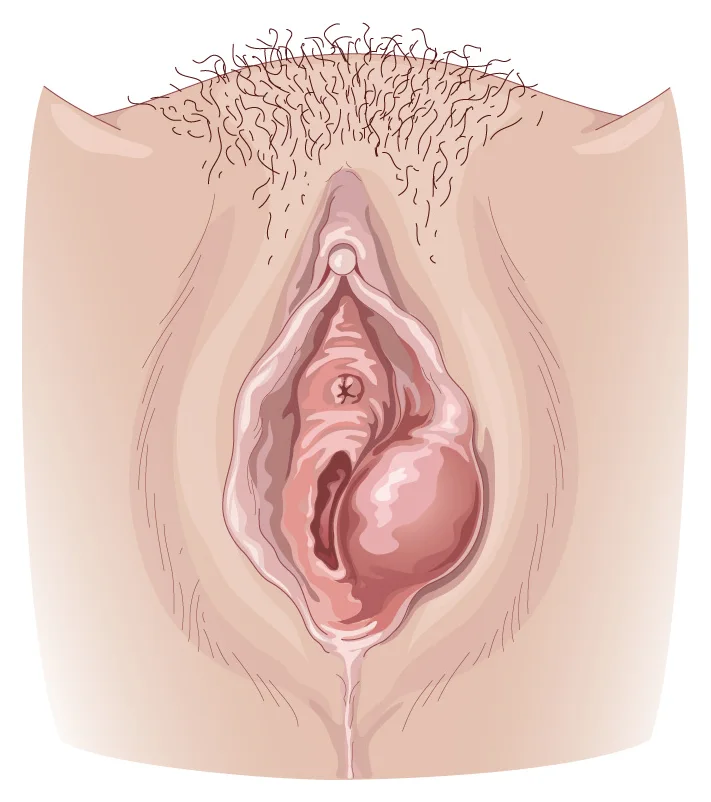
Which symptoms should alert you?
A cyst shows up as a lump on one side of the vaginal opening, often noticed while washing. It may cause discomfort during intercourse or when walking if it is large.
An abscess causes:
- one-sided vulvar pain that intensifies over one to three days;
- a red, hot, tense swelling of the labium majus;
- marked difficulty walking, sitting or having intercourse;
- sometimes fever and tiredness.
Other lesions can look like a Bartholin’s cyst: sebaceous cyst, Gartner’s duct cyst, folliculitis, hidradenitis. A gynaecological examination is usually enough to tell them apart.
How is the diagnosis made?
The diagnosis is clinical: it is based on your history and examination of the vulva. No imaging is usually needed.
The doctor may suggest:
- a swab of the pus during drainage, to identify the germ;
- screening for sexually transmitted infections (chlamydia, gonorrhoea) depending on the context;
- a biopsy in certain situations, particularly in older women, in the case of a hard, irregular mass, one that persists after treatment, or an unusual recurrence. Cancer of the Bartholin’s gland is very rare, but it must not be missed.
Should a cyst that does not hurt be treated?
Generally not. A small cyst that causes no discomfort can simply be monitored. Warm sitz baths may help it drain spontaneously.
Treatment is offered if the cyst is large, troublesome in daily life or during intercourse, if it recurs, or if it becomes infected.
How is a Bartholin’s abscess (bartholinitis) treated?
An established abscess does not usually heal with antibiotics alone: the pus must be drained. Antibiotics can be useful in addition, particularly in the case of cellulitis (inflammation spreading to the surrounding skin), fever or particular risk factors.
A simple incision with drainage brings immediate relief, but it carries a high risk of recurrence, because the opening closes quickly. This is why it is combined with a technique that keeps a drainage channel open.
Inserting a Word catheter
The Word catheter is a small flexible tube ending in a balloon. After a short incision under local anaesthesia, the tube is inserted into the cavity, then the balloon is inflated with a few millilitres of saline so that it stays in place. It is left in for several weeks, while a new duct forms, then removed in the consulting room after the balloon has been deflated.
Marsupialisation
Marsupialisation involves opening the cyst or abscess and stitching its edges to the neighbouring skin and mucosa, to create a permanent opening. It is often performed in the operating theatre, under general or regional anaesthesia; the type of anaesthesia is explained at the consultation. The procedure takes place at the Hôpital privé Geoffroy Saint-Hilaire (Paris 5th), the Clinique de la Muette (Paris 16th) or the Clinique Ambroise Paré (Neuilly-sur-Seine).
Other options
Other techniques exist, such as insertion of a drainage ring or cauterisation of the cavity with silver nitrate. In the event of multiple recurrences despite these treatments, complete removal of the gland (bartholinectomy) may be discussed; this is a more extensive operation, with a greater risk of bleeding.
Word catheter or marsupialisation: what do the studies say?
| Criterion | Word catheter | Marsupialisation |
|---|---|---|
| Anaesthesia | Local in most cases | General or regional in most cases |
| Time from diagnosis to treatment (WoMan trial) | About 1 hour | About 4 hours |
| Painkillers in the first 24 hours (WoMan trial) | 33% of patients | 74% of patients |
| Pain after treatment (WoMan trial) | Comparable | Comparable |
| Recurrence at one year (WoMan trial) | 12% | 10% — difference not significant |
| Drawbacks | Tube in place for several weeks; may fall out early | Requires a trip to the operating theatre |
The WoMan trial (Kroese et al.), conducted in 19 hospitals with 161 women, found comparable recurrence rates between the two techniques. A systematic review of randomised trials published in the BJOG in 2020 (Illingworth et al., 8 trials, 699 women) concluded that no surgical technique has been shown to be superior to the others for treating a symptomatic cyst or abscess. A more recent meta-analysis (Bakouei et al., 2024, 4 studies, 735 women) reached the same conclusion for the Word catheter and marsupialisation.
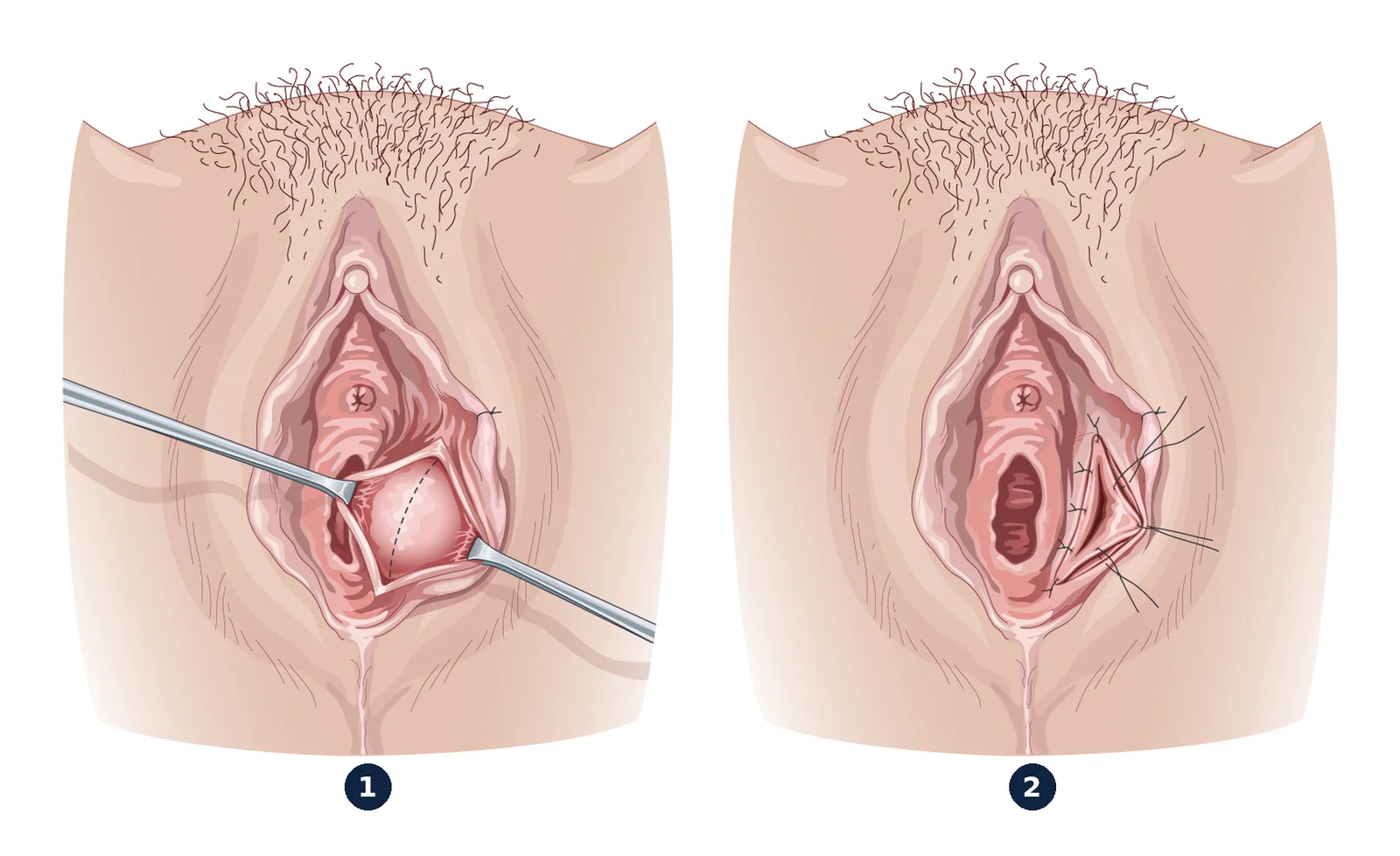
The choice therefore depends on the situation (size, recurrent nature, access to the operating theatre), the patient’s preference and the team’s experience; it is discussed with you at the consultation.
What is recovery like?
After drainage, pain eases markedly within a few hours to a few days. In practice:
- sitz baths or rinsing with warm water are often advised to encourage drainage and keep the area clean;
- a slight discharge is normal in the first few days;
- with a Word catheter, the tube may be a little uncomfortable; it may fall out early, which should be reported;
- intercourse is generally not advised while the area is painful or the tube is in place, according to the instructions given;
- sick leave is often short; its length is explained at the consultation.
A follow-up consultation is used to check healing and, where applicable, to remove the catheter.
Can bartholinitis come back?
Yes. Whatever the treatment, recurrence remains possible; it affected about one woman in ten at one year in the WoMan trial. A recurrence is not a sign that the treatment was done badly. It may lead to another technique being offered and, in the case of repeated recurrences, to discussion of removing the gland.
There is no preventive measure of proven effectiveness. Gentle hygiene, without harsh soap or vaginal douching, is advised, as for the whole vulvar area.
When should I seek urgent care?
Seek medical advice promptly (book on Doctolib or call 01 43 79 59 79) or go to a gynaecological emergency department in the event of:
- a painful vulvar swelling that is growing rapidly;
- fever above 38.5 °C, shivering;
- redness spreading to the thigh, pubic area or perineum;
- pain preventing you from walking, sitting or passing urine;
- an abscess in a woman who is diabetic, immunocompromised or pregnant.
If you feel faint, or have a high fever with a general decline in your condition, call 15 (SAMU) or 112 in France, or your local emergency number.
Would you like a medical opinion?Appointments in Paris 16th or 5th, or by video consultation.
Book an appointmentFrequently asked questions
Is a Bartholin’s cyst a sexually transmitted infection?
No. The cyst is caused by a blocked duct. An abscess is most often due to common bacteria; screening for sexually transmitted infections may nonetheless be offered depending on the context.
Can the abscess heal on its own?
An abscess sometimes bursts spontaneously, which relieves the pain. But drainage is often incomplete and recurrence is common: it is better to seek medical advice for appropriate drainage.
Can I get bartholinitis during pregnancy?
Yes. An abscess during pregnancy is treated, with the anaesthesia and medicines adapted accordingly. Report any painful swelling promptly to your doctor or midwife.
After removal of the gland, is lubrication affected?
Vaginal lubrication depends mainly on the vaginal wall and not only on the Bartholin’s glands. Dryness is possible after bartholinectomy; this is one of the reasons why this operation is reserved for repeated recurrences.
Are antibiotics always needed?
No. A well-drained abscess in a healthy woman does not always require antibiotics. They are considered on a case-by-case basis, depending on how far the inflammation has spread, fever and risk factors.
References
- Kroese JA, et al. Word catheter and marsupialisation in women with a cyst or abscess of the Bartholin gland (WoMan-trial): a randomised clinical trial. BJOG, 2017. doi:10.1111/1471-0528.14281 — PMID 27640367
- Illingworth B, et al. Evaluation of treatments for Bartholin's cyst or abscess: a systematic review. BJOG, 2020. doi:10.1111/1471-0528.16079 — PMID 31876985
- Bakouei F, et al. Comparison of Word Catheter and Marsupialization in the Management of Bartholin's Glands: A Systematic Review and Meta-Analysis. J Obstet Gynaecol Can, 2024. doi:10.1016/j.jogc.2024.102357 — PMID 38215822

Dr Olivier KadochObstetrician-gynaecologist and gynaecological surgeon in Paris, seeing patients in Paris 16th and at the Centre de la Femme Paris 5. Former chef de clinique-assistant (senior registrar) at the Paris public hospitals (AP-HP); individually accredited by the French National Authority for Health (HAS). RPPS 10003957809. Background and practice locations
A question about your situation?Appointments at the practice or by video consultation, usually within one week to 10 days.
Book an appointmentGeneral information article: it does not replace a medical consultation. In an emergency, call 15 or 112 in France, or your local emergency number.